by: Danish Manzoor
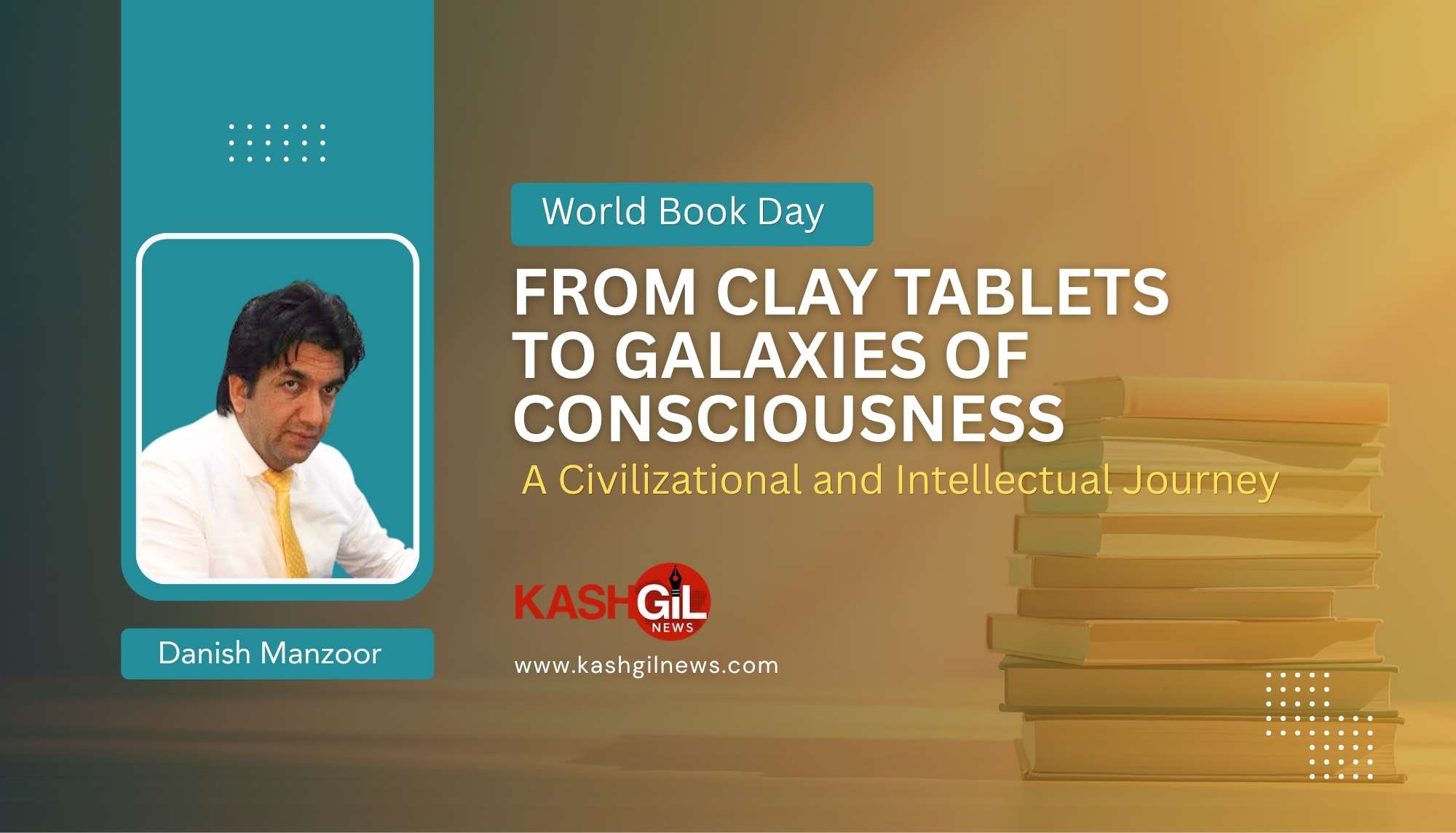
If the story of human civilization can be summed up in one thing, it is a book. But a book is not just a sequence of words, it is the breath of consciousness preserved in the bosom of time. This journey begins from the moment when man first recorded his thoughts on clay instead of entrusting them to the wind.
When man first engraved his thoughts on clay tablets to protect them from destruction. Then the papyrus of Egypt, the paper of China, and the seals and symbolic impressions of the ancient civilizations of the Indus Valley of the subcontinent gave this expression a permanent form. Here, knowledge was not just written, it flowed in the breath of civilization. In ancient civilizations, the signs engraved on clay tablets were actually an initial attempt to protect memory from destruction. The libraries of the world gave a new life to knowledge where books not only remained safe, but also began to spread, breathe, and travel from person to person.
In the scholarly tradition of the subcontinent, there has been a living experiment with the book as well as the text. In the form of the Vedas and the Upanishads, knowledge was transmitted from one person to another, and then when it found a written form, it merged spirituality, philosophy, and questions of life into a single stream. A shining example of this tradition is the Raj Tarangani, written by a Kashmiri writer, Pandit Kahlan, in the 12th century. This book is considered to be the first written historical book of the subcontinent. It is a river of consciousness as well as history, where along with events, the philosophy of human weaknesses, the fluctuations of power, and the ruthlessness of time also flows. The Raj Tarangani book does not only preserve the past, it also provides an angle for understanding it.
At the same time, a new lamp of thought was lit in the fields of ancient Greece in the West. Socrates made questioning the basis of knowledge. Plato made dialogue the soul of philosophy, and Aristotle shaped logic into a systematic knowledge.
In this way, the book was molded into a mold where knowledge became a quest along with tradition. The real perfection of any book is that it defeats time. A writer leaves his era and comes back to life centuries later in a foreign mind. This is that silent dialogue where there is neither sound nor noise, but the impact is so profound that civilizations are formed.
In the Islamic world, when the libraries of Baghdad, Cordoba and Samarkand became centers of knowledge, the book played the role of a bridge between civilizations. Greek philosophy, Indian wisdom and Arabic thought began to converse on the same page. This was the moment when the book became the common heritage of all humanity, rather than a single region. Then the printing press came and knowledge broke the walls of the elite. Now the book is no longer the property of a few hands. It has become a collective consciousness, but despite all this evolution, the spirit of the book has not changed.
The book still enlightens man to its own depths. In today’s digital age, when the brightness of the screen is dazzling the eyes, the book is still the same silent companion that takes a person towards his inner self. It teaches us that knowledge is not just information but also the process of thinking, questioning and discovering oneself.
The greatest philosophy of the book is that the book makes us feel the continuity that we are part of a chain in which the silent seals of the Indus Valley, the waves of the Tricolor, the logic of Greece and the consciousness of civilizations around the world are connected.
In the end, when all words are tired. When time becomes silent after telling all its stories, the book continues to burn like a lamp. Neither time can extinguish it nor can oblivion erase it. This is the silent trust that passes through the hands of man and continues to breathe in the chests of centuries.
The book not only tells us what we were but also teaches us what we can become. It awakens the human being within us who may have fallen asleep somewhere in the hustle and bustle of everyday life. So if ever the darkness deepens in the paths of life. If the burden of questions descends on the heart, then definitely knock on the door of a book. It is possible that you will not find anyone else there, but you will definitely find yourself. Reading a book is the art of reading yourself and the one who reads himself is the one who has the right to understand the times. Let us today again hold the hand of this silent friend, so that perhaps on this pretext we can gather our scattered consciousness and rediscover a better human being within ourselves.
A very happy World Book Day to all of you!
٭٭٭
Share this content: