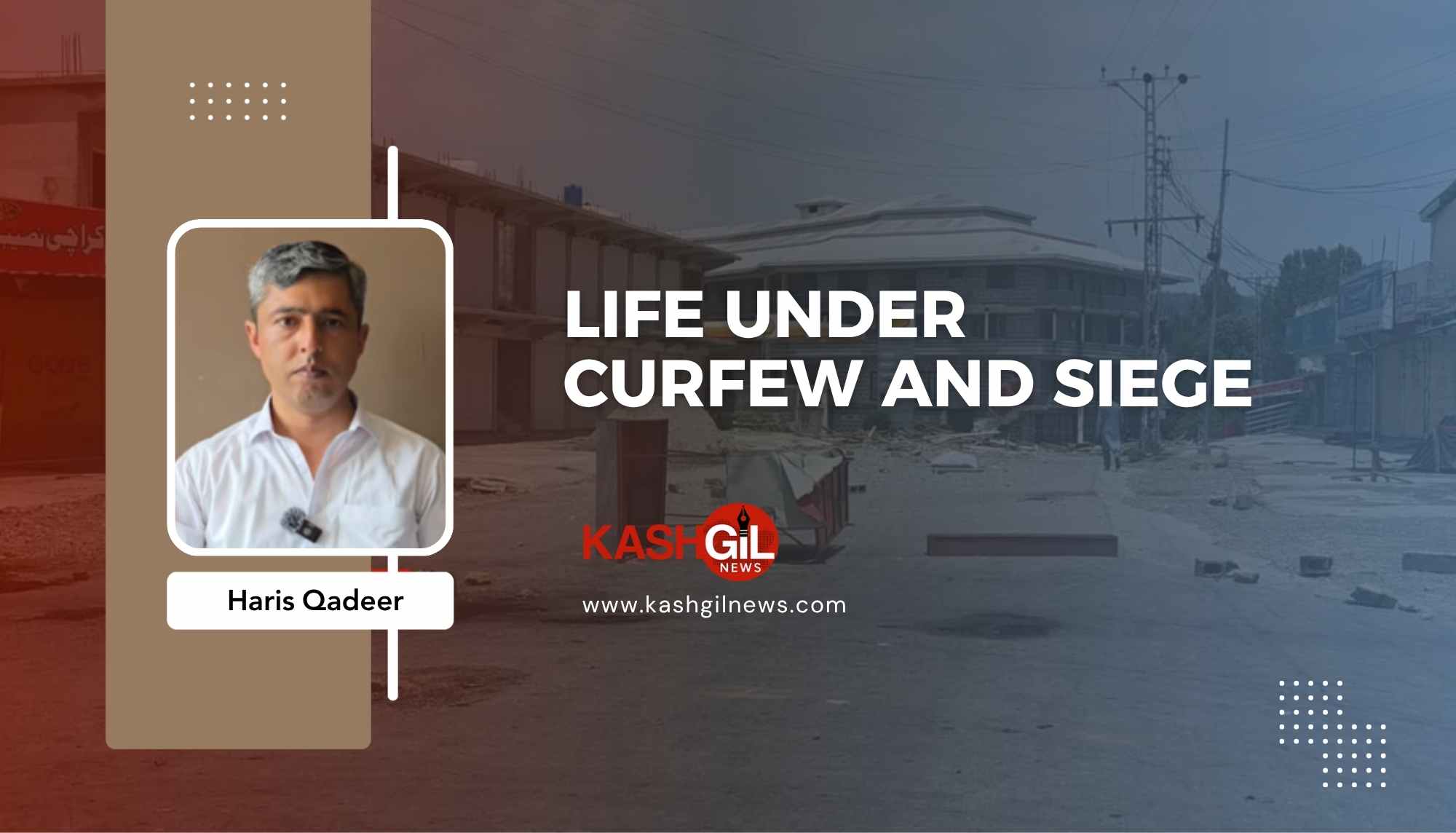
by: Haris Qadeer
A shutter-down and wheel-jam strike has been going on in Pakistan-administered Jammu and Kashmir since June 9 on the call of the Joint Public Action Committee. Although the protests have spread across the region, their most visible and intense reflection is visible in Poonch division. Thousands of people are present in protest sit-ins on all sides of Rawalakot, the divisional headquarters. Most of the small and big cities of Mirpur and Muzaffarabad divisions are under the control of security forces, but the scene is different in Poonch division. Here, the parallel governance of the state and the people’s committees is clearly visible on the roads. District Sidhanoti is completely under the control of the people’s committees, while most of the tehsil headquarters, towns, markets and main highways of Poonch are under the control of the people’s committees. Rawalakot city, however, is still under the control of security forces.
The shutter-down and wheel-jam strike in Rawalakot has been going on since June 6. On the intervening night of June 7-8, security forces took control of the city after a major and bloody operation and imposed a curfew immediately after. Since then, the continuous flag marches of siren-blaring force vehicles, checkpoints at every intersection, armed personnel checkpoints and searches at various places have become the new identity of the city. This is a city that is considered a symbol of resistance, political consciousness and popular struggle.
The kind of disciplinary actions taken against protestors during the past month are hardly comparable in the recent history of the region. Raids on protest leaders’ homes, vandalism of properties and vehicles, damage to offices, seizure of properties, closure of bank accounts and phone numbers, and even attempts to force leaders to surrender by harassing their families are still ongoing.
The internet service, which was suspended on June 5, has not been restored to this day. Mobile phone signals have also been severely restricted in Rawalakot. It has become almost impossible to contact the protest sites. However, the protesters have also broken these restrictions. Despite limited resources, they are somehow accessing the internet and are sharing their videos, photos and writings with the world.
Rawalakot is apparently being subjected to special repression. Citizens are stopped at police checkpoints without distinction of age, their mobile phones are searched, and if a phone is found to contain a photo or video related to a protest, rally or any political activity, or if there is any suspicion of sympathy, the person concerned is arrested. Many people are tortured on the streets and then transferred to police stations.
Gradually, all the entrances and connecting roads of the city have come under the control of the security forces. Movement within the city is almost paralyzed. A large population of Rawalakot has moved to villages or other cities, while those who cannot afford to go anywhere live in constant fear. Nights are spent awake, every knock is accompanied by the fear that perhaps a house is about to be raided or a nearby sit-in is about to be attacked.
The number of arrests has increased so much that the lock-ups of many police stations have proven to be insufficient. Even in the exits of police stations, detainees are being made to sit on the floor. Hundreds of young people are imprisoned in various police stations, including young boys. There have been numerous reports of torture, ridicule and humiliation of those arrested in Rawalakot police station in particular, and this trend is still ongoing.
The residents of Rawalakot have probably seen their city in this condition for the first time. A city that was once teeming with life, splendor, protests, sports and political activities, today feels besieged, silent and devastated. Many people have begun to consider themselves residents of a conquered city.
However, despite all this repression, the fear that the state wanted to impose on society is gradually losing its effectiveness. Young men and women have overcome this fear. Women walk miles to the sit-ins every day. Despite the fear of arrest and violence, young people leave their homes and join the protests. After every government action, the entire society seems to stand firmer in the ranks of resistance.
Guards are posted day and night to protect the sit-ins from possible attacks. Despite the sacrifice of dozens of lives and the injury of hundreds, young people fearlessly stand in front of bullets and try to stop every attack. This resistance has made it clear that bodies can be injured with force, but it is not easy to defeat the collective will.
Rawalakot, once known for strikes, political processions, playgrounds full of spectators and lively markets, is today lost in its own silence. The voices of protest are loud in its surroundings, the sit-ins are settled, the resistance continues, but silence has descended inside the city. Its streets are deserted, its roads deserted, and the air is weighed down by an unknown weight.
It feels as if the entire city is breathing under a prolonged siege, a siege that is not just of the streets, but also of the daily lives of people, their psyches, and their collective memory.
٭٭٭
Send feedback
Press tab for actions
Share this content: