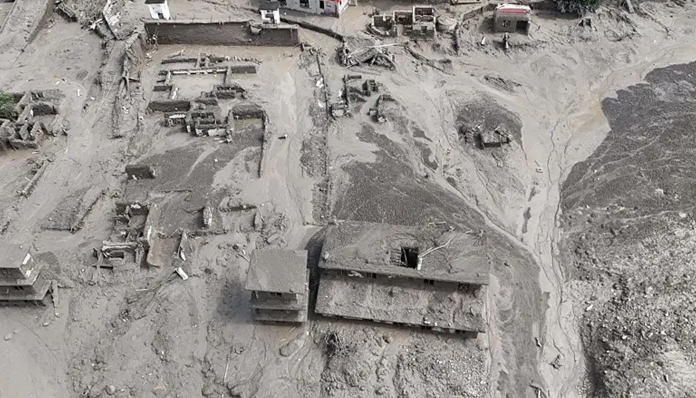
Devastating floods in Nepal’s Bhutikoshi River on Wednesday caused widespread destruction in three districts. More than 160 people have died in the disaster, while hundreds of people, including security forces personnel, foreign tourists and local citizens, are still missing.
The floods have severely damaged roads, bridges, electrical infrastructure and populated areas, causing huge loss of life and property. According to officials, it is one of the worst natural disasters to hit Nepal in recent years.
According to the Nepal Tourism Board, the missing tourists include more than 100 Indians, 54 Americans, 34 Australians and 33 British citizens. In addition, more than 100 Nepalese citizens are also missing. The area is very popular with pilgrims and trekkers.
In Tibet, Chinese state media reported three deaths and 265 missing. CCTV footage from Tibet showed a huge torrent of water and mud crashing into buildings at a border crossing.
Dozens of Nepali police, army personnel and electricity workers are also missing. “My family was swept away in front of my eyes,” said one woman. She and her son managed to escape by climbing onto the roof of a building.
Authorities initially suspected that an earthquake may have preceded the floods, but the US Geological Survey later found that the earthquake-like activity was actually caused by a landslide.
Nepalese police said 157 bodies had been recovered by late night of those killed in Wednesday’s floods. Police said in a statement on social media that 64 of the bodies were found in Chitwan district.
According to the police, 3,318 personnel have been deployed for search and rescue operations.
The initial estimate of damage to roads and bridges due to the severe floods on Wednesday is over 15 billion Nepali rupees.
According to experts, the geographical structure of the Himalayan region bordering Nepal and China, the constant changes in the condition of glacial lakes, and the heavy rains during the rainy season make the region prone to sudden natural disasters.
Several districts including Raswa, Nuwakot, Dhading, Gorkha and Chitwan were affected by the severe floods in the Bhutikoshi Trishuli river in Raswa on Wednesday morning.
There are many glacial lakes in the Tibetan region, while many settlements are located in the slopes on the Nepal side, so the region has to bear the losses caused by the bursting of glacial lakes and avalanches from time to time.
Speaking to the BBC, Dharmaraj Upreti, the executive chief of the National Institute for Disaster Risk Reduction and Management, said that “if we look at past experiences and the overall situation, it can be estimated that the increase in temperature in the high Himalayan regions and the resulting overall changes there are the main reason for this.”
According to Nepali officials, like last year, the Trishuli River flood this time also seems to have originated from Tibet, not from Nepalese territory. The flood entered Nepali territory on Wednesday morning.
Senior meteorologist and spokesperson for the Department of Hydrology and Meteorology, Vibhuti Pokhriyal, said that it is not possible to reach a final conclusion about the real cause of the incident yet.
“We are trying to understand it,” she said. “There is no way to say with certainty that this was the cause.”
Basant Adhikari, director of the Disaster Studies Center at the Institute of Engineering, Palchuk Campus, Trollhöven University, is currently in Sichuan Province, China, and is assessing the incident from there.
“The characteristics of the incident indicate that it could be an avalanche, and there are reports that the water has not completely drained, so the risk still exists. However, there is no option but to wait for satellite analysis to be definitive.”
“In the past, glacial lake outburst floods and avalanches have been seen as the main causes of such flooding events,” he said.
Share this content: