By : Khwaja Kabir Ahmed
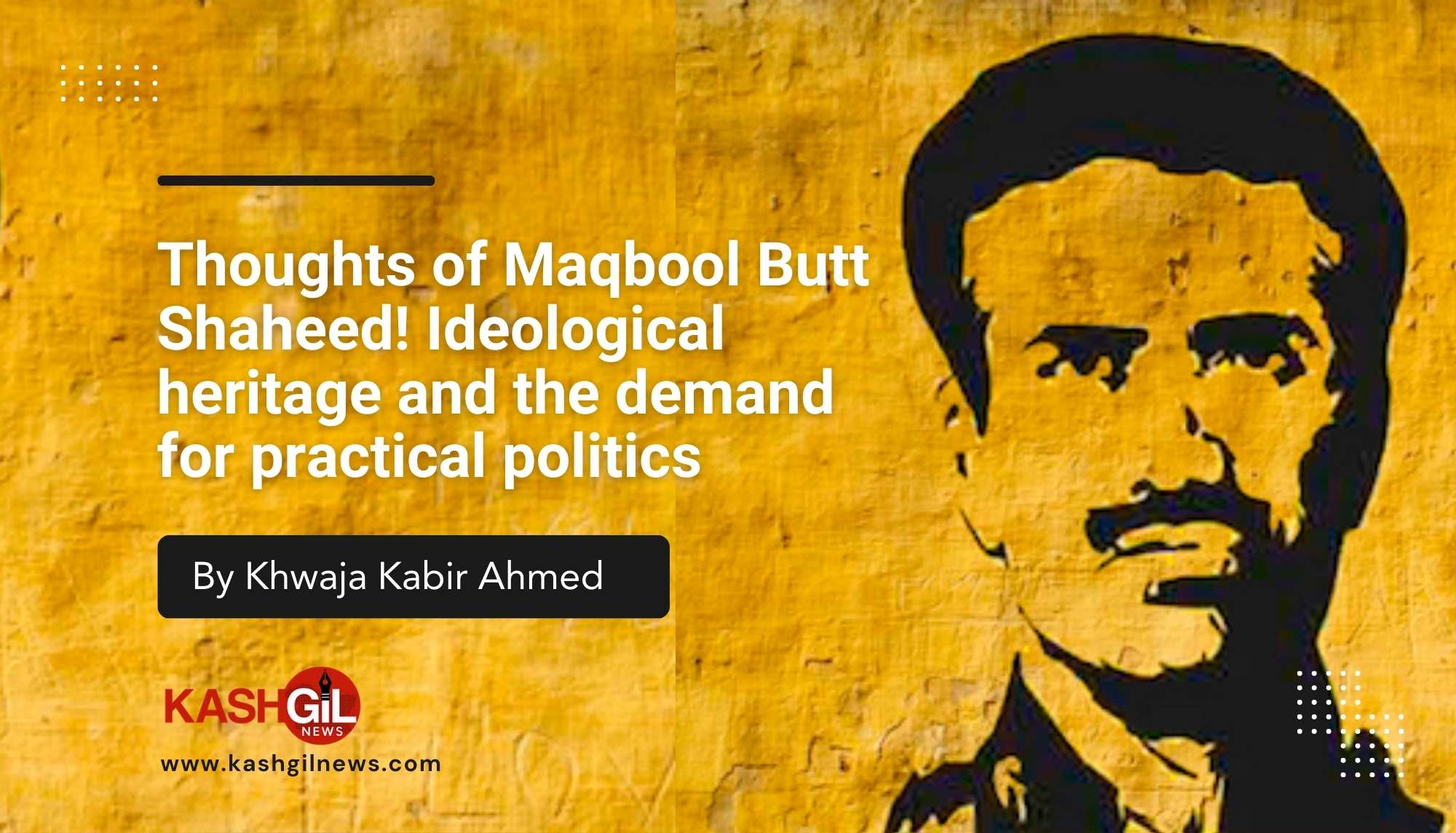
Maqbool Butt emerges as a prominent and controversial but influential name in the political history of the state of Jammu and Kashmir.
His struggle and thought not only gave rise to a specific political movement but also gave a systematic ideological form to the concept of freedom, autonomy and secular statehood. However, the question is to what extent are his thoughts effective and feasible in today’s practical politics?
If viewed in a historical context, it is clear that the politics of the region in the 1960s and 1970s were being shaped in the context of the Cold War, regional tensions and colonial influences. In this environment, Maqbool Butt presented the idea of an independent and autonomous Jammu and Kashmir, which was neither based on accession with Pakistan nor on integration with India. This position was different from the dominant narratives of the time and therefore faced strong reactions not only from both sides but also within the state. Their thinking is based on three points: state national sovereignty, popular sovereignty, secular and democratic governance! These points are still presented as references in a part of state politics today.
However, political ideologies do not remain static in their original form, they have to adapt themselves to the circumstances. The current global scenario is completely different from the 1960s. Global diplomacy, human rights politics, regional economics and digital communication, all these factors have influenced the method of struggle.
The fundamental question here is whether the institutional structure, continuity of leadership and internal unity required to transform ideological commitment into practical political strategy are in place? Analysis shows that the biggest obstacle is not ideological differences but organizational divisions, leadership conflicts and disagreements on strategy. This is where the concept of “collective purpose” in Maqbool Butt’s thought becomes important again.
Unity is not just an emotional slogan in political movements but a structural necessity. Examples of many national movements around the world show that internal divisions weaken the moral and diplomatic power of the movement. But unity does not mean ideological uniformity. A mature political movement can tolerate differences of opinion and still agree on a common goal. This aspect is also prominent in Maqbool Butt’s thought that the real goal is state independence and popular sovereignty, not the superiority of personalities.
An impartial analysis also requires that the question be raised. Can the strategies of the past be effective in today’s conditions? Is a military or hardline resistance narrative helpful or an obstacle to gaining international diplomatic support? Can political dialogue, democratic struggle and presenting a case based on human rights be a more effective path? These are the debates that require serious discussion. Ideological respect has its place, but in practical politics, the measure of results is determined by the effectiveness of strategy. If Maqbool Butt’s thoughts are to be considered not just a historical reference but a practical guide, then a few elements are indispensable for it. Such as internal organizational stability, a clear and workable political roadmap, international diplomatic strategy, public participation and transparent leadership. Without these elements, no ideology can go beyond the symbolic level.
Maqbool Butt’s name is an ideological reference, his thought provides a political direction. However, the real challenge in the present era is the renewal of ideology and its practical formulation. Unity can be effective if it is built on principled and institutional foundations; not as a mere emotional appeal. Political history shows that ideologies survive, but only those ideologies succeed that have the ability to adapt themselves to the circumstances. The question still remains, can ideological commitment be transformed into practical strategy and how? Only those who consider Maqbool Butt Shaheed a national hero and leader can answer this question. However, if this debate becomes the central point of today’s Kashmiri nationalist politics, perhaps a glimmer of hope can be lit.
***
Share this content: