by: Khwaja Kabir Ahmed
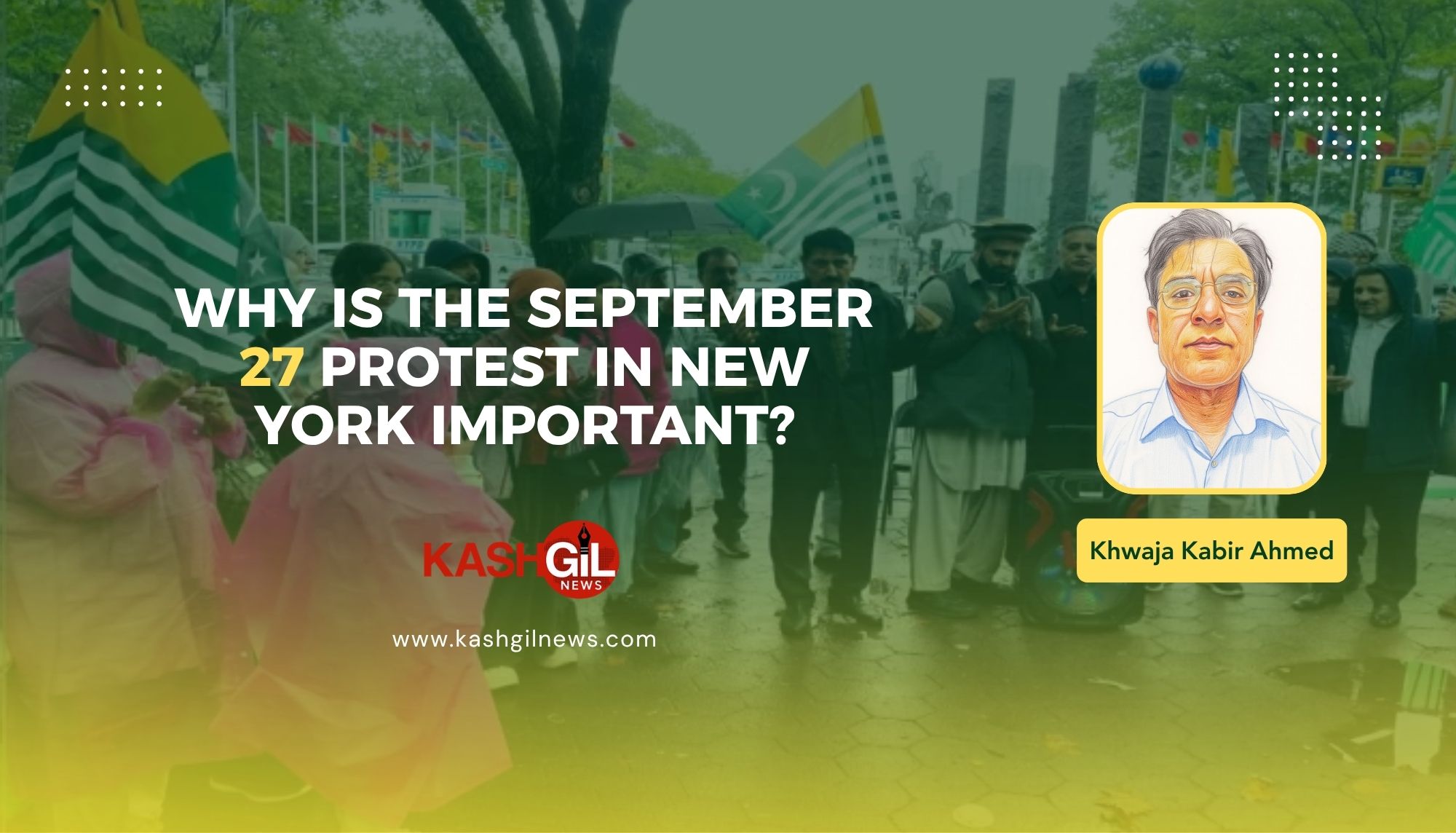
The Kashmiri protest to be held on September 27 in front of the United Nations Headquarters in New York is particularly significant because it will take place while the high-level session of the United Nations General Assembly is underway. Heads of state, heads of government, and senior diplomatic representatives from around the world will be present in New York.
The protest will primarily support the ongoing People’s Rights Movement in Pakistan-administered Jammu and Kashmir, the Charter of Demands of the Jammu Kashmir Joint Awami Action Committee, and the demands of the people. Demonstrators will also raise their voices against the alleged use of force, arrests, and human rights violations by Pakistani forces against the movement. They will call on the international community to ensure respect for the fundamental, political, civil, and economic rights of the people in Pakistan-administered Jammu and Kashmir.
However, the voice raised on September 27 will not be limited to Pakistan-administered Jammu and Kashmir. The protest will also provide an opportunity to highlight internationally the fundamental rights, human freedoms, political agency, and right to self-determination of the people of the entire state of Jammu and Kashmir.
In the other part of Jammu and Kashmir, administered by India, the United Nations Office of the High Commissioner for Human Rights has also documented serious concerns regarding the human rights situation. UN reports have expressed concern over arbitrary arrests and detention, restrictions on freedom of expression and peaceful assembly, alleged extrajudicial killings, enforced disappearances, and accountability issues, among other matters.
Therefore, the September 27 protest will not be a voice against any one administrative part alone. It will also be a demand that the fundamental human and political rights of the people of the entire state of Jammu and Kashmir be assessed according to the same global standards.
The question is: If human rights are universal and global principles, why should their standards differ on the basis of geography, administrative control, or political affiliation? Whether there are violations of people’s rights in Pakistan-administered Jammu and Kashmir or human rights concerns in India-administered Jammu and Kashmir, every case should be investigated independently, impartially, and transparently, and those responsible should be held accountable.
In this context, the September 27 protest can also present a demand before the United Nations and the international community that Jammu and Kashmir should not be viewed merely as a territorial dispute between India and Pakistan, but as an issue concerning the political, human, and fundamental rights of its people, as well as their basic human freedoms.
The Jammu and Kashmir dispute has remained on the agenda of the United Nations Security Council for decades, while the principles of equal rights and self-determination of peoples hold a fundamental place in the UN Charter.
That is why the demands of the Kashmiri people also include the fundamental point that the people of Jammu and Kashmir should be given the right to decide their political future. The right to self-determination means that the people of Jammu and Kashmir should decide their future themselves through a free, impartial, and credible process.
For this purpose, the September 27 protest can also raise internationally the demand for the withdrawal of all non-local military and armed forces from the entire state of Jammu and Kashmir, an end to military pressure, protection of human rights, and the establishment of a peaceful environment in which the Kashmiri people can express their free will. In the context of Jammu and Kashmir, the history of the United Nations also includes Security Council resolutions concerning the withdrawal of forces and the removal of armed personnel.
What is the Charter of Demands of the Jammu Kashmir Joint Awami Action Committee? What are the demands of the People’s Rights Movement in Pakistan-administered Jammu and Kashmir? Why was force used against the demonstrators? How many people were arrested or affected? What is the human rights situation in India-administered Jammu and Kashmir? What is the state of freedom of expression, political activity, and peaceful assembly? And above all, when and how will the people of Jammu and Kashmir be given the right to decide their political future?
These are the questions that can be presented, along with documentary evidence, to the international community, the United Nations, human rights organizations, and the international media through the September 27 protest.
The protest also provides an opportunity to highlight the principle that human rights standards should not differ for any state, government, region, or political party. The fundamental human, political, and civil rights of the people living on both sides of Kashmir should be assessed according to the same global standards.
Similarly, the right to self-determination of the Kashmiri people is not limited to the people of any one part; it concerns the people of the entire state of Jammu and Kashmir. For this right to be exercised in practice, an environment is necessary in which people can express their free will without fear, military pressure, political restrictions, or human rights violations.
The voice raised on September 27 in front of the United Nations in New York will, in fact, be an effort to highlight internationally, within a single framework, the ongoing People’s Rights Movement in Pakistan-administered Jammu and Kashmir, human rights concerns in India-administered Jammu and Kashmir, the withdrawal of forces from the entire state, equal global standards for human rights, and the inalienable right of the people of Jammu and Kashmir to self-determination.
The time has come for the voice of the people of Jammu and Kashmir to reach the doors of the United Nations—a voice that goes beyond support for or opposition to any one party and calls instead for human rights, political freedom, a peaceful resolution, and the right to self-determination.
٭٭٭
Share this content: