Subject: Politics of Kashmir, Dogra-era rule, the Kashmir Movement, the Partition of India, the political struggle of Sheikh Abdullah, and the relationship between the State of Jammu and Kashmir and India.
A Book, a Personality, and the Anguish of a Century in Kashmir
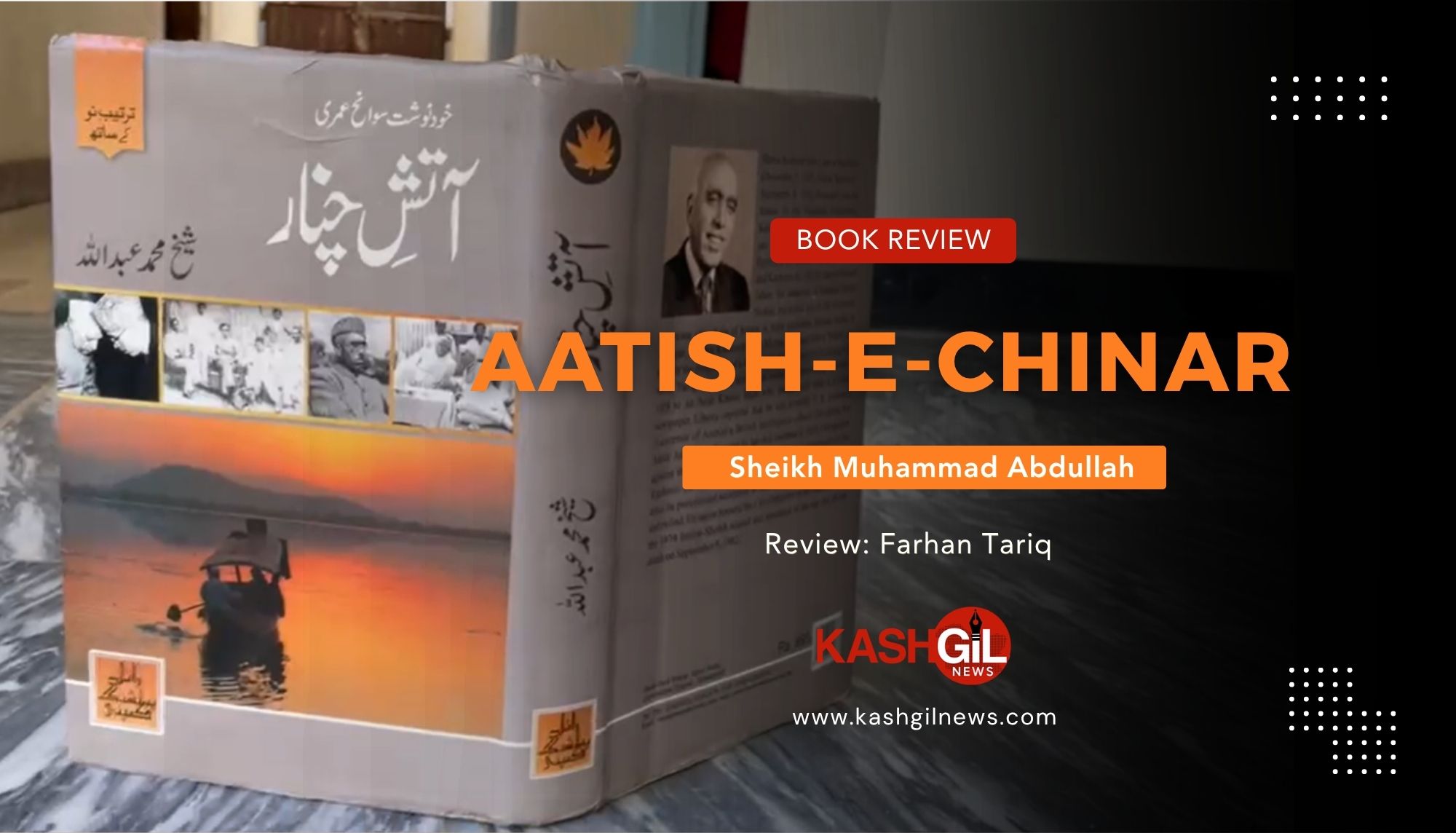
Some books do not merely recount the life of their author; rather, they present a portrait of the politics, society, power struggles, and collective consciousness of their era—a portrait in which an entire region, along with its history, comes into view. Aatish-e-Chinar, the autobiography of Sheikh Muhammad Abdullah, is one such significant work.
This book is not just the story of Sheikh Abdullah’s personal life; it is an account of the political awakening, popular resistance, pursuit of power, ideological shifts, and unfulfilled political dreams of twentieth-century Kashmir. It reveals the life of a leader who forged his political identity through a movement for public rights during the reign of the Dogra Maharaja; who transcended the role of representing only Kashmiri Muslims to envision a broader, inclusive politics; who made critical decisions during the tumultuous period of the Partition of India; and who, throughout much of his political career, navigated the complex cycles of holding power, facing arrest and detention, and engaging in political reconciliation.
As one reads the book, the question repeatedly arises: should a leader’s political success be measured by the power they held, or by the dreams that initially drew them into politics? The significance of Aatish-e-Chinar is, in part, rooted in this very question.
The Significance of the Title: The Metaphor of Aatish (Fire) and Chinar (Plane Tree)
The title Aatish-e-Chinar carries profound symbolic meaning. The Chinar tree serves as a prominent metaphor for the culture, identity, seasons, and collective memory of Kashmir. Its reddening leaves are a symbol of the beauty of autumn, yet they also evoke a sense of separation and decline hidden within this seemingly picturesque scene.
The word “Aatish” (fire) in the title adds a new dimension to this imagery. Fire can be interpreted as a symbol of resistance, unrest, rebellion, sacrifice, and transformation. Thus, the title Aatish-e-Chinar (The Fire of the Chinar) alludes to a history of Kashmir characterized by a complex interplay: beauty intertwined with anguish, hope with despair, and a yearning for freedom alongside political struggle.
From the very outset, this title invites the reader to look beyond the perception of Kashmir as merely a beautiful valley, urging them instead to understand the political experiences and historical wounds borne by the people of this region.
Sheikh Abdullah: From Individual to Political Symbol
Sheikh Muhammad Abdullah stands as one of the most significant figures in twentieth-century Kashmiri politics. Without understanding his life, it is difficult to find answers to many fundamental questions regarding the political history of modern Kashmir.
Aatish-e-Chinar chronicles the various phases of his life: his early years and education; the formation of his political consciousness; his struggle against the Dogra regime; the rise of mass-based politics; the crises that emerged during the Partition of India; the circumstances following the state’s accession to India; his loss of power; long periods of imprisonment; and, ultimately, political reconciliation.
What is particularly notable about this journey is that Sheikh Abdullah emerges not merely as a political leader, but as an individual deeply enmeshed in the contradictions of his era. His persona reflects a complex interplay between the struggle for public rights, political ambitions, ideological commitments, and the necessity of making decisions in response to ever-changing circumstances. The book is also significant because it invites us to understand the historical context behind a leader’s decisions, rather than simply labeling them a hero or a villain.
The Dogra Era and the Struggle for Public Rights
A key aspect of Aatish-e-Chinar is the political and social condition of the Kashmiri people during the era of Dogra rule.
In the State of Jammu and Kashmir, there existed deep economic, political, and social divides between the ruling class and the general population. For the common people, opportunities for political representation, access to state institutions, and the ability to raise their voices for their rights were severely limited. Under these circumstances, public discontent gradually evolved into a political movement.
Sheikh Abdullah’s politics emerged within this specific historical environment. His early struggles played a pivotal role in giving a political voice to the grievances and deprivations of the masses. To understand this period, it is essential to recognize that the movement in Kashmir was not merely about changing the ruler; it was also deeply intertwined with demands for self-respect, economic justice, education, employment, and political participation.
Here, the book leads the reader to a fundamental question: how does public resistance arise when a state system fails to address the basic problems of its people, and how do the leaders who spearhead such resistance evolve into major political figures?
Aatish-e-Chinar helps in understanding the historical backdrop of this question—though a comprehensive assessment of the era would also require consulting other historical sources.
The Movement of 1931 and the Formation of Political Consciousness
The year 1931 marks a significant turning point in the modern political history of Kashmir. Events such as political unrest, public protests, and state repression during this year left a profound impact on Kashmiri society.
Sheikh Abdullah’s political career must also be understood within the context of this era. Public gatherings, the articulation of political demands, and protests against the government’s conduct helped shape a political environment in which ordinary citizens began to view themselves not merely as subjects, but as individuals possessing inherent rights.
The significance of this period lies not only in the protest activities themselves but also in the formation of a political identity. When people begin to perceive their problems as collective deprivations rather than merely individual hardships, the very nature of politics undergoes a transformation.
However, when recounting the history of this period, it is essential to consider the roles played by various political and religious groups, their respective leaders, and the common people. Attributing the entire movement to a single individual risks oversimplifying historical complexities.
From the Muslim Conference to the National Conference: The Question of Ideological Shift
A central theme in the study of Aatish-e-Chinar (The Fire of the Chinar) is the political transition from the Muslim Conference to the National Conference.
This shift in Sheikh Abdullah’s politics was not merely a change in the organization’s name; rather, it raised fundamental questions regarding the basis of Kashmir’s political struggle—whether it should be rooted in religious identity, class and economic concerns, or a vision of a shared political nationality encompassing all religious communities.
The National Conference sought to forge a political identity that prioritized the common interests of the Kashmiri people. In this regard, the 1944 “Naya Kashmir” (New Kashmir) manifesto holds particular importance, as it brought concepts such as socio-economic reforms, public welfare, and the restructuring of the state system into the realm of political discourse. Reading this book gives rise to a fundamental question: Did the concept of a ‘shared nationality’ succeed in bringing different religious groups closer together politically, and did it provide an equitable space for the political aspirations of all segments of society?
To find an answer, one must examine not only the narrative of Sheikh Abdullah but also the stances taken by the Muslim Conference, the National Conference, and other political leaders who held dissenting views. Such a comparative study offers the reader a more comprehensive understanding of history.
The Partition of India and the Decisive Turning Point for Kashmir
The Partition of India in 1947 plunged the State of Jammu and Kashmir into a crisis, the repercussions of which are still felt today. The end of British rule, the creation of India and Pakistan, the question of the state’s accession, armed conflict, and the competing interests of various political forces ushered the history of Kashmir into a new phase.
Sheikh Abdullah was a pivotal political figure during this period. His political decisions and the stance of the National Conference occupied a prominent place in the debates surrounding the future of the state.
Aatish-e-Chinar presents this history through the eyes of a leader who was himself a participant in these events. This helps the reader understand the circumstances, apprehensions, and expectations under which political decisions are made.
However, a note of caution is necessary: while the memoirs of a leader who participated in an event serve as an important source, they do not constitute the entire historical record. To fully grasp the Partition of India and the question of Kashmir’s accession, it is essential to cross-reference these accounts with the writings of other political figures, official documents, and contemporary historical records. Perhaps the most significant question in this section is whether the political decisions made in 1947 truly reflected the aspirations of the Kashmiri people, or if the extraordinary circumstances of that time laid the groundwork for future conflicts—conflicts for which a resolution is still being sought today.
Power, Dissent, and Detention
A major part of the significance of Aatish-e-Chinar lies in its exploration of the relationship between power and political freedom.
Sheikh Abdullah was a leader who rose to prominence on the strength of popular support; yet, a substantial portion of his life was defined by the loss of power and the experience of detention. His dismissal from the premiership in 1953, followed by a long period of incarceration, served as a defining turning point in his political career.
This phase highlights the reality that a leader’s public popularity and their relationship with state institutions are not static. The friction between the forces within the corridors of power, constitutional authority, political disagreements, and public expectations can fundamentally alter the trajectory of a leader’s entire political life.
The experience of detention should not be viewed merely as the deprivation of an individual; it raises broader questions concerning civil liberties, political dissent, and the limits of state authority.
At the same time, the detention of a political leader cannot be taken as proof that every political decision they made was correct. Being a victim of coercion and being politically “right” are two distinct matters. It is precisely this distinction that underscores the need to approach this book with a critical eye.
The 1975 Accord and Political Reconciliation
A significant phase in Sheikh Abdullah’s political career was the 1975 accord between Indira Gandhi and himself, which led to his return to power.
This agreement is viewed from various perspectives. Some see it as a reconciliation and a return to pragmatic politics following a long political stalemate; conversely, critics argue that it entailed major compromises regarding Kashmir’s political autonomy and the ideological stance previously championed by Sheikh Abdullah.
A study of Aatish-e-Chinar offers a way to understand this period, as it provides insight into Sheikh Abdullah’s own political experiences and priorities.
However, when evaluating this decision, several questions arise: Was this accord a pragmatic choice among the political options available to the Kashmiri people? Did it resolve the core political conflict in Kashmir, or did it merely alleviate the political deadlock for a certain period?
Did the fundamental concepts that defined Sheikh Abdullah’s early political struggle remain intact within this agreement?
There is room for disagreement regarding the answers to these questions—a disagreement that renders the political history of this era significant and worthy of study.
To understand Aatish-e-Chinar, it is essential to consider both its literary and historical dimensions.
Share this content: