Research and Writing: Khawaja Kabir Ahmad
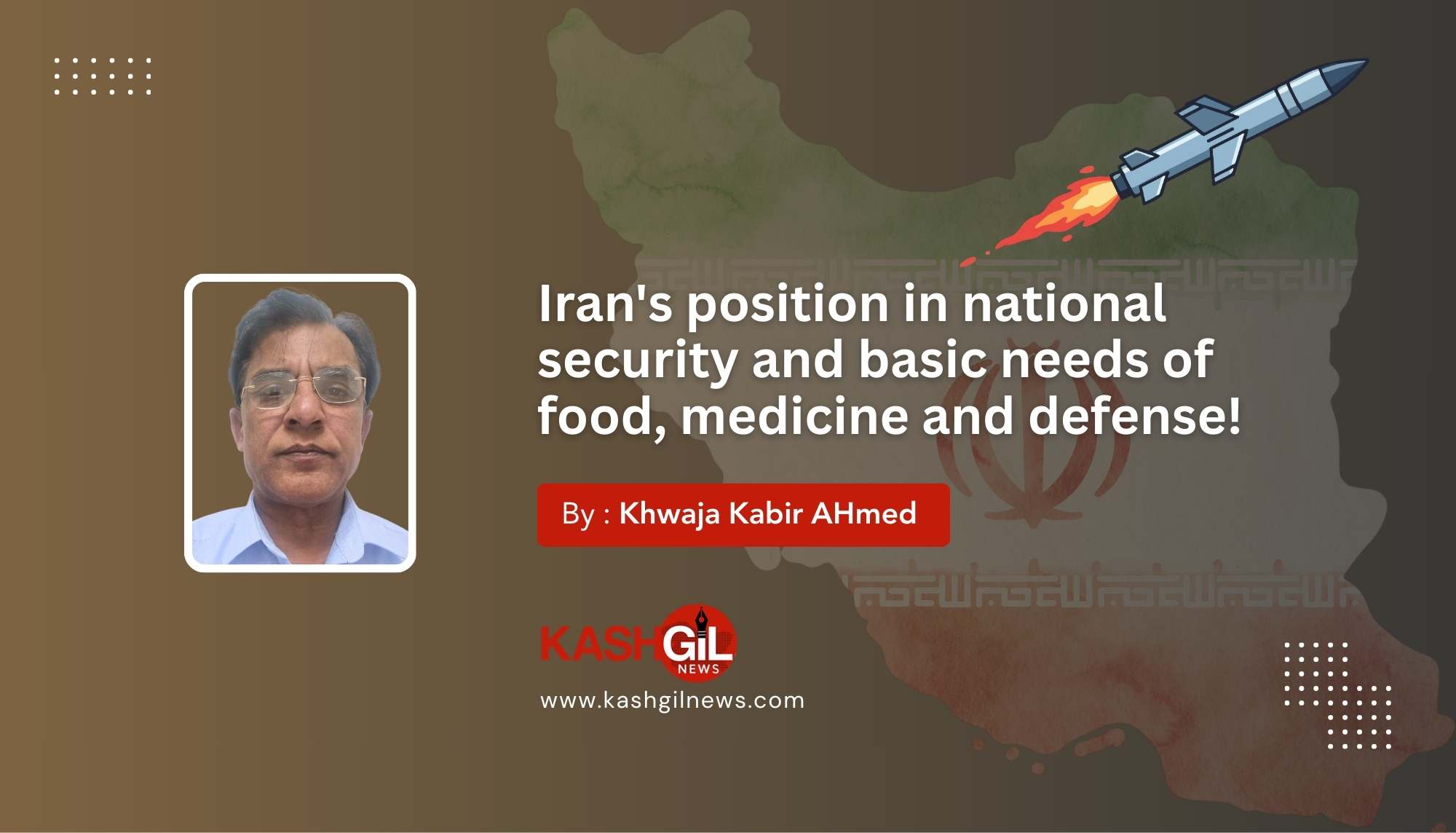
In Middle Eastern politics, Iran is a country that has faced continuous sanctions, economic pressure and diplomatic isolation over the past four decades. In these circumstances, Tehran created a narrative of “self-sufficiency”. The aim of which was to ensure national security and public welfare despite international sanctions. Now it is to be seen to what extent Iran has achieved its independence and self-sufficiency and to what extent does this self-sufficiency actually exist in the food, medicine and defense industries?
To understand Iran’s food situation, it is first important to know that it is a semi-arid country where severe water shortages, groundwater depletion and climate change affect agricultural production. According to official and semi-official data, Iran produces about 60 percent of its food needs itself, while in some years this rate was claimed to reach 70 to 80 percent. However, international research studies put this rate at between 55 and 75 percent in different periods.
The practical picture is that Iran achieved self-sufficiency in wheat in some years, but had to import millions of tons of wheat in years of drought. Iran is significantly dependent on foreign markets for edible oil, soybeans, corn, and livestock feed. There is also no complete self-sufficiency in sugar and rice. Thus, overall, Iran is connected to foreign supply chains by about 35 to 40 percent in the food sector.
A major reason for this dependence is not only the lack of production but also the structure of the agricultural structure. Inefficient use of water, lack of modern seeds and technology, and sometimes subsidy policies have kept production unstable. Despite this, Iran has made significant progress in poultry, dairy, and some horticultural products and has also exported to some countries in the region.
The picture is relatively different in the pharmaceutical sector. Learning from the experience of the 1980s war and the sanctions that followed, Iran prioritized a local pharmaceutical industry. Today, dozens of large and medium-sized pharmaceutical companies operate in the country. According to official figures, about 90 to 95 percent of medicines are manufactured in Iran. Some statements put the figure as high as 97 or 98 percent.
But an important point to understand here is that the medicines produced locally are mostly general-purpose medicines. Iran still needs external supplies for expensive, advanced and biological medicines, such as some cancer therapies, treatments for rare diseases or advanced vaccine technology. Moreover, the active ingredients of many medicines are imported. Thus, although the final packaging and manufacturing takes place in Iran, a part of the raw materials are foreign. From a financial point of view, imported medicines, despite their small quantities, account for a much larger share of the market value.
When it comes to the defense industry, Iran has placed the greatest emphasis on this sector. After the revolution, and especially during the Iran-Iraq War, there was a growing sense that dependence on foreign arms could pose a threat to national security. Against this backdrop, local production of missile technology, drone programs, small arms, armored vehicles, and naval equipment was promoted. Iranian officials often claim that 85 to 90 percent or more of its defense needs are manufactured domestically.
The ground reality is that Iran does indeed manufacture ballistic missiles, cruise missiles, drones, and a variety of ground-based weapons. Its drone program has garnered international attention. However, for modern fighter jet engines, advanced radar systems, high-end microelectronics, and some sensitive components, Iran either has to rely on outdated technology or obtain supplies indirectly from foreign sources. Defense cooperation in recent years, the details of which are not appropriate to give in light of the current situation, has filled some of the gaps, but the claim of complete self-sufficiency is still a partial reality, not a complete one.
Thus, if we look at the three sectors in an overall perspective, a clear picture emerges. Iran is relatively self-sufficient in food, but there is also dependence on imports for basic commodities and feed. Self-sufficiency in medicine is high in terms of volume, but foreign dependence remains in raw materials and expensive specialty drugs. Local manufacturing is prominent in the defense industry, especially in missiles and drones, but complete independence has not been achieved in the latest technology.
This entire model is actually the result of a “sanctions economy” where the state prioritizes domestic production to ensure its survival and security, but complete separation from the global supply chain is not possible. In today’s interconnected global economy, no country, be it Iran or a major power, can be completely self-sufficient. The only difference is the intensity and nature of the dependence.
It is a fact that Iran has been facing international sanctions of various kinds for four decades, especially financial and energy-related sanctions from the United States and the European bloc. Despite this, Iran has managed to maintain a basic industrial structure in many sectors. There are several reasons for this.
The first is the diversity of its population and economy. Iran has a population of over 90 million, which makes it different from other small states that rely solely on oil. It has a diversified economy that includes agriculture, petrochemicals, steel, cement, automobiles, and defense industries.
For example, Iran is a major producer of cement and steel in the region. This means that the economy is not based solely on oil revenues.
The second important reason is its domestic industrial capacity. Sanctions have forced Iran to produce many goods domestically. This is why the level of self-sufficiency in medicine, basic defense equipment, and some agricultural products is relatively good. When compared only in the context of “state survival” or “industrial autonomy,” Iran appears stronger than many of its neighbors that rely entirely on import models. For example, some Gulf states rely almost entirely on imports for food, medicine, and defense, while Iran can maintain its own supplies at least at a basic level.
It is also a fact that Iran has vast energy reserves. As a member of OPEC, it has the world’s largest gas and oil reserves. These natural resources protect it from complete economic collapse, although sanctions hinder its full exploitation of these resources. Nevertheless, Iran has indeed demonstrated a model of a “resistance economy” in some sectors.
***
Share this content: