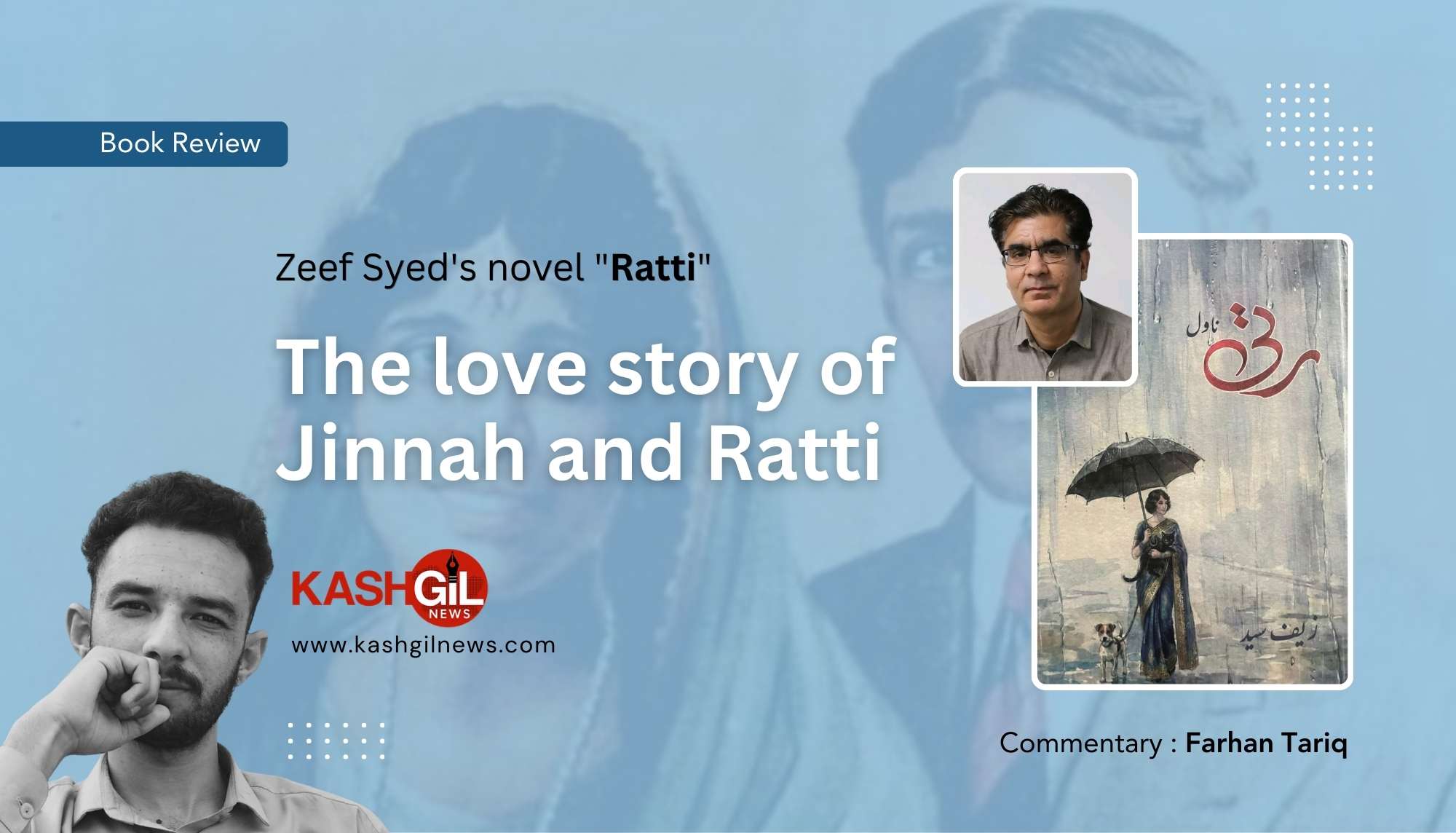
Author: Zaif Syed
Novel Name: Ratti
Commentary: Farhan Tariq
Zaif Syed’s latest novel “Ratti” brings to light the lesser-known aspects of the lives of Quaid-e-Azam and Ratti through a combination of history and fiction.
Ratti, who held Jinnah’s hand, leaving behind religion, family and property, is the flower of Bombay that burned in its own fire.
There are some novels that you are curious to complete soon. When Zaif Syed’s novel “Ratti” was published in February 2026 and I came to know about it through social media, I felt the desire to read it. A new thought emerged from the windows of the mind that who was Ratti, about whom we usually do not get to know much in the curriculum of Pakistan.
The author of the novel is Zaif Syed, who is currently the editor of The Independent and has written several books in the past. The recently published novel “Ratti” is a unique work of his. This novel consists of 282 pages. Based on fiction and historical events, this novel tells the love story of Rati and Quaid-e-Azam and reveals many realities of the past.
The first chapter of the novel is titled “Deep Black Night”.
It mentions the day of August 15, 1947, when the subcontinent was partitioned and Pakistan came into existence and the oath-taking ceremony was to be held on that day. But on the same day, there are also moments when Quaid-e-Azam looks sad and seems lost in the past.
Dressed in a white sherwani and a grey Jinnah cap, Quaid-e-Azam stands erect on the dais, but his body is slightly tilted to the left, as if the internal balance system has slipped from within. Another special thing about this day is that musicians are brought from India to this event on the instructions of Quaid-e-Azam through a special flight.
As soon as the music starts playing, Quaid-e-Azam is lost in the memories of the past evening of 20 April 1918. That day was Ratti’s 18th birthday and a function was held in connection with Ratti’s birthday at the Taj Mahal Hotel in Bombay. Ratti had invited Muhammad Ali to this function without informing his family.
As soon as Muhammad Ali entered the hall, Ratti’s father Sir Dinshaw Manekji Petit, sitting in a corner, was shocked, but Muhammad Ali’s attention was on Ratti. In this chapter, the novelist also describes Ratti’s beauty.
With the slogans of Quaid-e-Azam Zindabad, Pakistan Zindabad, Quaid-e-Azam comes out of the memories of the past and returns to the present.
In the second chapter of the novel, where the friendship between Ratti’s father Sir Dinshaw Manekji Petit and Quaid-e-Azam is mentioned, the incident of Quaid-e-Azam asking Dinshaw Manekji for Ratti’s hand in marriage is also narrated.
It is an April evening in 1916. The lawn of Sir Dinshaw Manekji’s Chateau Palace. Quaid-e-Azam and Sir Dinshaw are sitting at the tea table. The last rays of the evening sun are spreading in the air. Muhammad Ali and Sir Dinshaw are discussing the political and social future of India.
Quaid-e-Azam asks Sir Dinshaw:
“What do you think about marriage? Do you think that interfaith marriages in India can support the shaky social structure?”
Sir Dinshaw replies that such couples represent high ideals. He goes on to give an example of such a marriage in his own family.
In all these moments, Muhammad Ali is eager to express himself and is looking for the right opportunity. Finally, he tells Sir Dinsha:
“I want to ask for the hand of your daughter Ratanbai.”
Sir Dinsha freezes and says:
“I do not understand what you mean.”
Muhammad Ali replies:
“I want to marry Ratan. I am ready to fulfill whatever conditions you have.”
Sir Dinsha turns red with anger and stands up. The dishes on the table shake with the impact of his knee.
He says:
“Jinnah! You are my age and you are talking about marrying my minor daughter. Are you conscious?”
Muhammad Ali says that Ratan has such maturity and intelligence that is far beyond her age and she is ready to live with me.
Sir Dinsha becomes even angrier and says:
“Stop talking like that about my daughter and get out of my house.”
Jinnah is finally thrown out of the Chateau. It should be remembered that Muhammad Ali often used to spend his holidays at his friend’s chateau.
In the following chapters, while the novelist narrates the events of Ratti and Jinnah’s love and life, he also mentions the celebration held at Sir Dinshaw’s house on February 20, 1900 to celebrate Ratti’s birth.
The novel tells us about Ratti’s love for horse riding and that she kept high-bred horses. Ratti’s educational journey from St. Joseph’s Convent College in Bombay to France is also mentioned.
When the matter of sending Ratti to France came up, the question arose as to how a girl who had never spent a single night without her parents could be sent abroad. Finally, Ratti’s aunt took responsibility for her and left for France with her.
She writes that in France Ratti also paid attention to politics and was also fond of reading novels.
The novel also mentions the Taj Mahal Hotel and it is also stated that Jamshedji Tata founded this hotel as a resistance against colonial policies. It was a hotel where Indians and foreigners could come without discrimination. Its construction began in 1898 and was completed in 1903.
In the middle of the novel, there is a mention of Kajal, who was Ratti’s pet cat. Ratti also attended Congress meetings.She used to go to the mosque and liked Muhammad Ali’s style of speech that challenged the imperialism.
Sir Dinshaw sued Jinnah for seducing his daughter. The court ordered that Jinnah could not meet her until Ratti turned eighteen. After a two-year wait, Ratti’s eighteenth birthday party was held at the Taj Mahal Hotel and Jinnah came to the same party at Ratti’s invitation.
The novel also describes Ratti’s journey to becoming Maryam. A fierce debate broke out between the Parsi and Muslim newspapers and the Parsi community gave Sir Dinshaw an ultimatum that Ratti should be deprived of her property or the family would not be allowed to enter the fire pit.
Finally, Sir Dinshaw was defeated and the decision of the Parsi Panchayat prevailed.
Ratti told the judge in court:
“I have kidnapped Jinnah.”
When Ratti left home and went to Jinnah, she did not take any jewelry from the house, only her pet cat Kajal with her. The Jinnah family had forgotten to give her a ring at the time of marriage.
The novel also mentions Ratti and Jinnah’s daughter Dina. Jinnah called her Sofia while Ratti called her Dina.
Over time, the distance between Ratti and Jinnah increased. An incident occurred in Delhi when Ratti’s cat Kajal got lost in the hotel. Ratti was not willing to leave Delhi without it, while Jinnah returned to Bombay the next day due to a court appearance. This incident may have been the beginning of a cold spell in their relationship.
Later, Ratti started living alone in a room in the Taj Mahal hotel. She lived in solitude with her pets. During this time, Jinnah would occasionally visit her, but gradually these visits also decreased.
Finally, Ratti went abroad to Paris, but her health deteriorated further there. When Jinnah came to know about her illness, he reached Paris and stayed close to her for a month.
But one day, Ratti suddenly returned to Bombay with her mother.
It was February 20, 1929 — Ratti’s 29th birthday. That day Ratti took the pills. Doctors tried to save her, but Ratti eventually died.
Jinnah was present at the funeral in Bombay. None of Ratti’s family was present. Jinnah was overcome with grief and used to visit Ratti’s grave every Thursday.
At the end of the novel, there is a mention of the Taj Mahal Hotel, which was targeted by militants in 2008. According to the novelist, it was not just an attempt to burn a hotel but history.
٭٭٭
Share this content: