Written by: Danish Manzoor
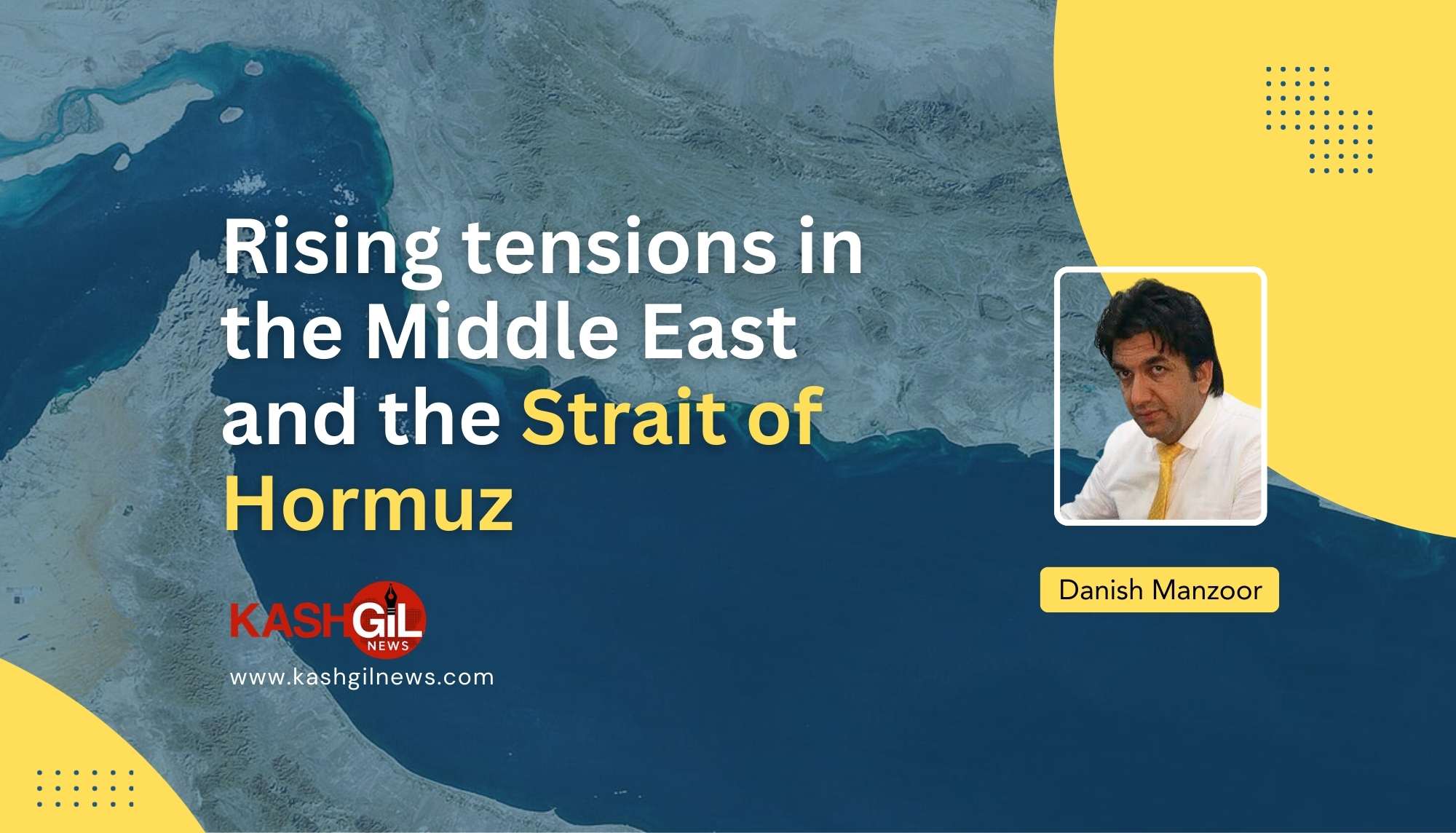
There are some places in world history that are not just geography, these places determine the fate of global power, economy and politics. The Strait of Hormuz is one such place. It is a narrow sea route, but its importance is so great that it is often said that if Hormuz is closed, the world economy could shake. This few kilometers wide passage located on the shores of the Persian Gulf has become the center of global politics, energy markets, military strategy and geopolitical conflict. From the tension between Iran and Israel to the military presence of the United States and the establishment of small Gulf states to the global oil trade, the story of all of them is connected to the Strait of Hormuz somewhere or other. In maritime and geographical terms, it is also called the Strait of Hormuz.
The Strait of Hormuz is actually a natural sea passage that connects the Persian Gulf with the Indian Ocean and the Arabian Sea. Iran is located to the north and Oman to the south. Its total width is about 39 kilometers, but the actual shipping route is only a few kilometers. That is why it is called the Chokepoint in world politics. About 20 percent of the world’s oil and a large amount of natural gas pass through this route. This route actually delivers the energy of Saudi Arabia, Iran, Iraq, Kuwait, Qatar and the United Arab Emirates to the world. Asian economies, especially China, India and Japan, obtain a large part of their energy from this route. Thus, this route is not just a sea passage but has become the world’s energy artery.
The Strait of Hormuz is not a modern discovery. It is a natural route that has existed for thousands of years and was used by ancient civilizations. The answer to when the Strait of Hormuz was founded and when it was discovered is found in both geology and the history of navigation. The Strait of Hormuz was not created by humans or the Strait of Hormuz was not discovered by a single sailor. It was a known trade route for ancient civilizations and is the result of natural geological processes.
About 30 to 50 million years ago, when the Arabian Plate moved north and collided with the Eurasian Plate, the mountain ranges of Iran, especially the Zagros, rose. This collision and the movements of the sea floor formed the Persian Gulf. Later, the sea level fluctuated during the glacial periods. About 10 to 12 thousand years ago, the current sea level was established and the Strait of Hormuz took its present shape. As a natural route, it is the result of millions of years of geological processes, not thousands. Through this route, Mesopotamia, Persia, the Indus Valley, the Arabian Peninsula and East Africa traded goods passing through here in ancient times. These goods included spices, cloth, incense, pearls, horses. This sea route was very important for trade between these regions.
A large part of the economy of Hormuz was connected to the subcontinent, traders from Gujarat, spice sellers from Kerala, Malabar, Indian cloth, and the transfer of Arabian horses to India were all possible through this route and this route remained important later during the Mughal period. Interestingly, maritime trade also strengthened the cultural ties between the subcontinent and the Gulf. Language, religion, culture, and Sufi movements spread through this maritime network. Spices, textiles, precious stones, and other goods were transported from one civilization to another through this route. At that time, this route was important, but it was not the center of world power politics.
For the first time in the 16th century, European powers realized the strategic importance of this region. In 1507, the Portuguese explorer Alfonso de Albuquerque captured the island of Hormuz. The Portuguese aimed to gain control of Indian trade here. To control the Arab sea routes and also to contain the Ottoman Empire. The Portuguese remained here for almost a century.
In 1622, the Safavid Iranian ruler Shah Abbas expelled the Portuguese with the help of Britain. This was a stage when the world saw for the first time that whoever controlled Hormuz would control trade.
The discovery of oil in the Gulf in the 20th century changed the fate of the region. Oil was discovered in Iran in 1908. Oil reserves were discovered in Bahrain in 1932, Saudi Arabia in 1938, Kuwait in the 1940s, and the Emirates in the 1960s. After the discovery of oil, the region became the world’s energy center. From that moment on, the eyes of world powers were fixed on this region.
After the discovery of oil, several small states came into existence in the Gulf, including Kuwait, Qatar, Bahrain, and the United Arab Emirates. Initially, all of them were British protectorates, but later they were replaced by the United States. A major goal of creating these states was to secure the production and movement of oil here. Today, the American military presence in the Persian Gulf is very extensive. The United States established important centers here. It stationed the American fleet in Bahrain. It built the Al-Udeid Air Base in Qatar. It established American military installations in Kuwait and built its own air base and naval facilities in the Emirates. The main purpose of all these bases was to keep the Strait of Hormuz open and secure.
After the 1979 revolution in Iran, Iran gave its foreign policy an ideological direction, and opposition to Israel became part of this ideological direction. Then a proxy network emerged in the region, which included Hezbollah, Hamas, Houthis and various militias. In contrast, Israel considered Iran the greatest threat to its security.
This tension is now visible on various fronts throughout the region. The Strait of Hormuz is an important geographical area for Iran.What is the advantage? Since Iran is located near the Strait of Hormuz. Although it is not easy to completely close Hormuz, Iran has the ability to make it dangerous. That is why Iran often gives this message that if Iran’s oil cannot flow, no one’s oil will flow from the Gulf.
If Hormuz is closed in a war, the consequences will be huge. There will be a severe global oil crisis. Energy prices will increase sharply and the crisis in the global economy may even raise the clouds of a possible world war. That is why Hormuz is often said to be the world’s most sensitive maritime chokepoint. So Hormuz is not just a sea or geography, it is a place where the global economy, energy politics, military strategy, regional wars and the rivalry of world powers are all interconnected. This is the main reason why whenever tensions increase in the Middle East, the first question in the world is whether the Strait of Hormuz is safe. If the Strait of Hormuz is shaken, not only the Gulf but the entire world economy may be shaken. If this route is closed, its effects will not be limited to the Gulf alone, they will affect the entire world.
After knowing this whole truth about the Strait of Hormuz, it can be said that world politics is not driven only by ideologies or slogans and religious narratives. Behind it lies the silent struggle of geography, resources and power that changes the fate of the entire world. To understand the current tension in the Middle East, instead of being limited to news headlines, one must also look at the broader scenario where a drop of oil, a narrow passage of the sea and the strategies of world powers are interconnected and affect the economy and politics of the entire world. That is why the Strait of Hormuz, in addition to being a sea route, is also the aorta of the modern world system, on whose pulse the eyes of the world are still fixed.
٭٭٭
Share this content: