Kashgil News Exclusive Report
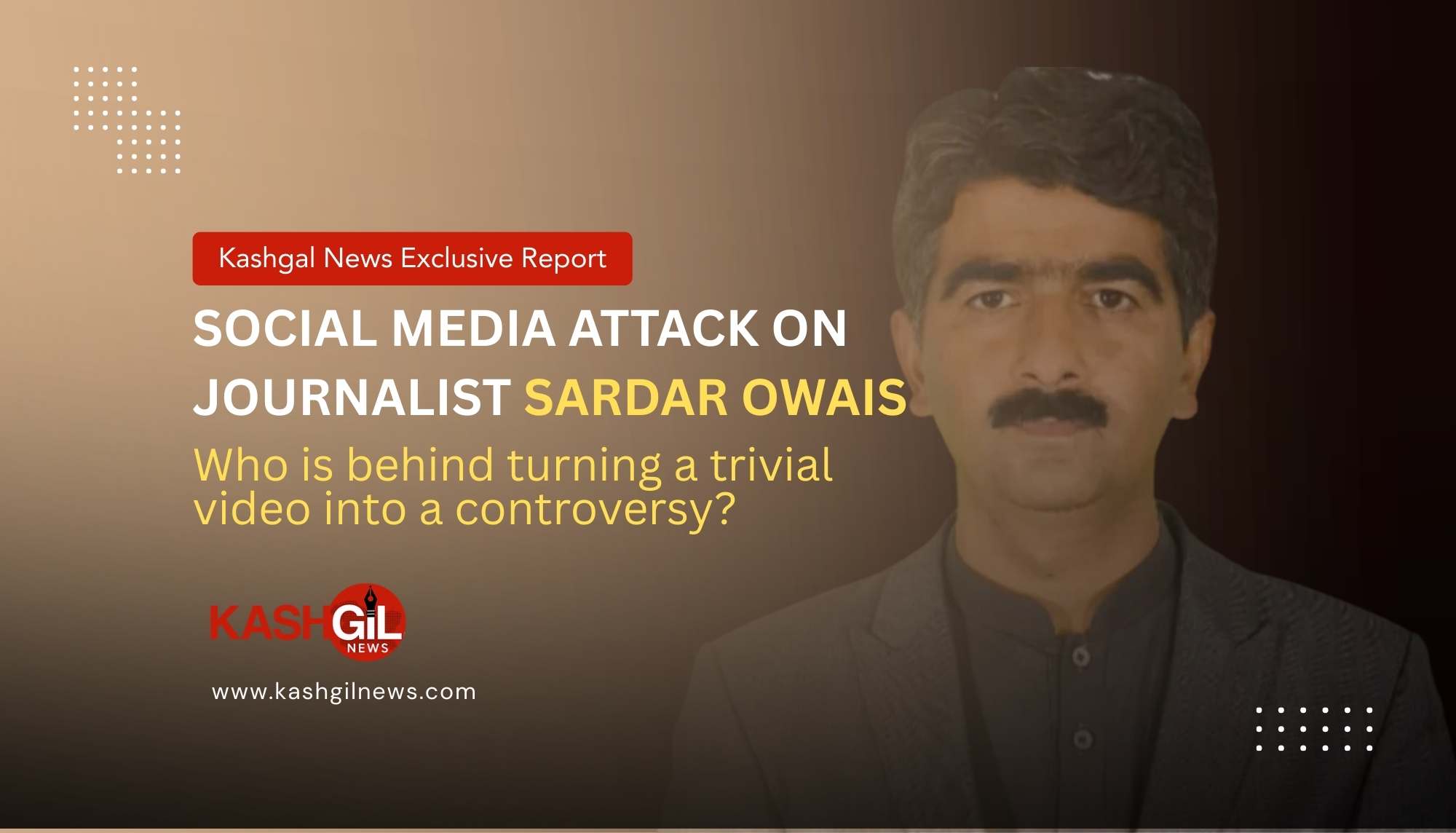
A critical trend has started on social media against journalist Sardar Owais, a resident of Bagh city in Pakistan-administered Kashmir. What are the facts behind this?
On Monday, March 16, journalist Sardar Owais shared a video on his Facebook wall, in which he is seen asking questions to a citizen selling SIM cards on the roadside. He asks if you are allowed to sell SIM cards on the roadside like this? And who gave this permission?
The young man replies very politely that he has been given permission by the franchise, and he also offers to sit down and talk. In this video of about one and a half minutes, it can be seen that neither Sardar Owais nor the SIM seller adopted any harsh or rude behavior.
However, as soon as the video was shared, a new debate arose on social media. Somewhere the SIM seller was portrayed as a victim, somewhere the issue was given a regional color, and a flood of baseless allegations were seen against Sardar Owais. This situation is raising many questions.
It is yet to be investigated whether the SIM seller was given any formal permission by the Bagh district administration or not.
Sardar Owais’ work as a journalist in the last two years and recent criticism
Sardar Owais was among the journalists who initially covered the ongoing public movement in Pakistan-administered Kashmir. He fulfilled his responsibilities to the fullest. Be it exposing corruption in Bagh district, reporting incidents, the issue of wanton deforestation or being the voice of the oppressed — Sardar Owais was busy working day and night.
Thanks to this work, he also gained considerable fame in Bagh district, but the sudden start of the social media trial against him is raising many questions.
Exclusive Stories, State Narrative and Ground Facts
On May 28, 2025, two brothers from Bagh district were killed in an alleged fake police encounter in Hussain Kot area of Rawalakot. The state position was that they were terrorists and belonged to a militant group in Afghanistan, but this narrative did not find acceptance on social media.
The next day, thousands of people attended the funeral of these brothers. Sardar Owais reported on the occasion such scenes that challenged the state narrative.
Similarly, when the mother of Zarnoosh and Jibran Naseem reached Bagh Press Club with her stand, the press club was closed due to alleged censorship, but Sardar Owais supported the oppressed by bringing the woman’s voice to the world.
On September 21, 2025, the government tried to give an impression by bringing people from different cities of Pakistan to show public support that the people of the state were satisfied with the government. Sardar Owais exposed this process, after which he also received threatening messages from a banned organization.
He also reported moment by moment on the march of the Public Action Committee on September 29, 2025.
Whether it was exposing the alleged corruption of an Afghan contractor or his relations with influential figures — Sardar Owais also raised questions on this.
He was also at the forefront on the issue of the poor construction of the Jamia Khaitan Bagh building.
Acceleration and new questions in the social media trial
Now the question arises that what are the factors behind a relatively small incident suddenly giving a regional color and spreading it so quickly? Could any influential circle have played a role in this?
Why are the writers who remained silent on important regional issues in the past suddenly seeming active on this issue today?
Instead of researching this issue, the silence of the relevant parties is also raising many questions.
State narrative and the use of temporal trends
The first priority of the state in any region is to effectively enforce its narrative on the people. Various methods are adopted for this, including using temporal social media trends as a weapon.
Sardar Owais is one of the few voices who has been bringing out the ground realities contrary to the state narrative. In such a situation, the question is also important whether the current social media trend is not a link to settling accounts with the past?
٭٭٭
Share this content: