Military sources affiliated with the Yemeni government say that Houthi fighters have attacked the Red Sea coastal city of Al-Mokha.
The Yemeni army said in a statement on X that ‘the Houthis have fired ballistic missiles at the city.’
According to the Yemeni army, ‘the Houthis have also targeted important installations at the city’s port.’
After the Houthis resumed attacks on Al-Mokha, the Yemeni port city of Al-Mokha is in the news again.
A few months ago, the Yemeni government announced a plan to develop the port and increase the capacity of ships to anchor and store commercial goods, with the aim of restoring its commercial role that has declined over the past several decades.
Image caption: The Yemeni city of Al-Mokha: A picture by Fleury and Blonduo, from Noel D’Orsay’s book ‘Arabia’, published in Paris in 1847.
According to two military sources affiliated with the internationally recognized Yemeni government, the Houthis have been carrying out a series of missile and drone attacks on the Red Sea coastal city of Al-Mokha for the past several days, killing at least eight soldiers and wounding more than 40 others.
The Houthi military spokesman, Yahya Saree, said that the attack targeted Saudi weapons depots in Al-Mokha. However, the Yemeni army said that the attacks targeted residential areas, while the Ministry of Transport said that civilian and economic facilities inside the port were also damaged.
The BBC has not been able to independently verify the locations of the facilities targeted by the Houthis in Al-Mokha and those claimed by them to be Saudi military bases.
The port of Al-Mokha is located in the west of Yemen’s Taiz province. It is located approximately 65 to 75 kilometers north of the Bab al-Mandab Strait and approximately 100 kilometers west of the city of Taiz.
According to the Yemeni Ministry of Transport, the port is only about six kilometers from the international sea route, which connects the Indian Ocean and the Arabian Sea with the Red Sea and the Suez Canal.
The city of Mocha became famous for its coffee production. From the 16th century, it became one of the most important ports in Yemen, where the grain produced in the mountainous regions of Yemen was brought and then exported to India, East Africa, the Ottoman Empire and Europe.
In the 17th and 18th centuries, Dutch, British and French trading companies also established their trading centers in the city. Over time, the name ‘Mocha’ became synonymous with Yemeni ‘coffee’ in world markets. Later, the same name was also used for the drink made from ‘coffee’ and ‘chocolate’, which is now known worldwide as ‘mocha’.
The port’s activities were not limited to ‘coffee’. Various goods including frankincense, myrrh, aloe vera and arrack were exported from here, while clothes, spices, livestock and other products were imported from India, East Asia and the eastern region of Africa.
The port of Al-Mokha began to lose its importance after the European colonies began to cultivate ‘coffee’ in various parts of Asia and America. Then, the British occupation of Aden in 1839 and the rise of the port of Aden, as well as the development of the port of Hodeidah, further affected the commercial status of Al-Mokha.
As a result of these changes, Al-Mokha almost lost its role as an important trade route for Sana’a and central Yemen.
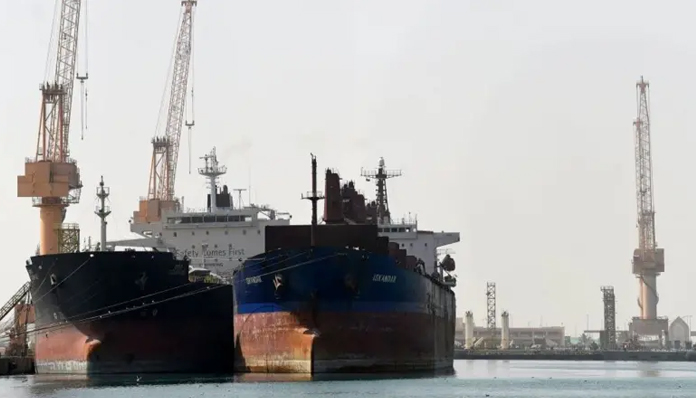
The modernization of the port began in the 1950s and was equipped with modern facilities, while they were rebuilt and expanded in the 1970s. The port has a total length of about 430 meters, including warehouses, storage yards, a platform for fuel tankers and a quarantine facility for livestock.
The port is designed to handle approximately 1.5 million tons of salmon annually, but its channel depth is between 7.2 and 7.8 meters, making it unsuitable for large container ships and tankers.
The port also faces a shortage of cargo handling equipment and maritime services, and the channel requires ongoing dredging and repair.
The port’s normal commercial activities were suspended after the war in Yemen began in late 2014. The port was later captured by the Houthis during their advance on the western coast, but was retaken by pro-government forces in January 2017.
The port is currently under the control of the National Resistance Forces, led by Tariq Saleh. Tariq Saleh is also a member of the Presidential Leadership Council.
The port was attacked with missiles and drones in September 2021. At that time, the port was close to resuming imports. However, the attack on the port caused significant damage to support facilities, warehouses, and a fuel tank.
In December 2025, the Yemeni government signed a memorandum of understanding for the development of Al-Mokha Port at a cost of approximately $138.9 million.
The project includes the construction of a berth for ships, a wharf that is 280 meters long and 12 meters deep, a container yard, warehouses, and storage facilities for grain and cement.
The government aims to increase the annual capacity of the port to 2.275 million tons upon completion of the project. The port is expected to handle 1,000 tons and approximately 195 ships annually.
Share this content: