Unity or Fragmentation — The Jammu Kashmir Liberation Front Must Decide
Part Two
This is not a time for ambiguity; it is a time for clarity. This is not a moment to remain confined within factional boundaries; it is a moment for collective decision-making. If there is any organization that can truly be called the largest follower of Maqbool Bhat’s ideology, it is the Jammu Kashmir Liberation Front (JKLF). It was this platform that gave organizational form to Maqbool Bhat’s ideas, and it is this name with which the strongest ideological association has remained. All other pro‑independence groups acknowledge this fact.
Yet the bitter reality today is that this very organization stands divided into groups and factions. The question can no longer be postponed: when the ideology is one, the leader is one, and the claim is one — why are there multiple platforms?
Every faction declares itself the true heir of the organization. Every group claims to be the complete and original JKLF. But the ground reality is that a divided force can never become a decisive political power. An organization fragmented into small groups, no matter how lofty its claims, cannot become a substitute for a unified movement. The issue here is not ideological disagreement; it is organizational disintegration.
Differences exist in every political party, but mature organizations continue to function under a central structure despite disagreements. The real crisis is not disagreement — it is parallel leaderships, parallel claims, and permanent factional alignments. The energy of the workers is being scattered. Those who believe in the same ideology are moving in separate circles. Each faction is busy protecting its own press field, its own publicity, and its own identity — while the collective identity grows weaker.
It must be acknowledged that numbers do not create power; unity creates power. And unity does not come from speeches — it comes from practical decisions.
If Maqbool Bhat’s ideology was truly rooted in collective freedom and national self‑determination, then its first requirement is that the organization must be one. An ideology cannot move forward with division. An ideology becomes effective only when its followers are organized under a single center.
Today, all factions of the Jammu Kashmir Liberation Front must ask themselves:
Has factional leadership become greater than the cause?
Has personal influence overshadowed ideological commitment?
Why are the sacrifices of workers being consumed by factional politics?
And workers must ask their leadership why they are being used as fuel for division.
If obstacles to unity remain, the loss will not be limited to any one faction — the entire movement will suffer. The world does not take scattered voices seriously. At the international level, only those forces are considered credible that are organized, united, and clear.
Workers can no longer remain silent spectators. They must demand that all factions come to one table, engage in serious dialogue on constitutional principles, organizational structure, and leadership mechanisms, and agree on a common framework. Unity will not be the victory of any one faction — it will be the survival of the entire movement.
This is not the time for blame; it is the time for decisions. Either the factional shells will remain intact and the organization will grow weaker, or all groups will prioritize collective interest and gather on a single central platform. History remembers not scattered ranks, but united forces.
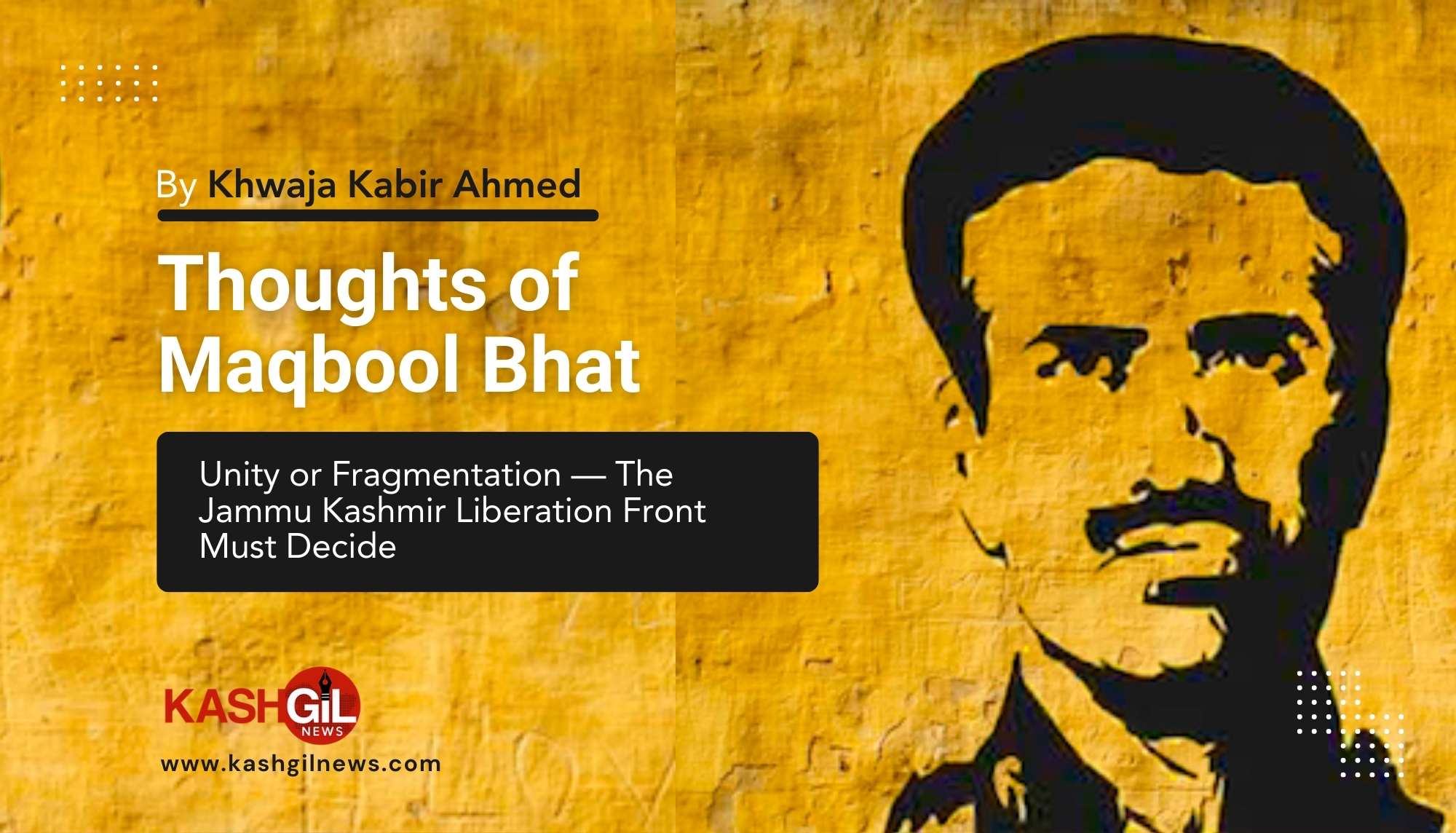
Maqbool Bhat’s ideology is clear: collective struggle, organized politics, and a shared direction.
Now the decision lies with the factions of the Jammu Kashmir Liberation Front — whether they want to keep this ideological legacy fragmented, or shape it into a united force worthy of being presented before history. Unity is the first step. And without taking this step, the claim of reaching the destination will remain nothing more than a claim.
٭٭٭
To be continued
Share this content: