Kashgil News
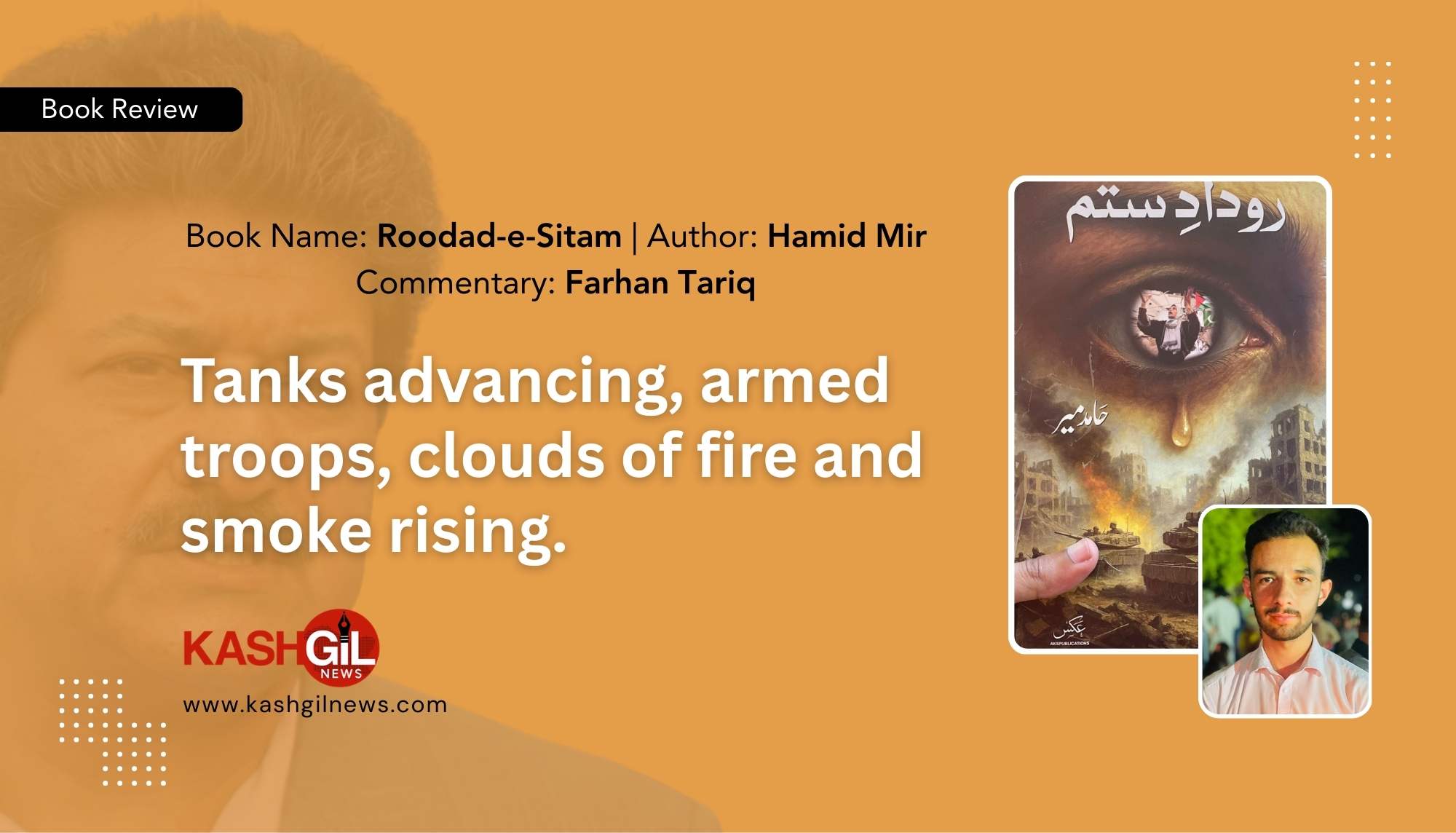
Book Name: Roodad-e-Sitam
Author: Hamid Mir
Commentary: Farhan Tariq
Hamid Mir’s book Roodad-e-Sitam is a collection of columns written on democratic and undemocratic events, wars, politics, the role of the establishment, and the situation that took place in Pakistan from 2023 to 2025.
Hamid Mir has previously written a book titled Sach Bolna Mane Hai, covering the situation from 2018 to 2023.
In the 349-page Roodad-e-Sitam, the author has described various incidents. The details of each incident may cause anxiety for the readers, so we try to keep this commentary brief and present the important points.
The opening chapters of the book discuss the general elections held in Pakistan on February 8, 2024. According to Hamid Mir, when the results were being broadcast on Geo News on February 8, the results released by the Election Commission were the opposite. According to the author, the PTI’s mandate was snatched in this election. He calls the current system synonymous with dictatorship and raises the question of whether Pakistan is being run under the 1973 Constitution or under the MPO? According to him, today the MPO has become the weapon of the democratic government, which he calls a black law that the founder of Pakistan refused to sign.
The book also mentions Idrees Khattak, who himself went missing during the struggle to recover missing persons and was later tried in a military court, which was during the reign of Imran Khan.
Regarding the fourth pillar of the state, the media, the author writes that when censorship by the state increases, the hero of the past becomes the villain of the present. According to him, during the reign of Imran Khan, showing pictures of Nawaz Sharif on TV screens was prohibited, while during the reign of Shahbaz Sharif, showing pictures of Imran Khan became a crime. According to the author, in this whole game, the media has been forced to follow the signs and critical voices have been targeted in every era.
Hamid Mir also made the disappearance of missing poet Ahmed Farhad from Pakistani Kashmir a topic in May 2024. He writes that when Ahmed Farhad’s case was going on in court, the Attorney General took the position that Azad Kashmir is a foreign territory, so Ahmed Farhad cannot be produced in court. The author questions this statement that if Azad Kashmir is a foreign territory, then what is the justification for the presence of the Pakistani army there?
The Balochistan insurgency is also described in detail in the book. According to the author, killing non-locals by taking them off buses is terrorism, which is affecting the reputation of Baloch rebels fighting for fundamental rights. He writes that Baloch is not a citizen but the constitution is missing. The book also mentions Sami Baloch, the daughter of the missing Dr. Deen Muhammad Baloch, who came to Islamabad at a young age to recover her father and kept meeting various rulers, but to no avail.
The author also sheds light on the long march of the families of the missing persons led by Mahrang Baloch and the incidents of violence against women and children in Islamabad. Mentioning the resignation of nationalist Baloch politician Akhtar Mengal, he writes that he is disappointed with the parliamentary system and that past promises have not been fulfilled.
In this context, mention is also made of Attaullah Mengal’s nine-month government and the resolution presented in the Balochistan Assembly on June 21, 1972 to abolish the chieftaincy system. The author’s stance regarding the current Chief Minister of Balochistan, Sarfaraz Bugti, is that as long as there is insurgency in Balochistan, vested interests will continue to flourish.
The book mentions Iman Mazari under the title “Rude Girl”. The author writes that even during the reign of Imran Khan, she was critical of the government and displeased the establishment.
In the last part of the book, the author pays tribute to Syed Ali Gilani and Maqbool Butt. In addition, the ongoing movement in Pakistan-administered Kashmir, the Palestinian issue, and the Indo-Pakistan tension in May are also discussed.
٭٭٭
Share this content: