By : Senge Sering
The infamous Green Tourism company is expanding its illicit commercial activities in Pakistan-occupied Jammu Kashmir and Gilgit Baltistan (POJK). According to several sources, Green Tourism Limited (GTL), founded under the Special Investment Facilitation Council, is linked to Pakistan’s armed forces. GTL holds long-term leases on dozens of motels and guest houses in Gilgit-Baltistan. The GTL Gilgit-Baltistan is now inviting bids to sublease tourist amenities to private enterprises.
Locals believe that the GTL seeks to occupy local forests, lakes, scenic mountain pastures, and valuable tourism destinations. Locals exclaim that the authorities undermine local norms and are responsible for significant deforestation in Neelam, Astore, Taobat, and Kamri valleys of POJK. The Pakistani government has not disclosed the details of the company’s land allotment deal to the public.
Such illicit operations are harmful to the local fauna and ecosystem. Pakistani enterprises disrupt the environmental balance and sustainability, potentially leading to significant future natural disasters. Many local activists are facing prosecution after speaking out against Pakistani economic and environmental terrorism.
In 2025, Gilgit police arrested Abrar Ali Bagoro, the leader of the Karakorum National Movement and the Awami Action Committee. They charged him with terrorism for exposing illegal land encroachment and abuse of natural resources. According to the police report, Bagoro attempted to instigate discontent by making derogatory comments about the military and undermining public trust in Pakistan’s security establishment.
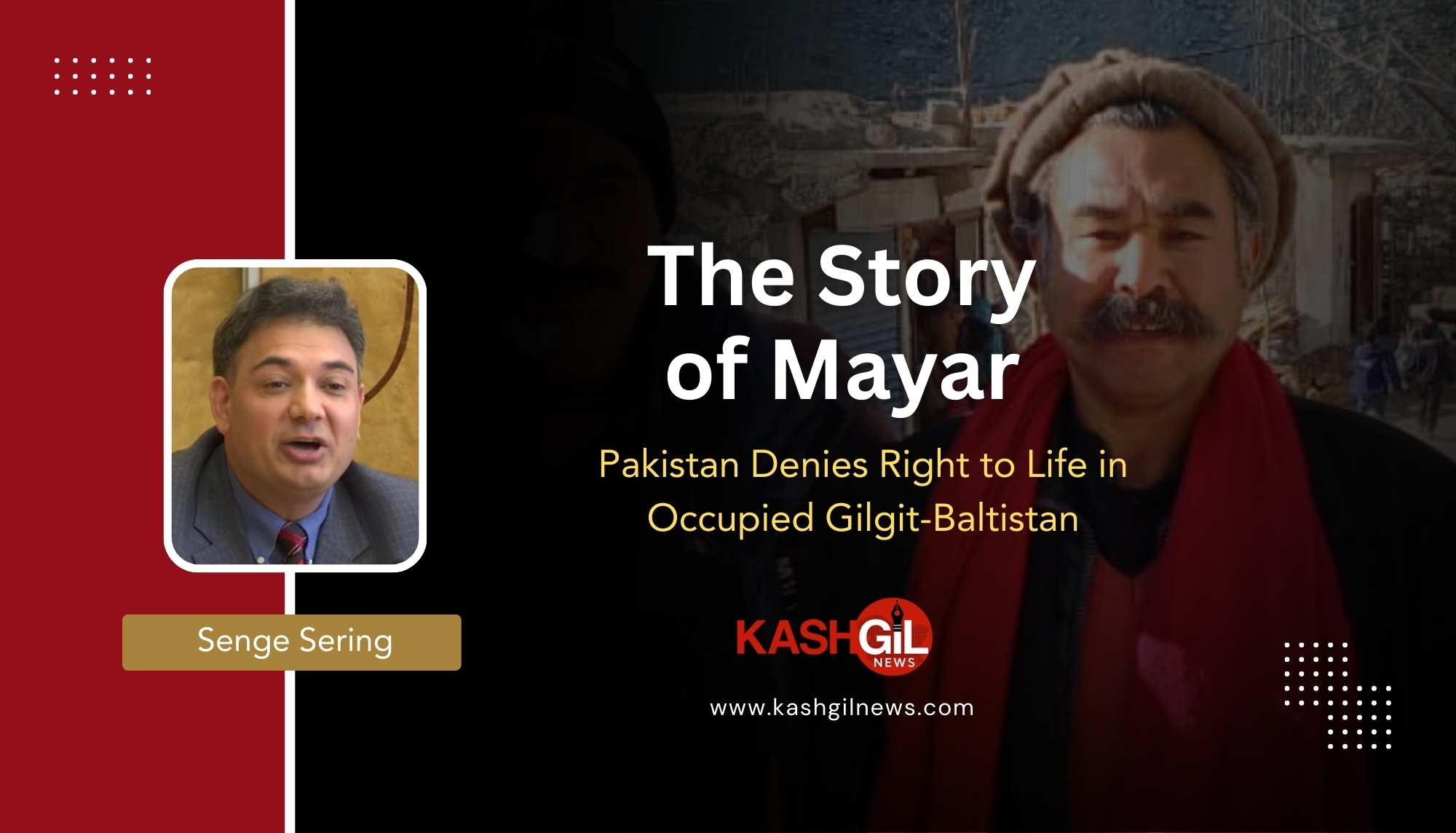
Shabbir Mayar, another activist, has been under house arrest for the past 18 months for attempting to defend local lands and resources from unlawful mining and encroachment. Mayar is the convener of the Gilgit Baltistan United Movement and represents the Kharmang chapter of the Awami Action Committee. Pakistani intelligence authorities are concerned about Mayar because of his widespread popularity and public support in the area. He is currently facing multiple charges, including terrorism under Schedule IV of the Anti-Terrorism Act.
Mayar rose to prominence for his campaign to reopen travel and trade between Gilgit-Baltistan and Ladakh. The border blockage is extremely distressing for tens of thousands of residents from Gilgit-Baltistan and Ladakh who were separated from their families during the Indo-Pakistan wars. Furthermore, the travel ban has negatively affected trade and resulted in widespread poverty in the districts of Kharmang, Skardo, Shigar, and Rongyul. Mayar says that the Pakistani masters want communities to remain destitute and rely on government handouts for easy control.
In 2025, police arrested Mayar from Gilgit’s anti-terrorism court while attending a hearing on a previously fabricated case against him. He was thereafter taken by force to Kharmang to be placed under house arrest.
The Awami Action Committee claimed that Mayar’s arrest was an attempt to prevent him from taking part in the long march for the victims of the Diamer Dam project. China is constructing this dam in Gilgit Baltistan, and residents are protesting the denial of financial compensation.
All political groups representing the Awami Action Committee, including the Awami Workers Party of Gilgit-Baltistan, declare their support for Mayar and condemn his imprisonment as a violation of fundamental human rights. Its leaders, Zahoor Elahi and Asif Sakhi, denounce the colonial authority for silencing nonviolent voices and restricting freedom of expression.
Shabbir Mayar has a cardiac condition, and doctors in Skardo have advised him to get an early checkup at Pakistan’s Rawalpindi Institute of Cardiology. Because of a dearth of medical facilities, the vast majority of people in occupied Gilgit Baltistan seek care in Pakistani hospitals. Mayar informed the journalists that police once took him from Skardo Hospital and forced him to return to his village.
In a recent video message, Mayar stated that criminalizing dissent and peaceful activism is unethical and illegal. However, colonial authorities have a free hand in Gilgit Baltistan because it is an occupied region rather than a constitutional part of Pakistan. He has asked international human rights organizations that support persecuted people in occupied territories to speak up for him.
He stated that the police have prohibited his entire family from traveling for medical care. He claimed that on seven separate occasions, he attempted to travel to Skardo for a medical checkup, but authorities stopped him each time and brought him to his home. The residents of Kharmang have called for a rally in support of Mayar to reveal the fascist face of Pakistani occupiers.
In December 2025, the Human Rights Commission of Pakistan issued a report on the state-sponsored abuses against the political activists of Gilgit-Baltistan. The dossier exposes how the authorities exploit the specially created anti-terrorism court to muzzle activism. In a statement posted on social media, Pakistan’s Human Rights Commission urged that charges against political activists be dropped immediately to restore the rights to free expression and peaceful assembly.
However, we all know that peace will only return if Pakistan withdraws from Gilgit Baltistan and the territory is merged back into Indian Ladakh to restore constitutional citizenship rights.
…………………………………………………………………………………………….
Senge Sering is a native of Pakistani-occupied Gilgit-Baltistan. He is an independent analyst and writer and runs Gilgit-Baltistan Studies, based in Washington, DC.
Share this content: