Research and writing: Khwaja Kabir Ahmed
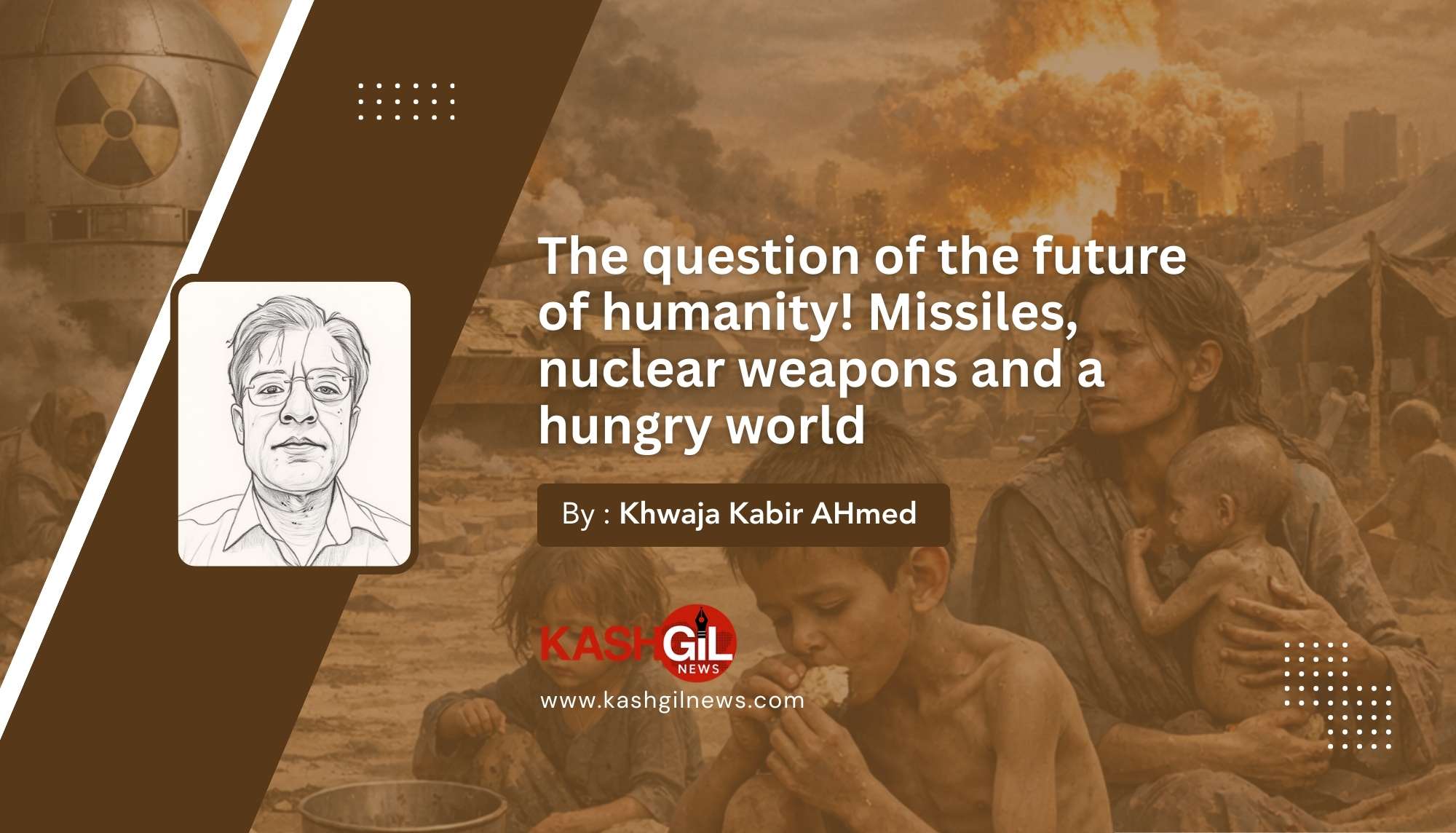
In the past few years, the situation of global politics and security has reached a point where the world is facing two completely different realities at the same time. On the one hand, the most deadly weapons in the history of humanity have been developed, while on the other hand, millions of people on this earth are yearning for food and basic necessities. This contradiction has become not only a moral but also a question of civilizational and human survival.
Today, the world has the capacity of missiles, drones and nuclear weapons that can wipe out entire cities and millions of people in a few minutes. On the other hand, the food produced globally is enough to comfortably feed the entire humanity, but the failure of the distribution system has made it a tragedy.
The most dangerous weapons in the race for military technology are considered ballistic missiles. These missiles can travel thousands of kilometers and have the ability to carry nuclear warheads. Information about these weapons and their capabilities has also been described in reports by global defense research institutions such as the Center for Strategic and International Studies and the International Institute for Strategic Studies.
The US Minuteman III can hit targets up to about 13,000 kilometers, while Russia’s RS-28 Sarmat can hit targets up to about 18,000 kilometers. China’s DF-41 also has a range of about 12,000 kilometers, while North Korea’s Hwasong-17 is capable of reaching the United States.
In South Asia, Pakistan’s Shaheen-III can hit targets up to about 2,750 kilometers, and India’s Agni-V can hit targets up to five to eight thousand kilometers.
The most dangerous feature of these missiles is that some missiles can carry several nuclear warheads at once, which is called Multiple Independently Targetable Reentry Vehicle (MIRV) technology. This means that a single missile can hit several cities simultaneously.
Along with ballistic missiles, cruise missiles have also become an important part of modern warfare. Their speed is relatively low but their accuracy is very high.
The US Tomahawk cruise missile can hit a target up to about 1,600 km. The Russian Kalibr missile can hit a target up to about 2,500 km, while China’s CJ-10 can attack with extreme accuracy up to about 1,500 km.
In the past decade, combat drones have completely changed the style of warfare. Earlier, drones were used only for surveillance, but now they have become direct attack weapons.
The US MQ-9 Reaper is a powerful attack drone, while Turkey’s Bayraktar TB2 has proven effective in several wars. Iran’s Shahed-136 is a low-cost but effective drone that can attack thousands of kilometers away. Israel’s Heron TP is also used for both surveillance and attack.
The biggest feature of drones is that they are relatively cheap and can be used in large numbers, making it difficult for defense systems to stop them.
If we talk about nuclear weapons, the total number of nuclear weapons in the world is still in the thousands. Authentic information about the number of nuclear weapons and their distribution at the global level is also published in reports by the Stockholm International Peace Research Institute and the Federation of American Scientists.
Russia has about 6,000 nuclear warheads, while the United States has about 5,500. China has about 500, France has about 290, and the United Kingdom has about 225 nuclear weapons.
In South Asia, Pakistan has about 170 to 200 nuclear warheads, while India has about 160 to 170 nuclear warheads. North Korea is estimated to have about 50 to 60 and Israel has about 90 nuclear weapons.
The most dangerous of these systems are Intercontinental Ballistic Missiles (ICBM) and Submarine Launched Ballistic Missiles (SLBM) because they can travel between continents in a matter of minutes.
In the modern world, powerful radar and satellite systems are used to detect missile attacks in time. One of the most important of these systems is the AN/FPS-132 Early Warning Radar, which can detect missiles coming from thousands of kilometers away.
This radar is an important part of the missile defense system of the United States and its allies and is installed at RAF Fylingdales in the United Kingdom, Pituffik Space Base in Greenland, and Clear Space Force Station in Alaska. Usually, if a ballistic missile is fired, this system detects it within two to five minutes of launch.
A few countries in the world have developed multi-layered missile defense systems. The technical details of these defense systems are also described in reports by global defense research institutions.
Israel has systems like Iron Dome, David’s Sling, and Arrow-3. The United States has systems like THAAD, Patriot PAC-3, and Ground-Based Midcourse Defense. Russia has developed systems like S-400 and S-500, while China is working on HQ-19 and HQ-22.
However, experts say that no defense system is 100 percent effective.
Nuclear war is not limited to the destruction of a few cities, but can also have global effects. According to scientists, after large-scale nuclear explosions, smoke and ash can spread in the atmosphere, which can block sunlight from reaching the Earth. This situation is called Nuclear Winter.
Faced with this threatSeveral countries have also built underground shelters. The Mount Weather Emergency Operations Center and Cheyenne Mountain Complex in the United States, the Burlington Bunker in the United Kingdom, the Kosvinsky Mountain Bunker in Russia, and the Beijing Underground City in China are such centers where governments can continue their activities in the event of a nuclear war.
There are also projects at the private level such as the Vivos Underground Bunker Network, which have the potential to keep thousands of people alive for months or years.
The surprising thing is that the food produced globally is so much that theoretically each person can get about 4200 calories per day, while the human body needs only 2100 to 2500 calories on average.
Despite this, about nine percent of the world’s population suffers from severe malnutrition. The main reason for this is not a lack of food, but its unequal distribution, poverty, wars, and food waste. According to global estimates, about a third of the food produced in the world is wasted.
If we look at the economic aspect, the total value of nuclear and modern weapons in the world is estimated to be around $20 trillion. On the other hand, it takes about $8.8 trillion to provide a full year of food for eight billion people around the world.
That is, the value of the weapons in the world is equivalent to about two years of global food.
These figures raise a fundamental question. Has man used his abilities to improve life or to make destruction more effective?
Today, man has the power to destroy an entire civilization in a few minutes, but on this same earth, millions of people are deprived of basic food. This is the contradiction that has become the greatest moral test of our era.
The survival of humanity is not only linked to technology, but also to reason, justice and global responsibility. If the world does not prioritize balance, cooperation and humanity over power, these deadly weapons can endanger not only enemies but all of humanity.
Perhaps at this juncture in history, humanity will have to make a fundamental decision — will the future be weapons or humans?
Note:
All these figures are based on available reports and global defense studies from various global research institutions such as SIPRI, FAS, CSIS, IISS, United Nations and FAO.
***
Share this content: