By: Khwaja Kabir Ahmed
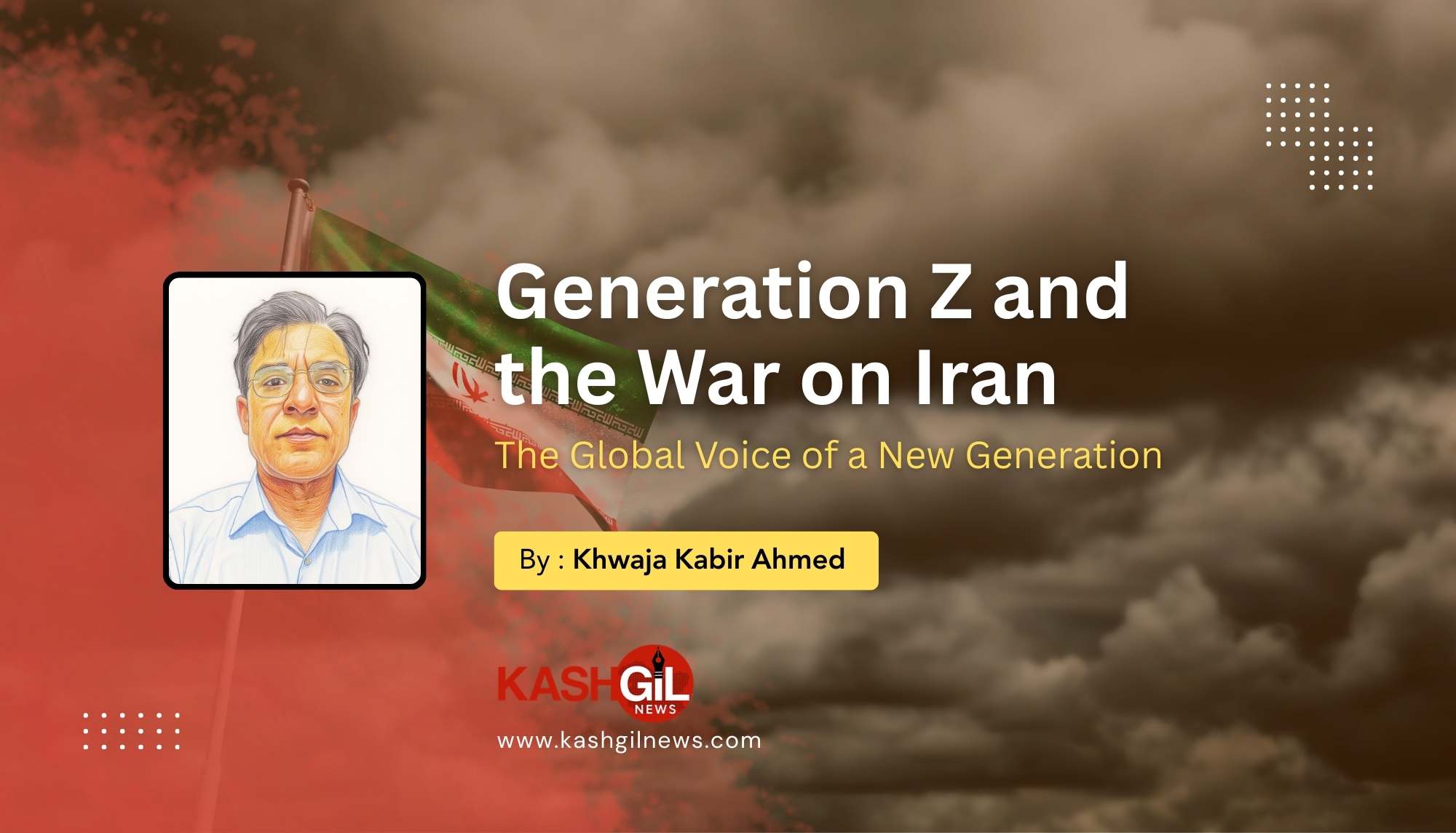
The attacks on Iran by the United States and Israel have not only sparked debate in the Middle East but have also triggered a new global discussion. In this debate, one voice has emerged prominently—the voice of the younger generation, commonly known as Generation Z. This is the generation that has grown up in the era of the internet, social media, and instant information, and whose worldview often extends beyond traditional geographical, religious, and national boundaries.
Today, young people around the world are not viewing global politics solely through the lens of state interests but also from a humanitarian perspective. In the context of the ongoing attacks on Iran, this trend has become particularly visible. Across various countries, young people have raised their voices against the war on social media platforms such as Instagram, TikTok, and X. On these platforms, millions of young users are sharing messages opposing the war, arguing that in any conflict, it is ordinary civilians who suffer the most. Therefore, they believe that global disputes should be resolved through diplomacy and negotiations rather than the use of military force.
Following the attacks on Iran by the United States and Israel, protests by young people have also been witnessed in university campuses and major cities across the United States, Europe, and other regions. Participants in these demonstrations argue that the outcomes of wars such as those in Iraq and Afghanistan over the past two decades have shown that attempting to solve problems through military power is not only difficult but often leads to further destruction. For this reason, the younger generation appears to be adopting a more cautious and critical stance toward war policies.
A significant portion of Generation Z also believes that the balance of power in global politics remains unequal, and that major powers frequently resort to military actions to protect their interests. According to many young observers, this approach often turns weaker or developing countries into arenas for power struggles among larger states. As a result, many young people are increasingly questioning the double standards that exist in international politics and are calling for international laws and principles to be applied equally to all countries.
In the case of the attacks on Iran, expressions of sympathy for the Iranian people have also been observed among young individuals in various parts of the world, particularly in Asia, Africa, and Latin America. Their argument is that ordinary citizens of any country should not have to pay the price for political or military conflicts. In this context, several hashtags and online campaigns have also emerged on social media demanding an end to the war and the protection of civilians.
However, it is also a reality that Generation Z is not entirely united in its views. Some young people within this generation also criticize the Iranian government and its policies, arguing that multiple actors share responsibility for the tensions in the Middle East. In their view, it is not accurate to look at the issue solely from the perspective of one side; rather, it is important to understand the complex political realities of the region. Therefore, many young voices emphasize that human rights, regional security, and international law must all be considered simultaneously.
Overall, the central idea emerging from the thinking of Generation Z worldwide is that war does not provide a sustainable solution to conflicts. This generation tends to favor global justice, humanitarian values, and dialogue over the politics of power. Regarding the ongoing war involving Iran, a large number of young people are saying that if the world truly wants a safer and more stable future, it must prioritize diplomacy, dialogue, and international cooperation rather than warfare.
It can therefore be said that the voice of Generation Z regarding the attacks on Iran is not only about a particular country or region but also raises a broader question about the global order: will the world of the twenty-first century continue to operate on the principles of power and war, or will it move toward a new global approach based on humanity, justice, and dialogue? If this question begins to be seriously debated at the global level, the younger generation may play a significant role in shaping the direction of international politics in the years to come.
Note:
The points presented in this column are based on general information drawn from global media reports, social media trends, and available observations regarding the reactions of young people in different parts of the world.
Share this content: