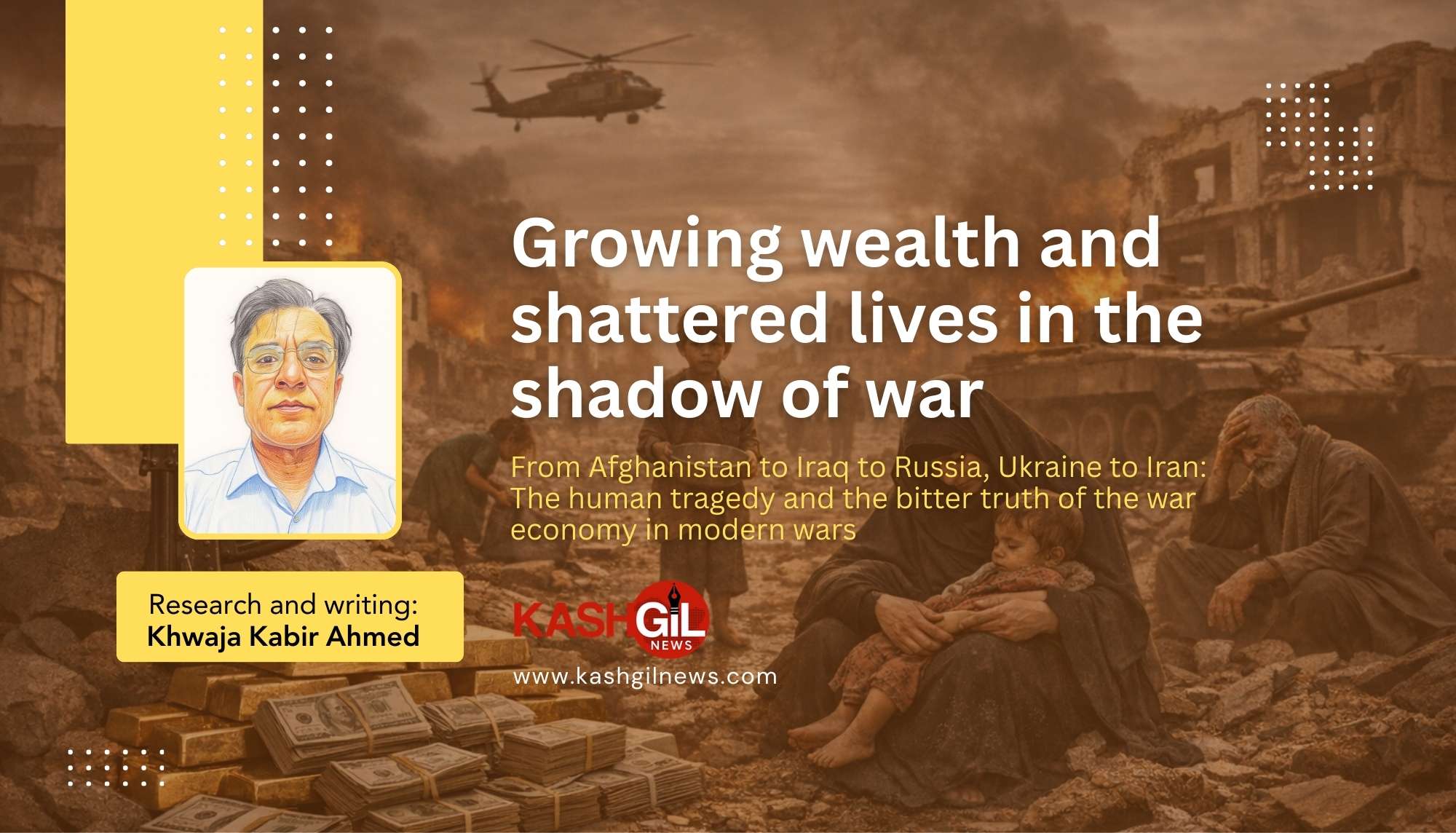
From Afghanistan to Iraq, Russia, Ukraine to Iran: Human tragedies in modern wars and the bitter truth of the war economy
Research and writing: Khwaja Kabir Ahmed
Wars in human history have always been linked to the politics of power, resources and interests. But one fact seems to be common in almost every war that the greatest burden of war is borne by ordinary people, while its economic benefits often accrue to powerful states and big capitalists. The major wars of the latter part of the twentieth century and the beginning of the twenty-first century in Afghanistan, the Persian Gulf, Iraq, the global war on terrorism, the Russo-Ukrainian war and the current Iran-Israel-US tension are clear examples of this bitter reality.
According to the Costs of War Project (Brown University), a global research organization, more than 900,000 people died directly in war violence in the wars in Afghanistan, Iraq, Syria, Yemen and other regions after 2001, including more than 400,000 civilians. If the indirect effects of the war, such as disease, food shortages, a collapsed health system, and economic collapse, are included, the total death toll reaches 4.5 to 4.7 million. According to the same study, more than 38 million people were displaced from their homes as a result of these wars.
The Soviet Union’s intervention in Afghanistan during the 1979–1989 Soviet-Afghan War ushered in a new phase of the Cold War. Approximately 1 million Afghan civilians were killed in this war, while more than 5 million people became refugees. This long war severely damaged Afghanistan’s infrastructure, economy, and education system. Its effects can still be felt in Afghan society today.
After the September 11, 2001 attacks on the United States, the United States and its allies launched a military operation in Afghanistan that lasted for almost twenty years (2001–2021). More than 46,000 Afghan civilians were killed in this war, while millions were injured or disabled.
Economically, this war is considered one of the most expensive wars in the world. According to various research estimates, more than $2 trillion was spent on Afghanistan and related war expenses. As a result of the war, Afghanistan’s economy weakened, poverty increased, and millions of people were displaced.
The United States and its allies took military action after Iraq’s invasion of Kuwait in 1990. This war was short, but it had profound effects on Middle Eastern politics and the global energy market. The oil reserves of the Persian Gulf became a major strategic issue for world powers, and military presence in the region increased.
In 2003, the United States and its allies attacked Iraq, the effects of which are still being felt throughout the Middle East. According to various research estimates, about 300,000 people were killed in this war, a large number of whom were civilians.
The financial cost of this war is estimated at between $2 and $3 trillion. This resulted in increased political instability and civil war in Iraq, while millions of people were displaced.
After 2001, the United States and its allies conducted military operations in various countries, collectively known as the “War on Terror.” A total of more than $8 trillion was spent on this global war.
The effects of these wars were not limited to the battlefield, but their economic and social effects are likely to continue for decades.
The Russia-Ukraine war that began in 2022 severely affected European politics and the global economy. Millions of people were displaced from their homes, while thousands of civilians and soldiers were killed. As a result of this war, European countries significantly increased their defense budgets and global demand for weapons also increased.
The recent joint war between Israel and the United States against Iran has taken a dangerous turn. According to various reports, hundreds of people have been killed and thousands injured in Iran and other parts of the region as a result of air and missile attacks in 2026. (The war is ongoing, so it is not yet possible to obtain reliable data.)
This tension has increased tensions in the Persian Gulf and the Strait of Hormuz, through which about 20 percent of the world’s oil supply passes. As a result, global oil prices have increased significantly and have also had an impact on the global economy.
An important aspect of war is the “war economy”. When a war begins, the demand for weapons, military technology, fuel and defense systems increases.
According to the global research institute SIPRI, the annual sales of the world’s 100 largest arms companies have reached about $ 600 billion. During the wars in Afghanistan and Iraq, the defense contracts of these companies increased significantly and the global arms industry continued to grow.
The wars in the Middle East have also affected global energy politics. The oil and gas reserves of the Persian Gulf are extremely important for the global economy. That is why wars in this region have a direct impact on global energy markets. After the war, billion-dollar reconstruction projects are launched in devastated countries, with large contracts often awarded to large international companies.
The soldier fighting on the battlefield is also from an ordinary family, and the civilian who dies is also an ordinary person. But after the war is over, its effects remain for generations. Destroyed economies, ruined education systems, health crises, major refugee crises, these problems continue to affect societies for decades.
History has repeatedly proven that wars do not end on the battlefield, but their effects are felt in theOn the one hand, the common man loses his life, home and future, while on the other hand, the capitalists connected to the war economy continue to increase their wealth. That is why many thinkers say:
The one who dies on the battlefield is also a common man and the one who kills is also a common man, but the profits of this war are often reaped by those who sit far away from the battlefield.
Note:
The figures mentioned in this column have been compiled based on the information available in various international research institutions and reports such as the Brown University Cost of War Project, SIPRI and other global research institutions.
٭٭٭
Share this content: