By: Khwaja Kabir Ahmed
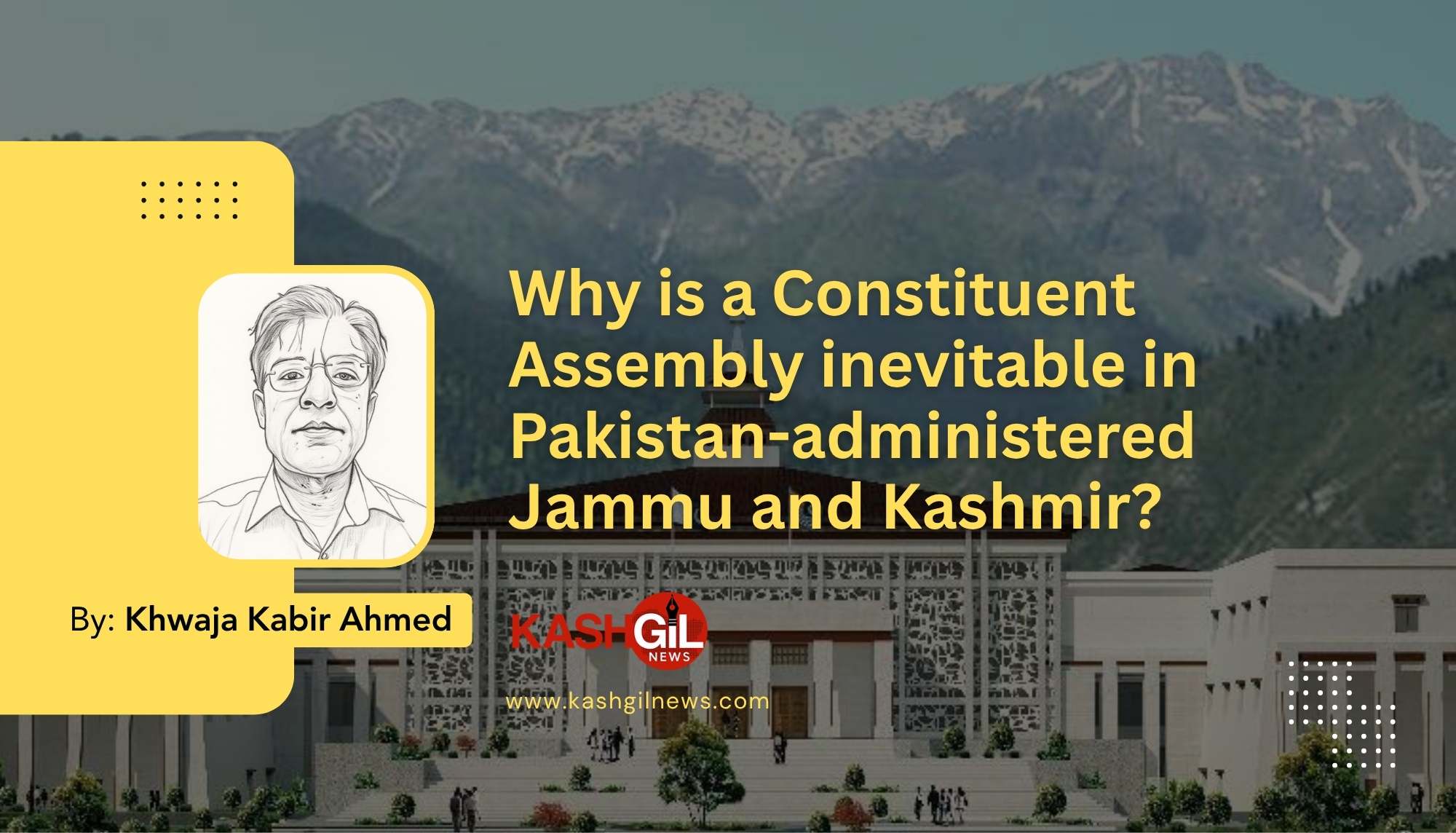
Pakistan-administered Jammu and Kashmir is currently going through a constitutional and political vacuum where institutions exist but no authority; representation exists but no autonomy. This is the fundamental contradiction that has made the people restless on a large scale and what has been a demand for a long time on a limited scale is now becoming a demand of the majority of the people and that demand is the establishment of a constituent assembly.
This demand is an expression of a deep political and constitutional need and to understand it, the first thing to do is to clarify the difference between a constituent assembly and a legislative assembly.
A legislative assembly, as the name suggests, is a body that makes laws within a pre-existing constitutional framework. Its powers are limited, its boundaries are defined, and it is subject to a higher constitution or act. The assembly in Pakistan-administered Jammu and Kashmir is also a body of this type, which works within a specific legal framework. The problem is that when this framework itself is deprived of full authority, the laws made within it also become mere formalities.
The fact is that there is a fundamental ambiguity here. The assembly that currently exists in Pakistan-administered Jammu and Kashmir is formally called the “Constituent Assembly”, but in practice it neither has the powers of a full-fledged constituent assembly nor does it meet the criteria of an independent legislative assembly. Its powers are subject to a supranational legal framework, due to which it can neither independently determine the constitutional features nor has full legislative autonomy. Thus, it has become a limited body that is a clear example of the contradiction between name and reality.
In contrast, the Constituent Assembly is a representative body of an entirely different and more fundamental nature. It does not just make laws but determines the entire constitutional features of the state. It decides where power will come from, how it will be exercised, and what fundamental rights the people will have. The Constituent Assembly is not bound by any supranational law but itself provides the foundation on which the entire system stands.
This is the point that the people of Pakistan-administered Jammu and Kashmir are feeling acutely today.
When a legislative assembly is confined within its own boundaries, when it is not empowered to make fundamental decisions, when it remains a mere part of an administrative structure, then the question arises whether it is truly the voice of the people or is it just an institution that exists to maintain a pre-determined system?
The demand for a constituent assembly at the public level is actually a reaction against this status quo. It is an effort through which people want to determine their own political future, and not within an imposed framework. But here an important question also arises: is the demand alone enough?
The fact is that it is not. The demand for a constituent assembly has existed for a long time, whether in the form of slogans, rallies or occasional statements, but if it remains limited in this way, it too will remain buried in the pages of history like many demands of the past. To make this demand effective, it is necessary to mold it into a systematic, clear and continuous public narrative.
The Jammu Kashmir Joint Public Action Committee has indicated this publicly in its recent meeting of the Dayal Declaration. Now it remains to be seen how it is given the form of reality. Now the need is that first of all, the people must be made to understand that the Constituent Assembly is not something vague or distant, but a reality linked to their daily rights, their land, their identity, their representation, and their future. Until this awareness is widespread, the demand will not be able to assert its power.
Second, this demand should be made a common public agenda beyond political affiliations. If it remains limited to a single party, group or leadership, its scope and impact will be reduced. The demand for a Constituent Assembly is actually a case of the entire population, it should also be presented at this level.
Third, this demand should be presented as an alternative vision rather than a mere reaction. That is, it should be made clear what will happen after the formation of a Constituent Assembly? What kind of constitution is required? How will the powers be distributed? How will the rights of the people be guaranteed? Until this outline is revealed, the demand will remain unfulfilled.
Today, Pakistan-administered Jammu and Kashmir stands at a juncture where it is not possible to solve the problems through partial reforms or limited powers. What is needed is to rebuild the foundation itself, and this work can only be done by a Constituent Assembly.
It is time to transform this demand from a temporary political slogan into a serious, coherent and powerful public movement. Because history teaches us that nations that do not determine their constitutional future themselves end up having their decisions passed into the hands of others. And the people of this region themselves are a clear example.
The demand for a Constituent Assembly is actually a demand for self-determination and identity, and to fulfill such demands, one does not just raise one’s voice, but also insists on it with consistency, intellectual clarity and collective strength.
٭٭٭
Share this content: