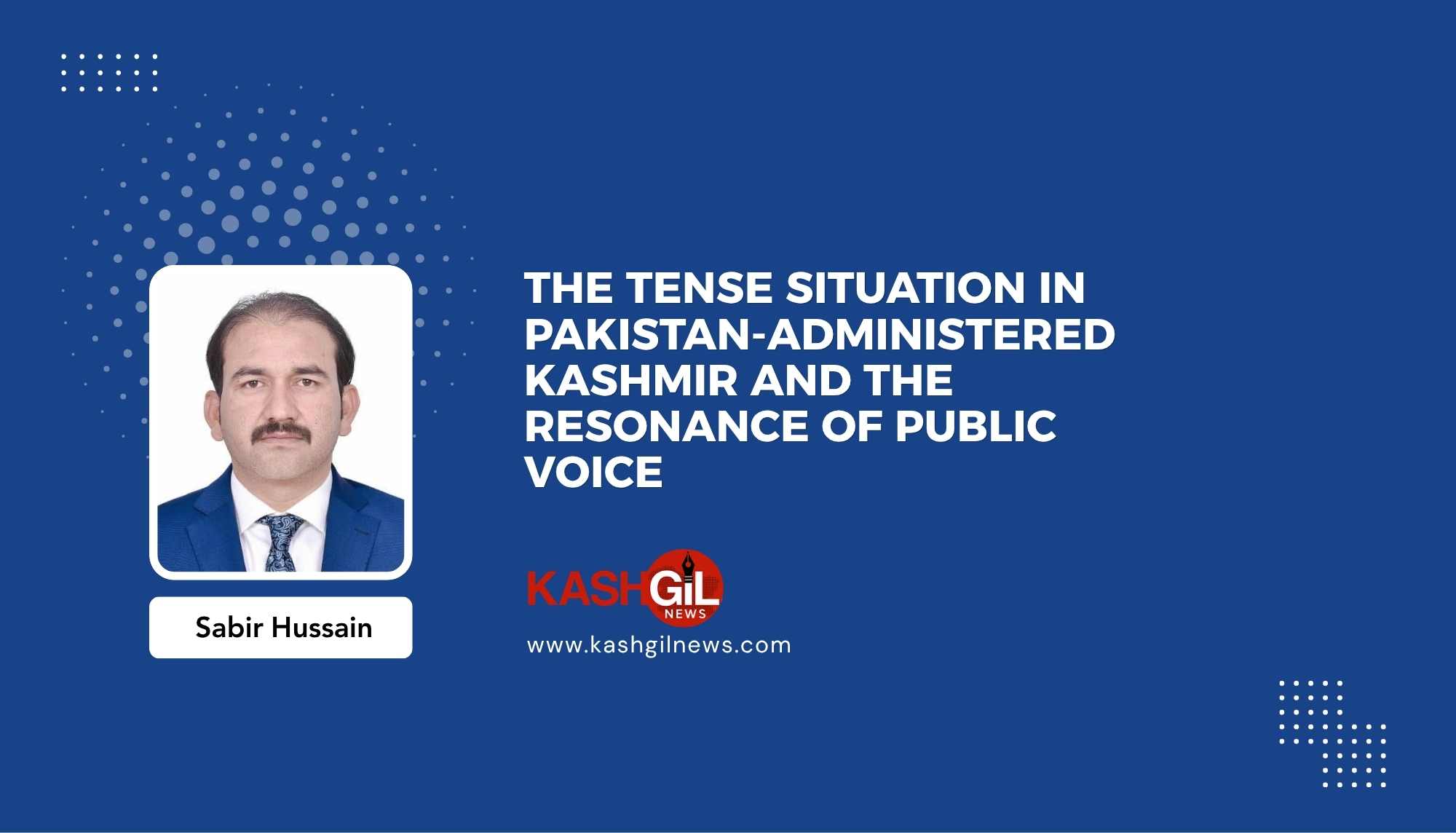
by: Sabir Hussain
As a citizen of Jammu and Kashmir, I express my deep concern and sorrow over the current situation in Pakistan-administered Kashmir. The situation that has arisen over the past few weeks has not been limited to political differences or temporary protests, but has taken the form of a serious humanitarian, social and economic crisis that has plunged the entire region into uncertainty, fear and anxiety.
According to various reports, more than 24 people have lost their lives in the last fortnight while hundreds have been injured. Along with this, several arrests have also been made and many families are still uncertain about the status of their loved ones. At the same time, there is an attempt to suppress the voice of the common man by imposing the Fourth Schedule on those who are waging the movement. Internet shutdowns, road blockades and disruption of business activities have severely affected the lives of ordinary citizens, and the worst affected have been the poor, workers, students and small business owners who were already living with limited resources.
It is an important question why people protest. History always shows that people take to the streets when their voices are not heard, their problems are not resolved and they do not feel justice and representation in their own system. In Azad Kashmir too, the main reasons for public protests include better governance, a transparent system, lack of basic amenities, inadequate health and education infrastructure, limited employment opportunities and difficult access to justice. When the people repeatedly feel that their voices are not being heard, peaceful protests remain the only way for them to raise their voice, which is considered a fundamental right in every civilized and democratic society.
The most worrying aspect of the current situation is that reports of use of state power, firing, lathi-charge and arrests have been reported in some areas. There are also serious reports of raids on homes at night by some families, harassment of women and children and alleged enforced disappearances. If these reports are true, these are very sensitive and serious human rights issues that need to be investigated immediately, independently and impartially so that the truth can be revealed and public confidence can be restored.
Along with this, the fact cannot be ignored that Azad Kashmir is still suffering from several fundamental problems where issues such as lack of infrastructure, inadequate health and education systems, limited employment opportunities and low participation of the common citizen in decision-making are further increasing the public sense of deprivation. With time, the sense of class difference is also deepening as the common citizen is facing inflation, unemployment and lack of basic amenities while the impression is also strengthening among the public that the powerful class is benefiting from various privileges, which is further widening the social gap.
At the same time, political rhetoric and harsh language are also making the situation more tense because when differences of opinion are presented as hostility or crime, it creates fear and division instead of trust. In a democratic system, the real responsibility of leadership is to reduce tension, not increase it.
Similarly, questions are being raised about the role of the media and a section of the public believes that the ground realities are not being fully revealed, which leads to the spread of rumors and unverified information. The job of a responsible media is to impartially convey the truth to the public so that trust remains and society can move forward with accurate information.
In all this, it should be clear that peaceful protest is a fundamental, constitutional and democratic right of every citizen. The public should not be treated as enemies but as part of their own system and their voices should be heard, because history proves that force and coercion can create temporary silence but can never bring lasting peace.
The impact of the current situation in Pakistan-administered Kashmir is not limited to the local level, but also around the world, the Kashmiri community has held protests, rallies and sit-ins in the UK, Brussels, Geneva, Canada and the US, where people have expressed serious concern over alleged human rights violations, arrests, torture and lack of basic facilities and have appealed to international organizations to take notice of the situation. These protests are a sign that this issue is now becoming a subject of international humanitarian attention.
According to further reports, the supply of food, medicine and daily necessities has been severely affected in some areas and Pakistani agencies are confiscating even food and drink items at entry points, video evidence of which is circulating on social media. This situation is creating further difficulties for ordinary citizens, children, the elderly and the sick. Basic human needs should not be used as a pressure or administrative strategy in any way.
Finally, I would like to say that the people of Kashmir are raising their voice not for any hostility but for their rights, dignity, justice and a better future. If a truly peaceful and stable society is to be established, the only way is not through the use of force, but through dialogue, transparent investigations, respect for fundamental human rights, and restoration of public trust, for peace is not possible without justice, and lasting stability can never be achieved through coercion.
***
Share this content: