Research and writing: Khwaja Kabir Ahmed
Note: The figure of 379 deaths in Jallianwala Bagh in this article is based on the British government’s Hunter Commission Report (1920). However, it is important to clarify that according to the Indian National Congress’s inquiry committee and some independent sources, the number of deaths was more than 1,000. Therefore, the figures of deaths in Jallianwala Bagh are found to differ in different investigations and sources. This explanation is being added to the article as a completion of the reference and as a scholarly correction. (Kh/K/A)
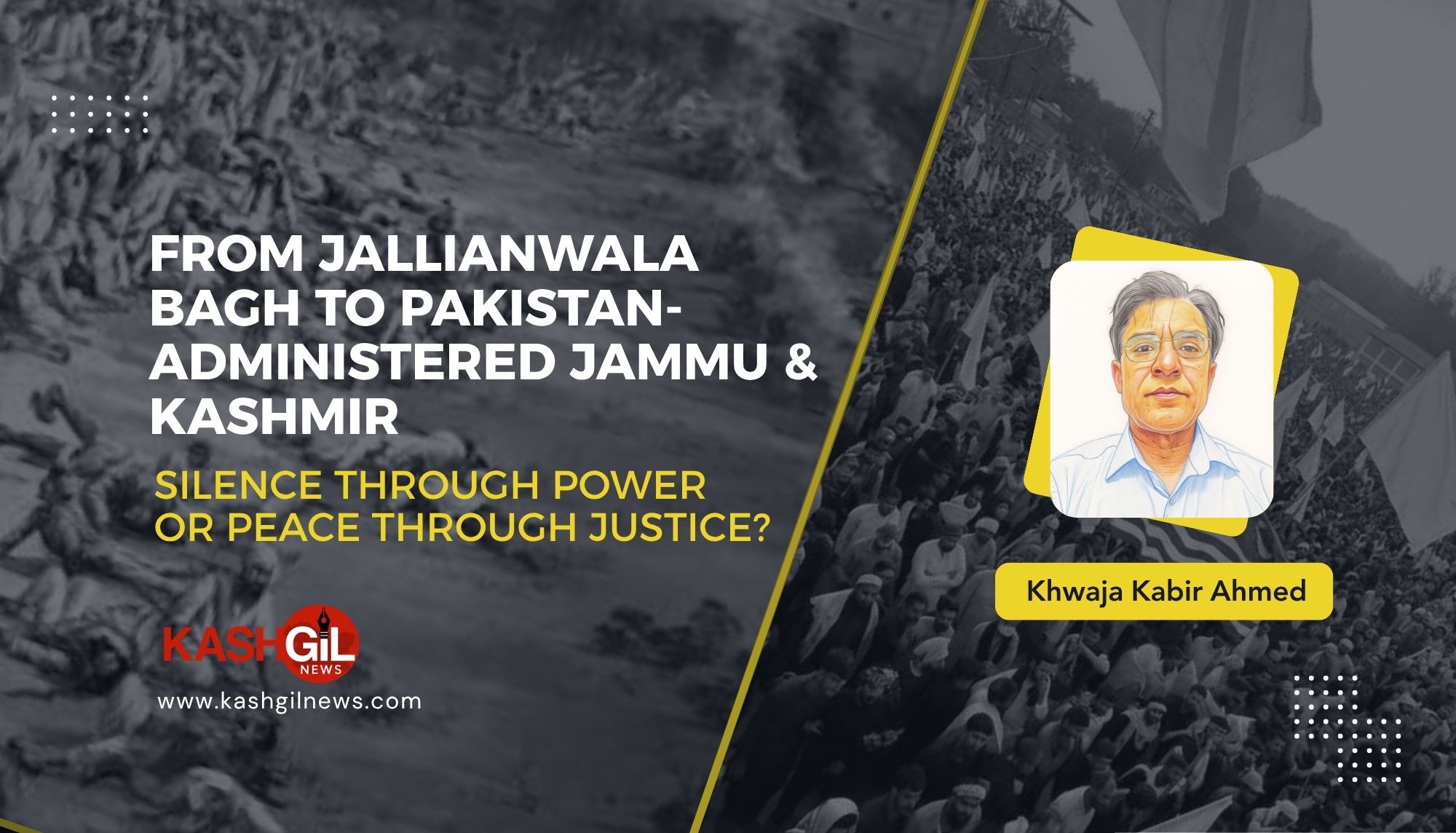
Some events in history are not just events of the past. They hide a question within themselves that remains alive even after many generations. The Jallianwala Bagh of April 13, 1919 is one such event. On one side were the British colonial power, its army, its laws and the political circles that protected that power, and on the other side were the ordinary people of India who were raising their voices for political and civil rights. More than a century later, Jallianwala Bagh still symbolizes the fundamental question: when the state responds to the political demands of the people under its rule with force, fear and bullets instead of negotiations, are the consequences limited to a few dead bodies or do they affect the moral and political foundations of the entire state? And this same question stands before us once again today, in August 2026, in the context of the ongoing civil rights movement in the Pakistani-administered state of Jammu and Kashmir and the use of state power against it.
It is important to clarify a fundamental difference here at the outset. The India of 1919 was directly under British colonial rule, while today Pakistan is an independent country, while the Pakistani-administered state of Jammu and Kashmir has a constitutional and political system. Therefore, it would not be historically accurate to describe the two periods word for word as identical (despite the fact that the constitution and political system prevailing in this region are no different from any colonial system). But a comparative study of the use of state power, the perception of public protest as a threat, the construction of political legitimacy after power, the suppression of dissenting voices and then the role of the political class in defending the same action can certainly be made.
And this is perhaps the aspect where the deepest similarity can be found between Jallianwala Bagh and today’s Pakistan-administered state of Jammu and Kashmir. On April 13, 1919, thousands of people gathered at Jallianwala Bagh in Amritsar. It was Baisakhi day and the gathering was attended by ordinary citizens along with the political protesters. According to the Hunter Committee of the British government, on the orders of General Reginald Dyer, the army opened fire and fired about 1,650 rounds. The official inquiry admitted that about 379 people were killed, while the number of injured was many times higher. The Hunter Committee report also criticized Dyer’s action because he did not give adequate warning to the crowd to disperse and continued firing even after the people had begun to disperse. But the real historical significance of Jallianwala Bagh was not only in the number of deaths. The real problem was the mindset under which a state officer considered that terrorizing the people was a legitimate means of self-government.
General Dyer’s own statement and subsequent investigations make it clear that he did not just want to disperse the crowd; his aim was to create a “moral effect” that would make people fear the power of the state. That is, the bullet was not aimed only at those present at the time but was used to send a message to the entire society. Here begins the second and perhaps more dangerous aspect of Jallianwala Bagh: the political defense of Dyer’s action.
Dyer had strong critics in the British political system. He was removed from his command in India and prosecuted. But on the other hand, there were those in British political circles who considered his action “necessary”. Voices were raised in Dyer’s defense in the House of Lords and a formal resolution in his favor was also passed. Financial assistance was collected for him in Britain. That is, despite state-level action being taken against the person who fired shots at Indian citizens, a section of political and public circles considered him a defender of the empire rather than a criminal. This point is extremely important.
State coercion is not only dangerous when the gun fires; it becomes much more dangerous when, after the gun fires, a political justification is also created for it. For Dyer’s supporters, the issue was not the killing of civilians; for them, the issue was the “writ” of the empire. For them, the use of force was justified if the empire was threatened. This is the logic that can be studied in the conditions of today’s Pakistan-administered Jammu and Kashmir.
The civil rights movement in the Pakistan-administered state of Jammu and Kashmir did not suddenly arise in 2026. The Jammu and Kashmir Joint Public Action Committee emerged as a prominent public platform from 2023 with demands for civil, economic and political rights. Issues such as cheap electricity, the price of flour and basic food items, the privileges of the ruling class, the right to public resources, education, political representation and, especially, reserved seats in the assembly were discussed at different stages of the movement.
The movement took a temporary hiatus after the negotiations and agreements in 2025, but it intensified again in 2026 as the underlying political issues remained unresolved. This time, the issue was not limited to economic demands but also the question of political representation and state authority.
In particular, the 12 reserved seats in the assembly became a central dispute. These seats are reserved under the 1974 constitutional arrangement for those who migrated from Indian-administered Kashmir. The JAAC maintained that such seats gave political power to people who were not residents of the state, while the government and other political circles considered these seats to be part of the existing constitutional system. The international media also considered this dispute to be one of the main political factors in the 2026 crisis. Even here, the disagreement was political. But when the political disagreement was suppressed through the use of force through killings, arrests, internet shutdowns, road closures and the use of forces, the matter turned into a major human rights crisis.
Pakistani forces and protesters clashed in several locations during June and July 2026. There are significant discrepancies between official and public figures. Reuters reported on July 29 that the JAAC in Rawalakot claimed more than 30 deaths, while authorities confirmed the deaths of at least three protesters and one security official. More than 100 civilian deaths have been reported so far, while the number of deaths among security personnel is estimated at less than ten.
ABC News reported that protesters said unarmed civilians had been shot at. The JAAC claimed that more than 83 people had been killed by forces since June, while the government rejected this figure and said that armed elements were involved in the protests. The ABC made it clear that it was difficult to independently verify the full death toll because internet and mobile phone service remained blacked out and access to foreign journalists in the area was limited.
Here, it is important for a responsible journalist not to present the numbers of any one side as the final truth. But one fact is clear that people were killed. There were bloody clashes between the forces and the protesters. State power was used. A large number of people were arrested or disappeared. Communications were disrupted. And basic human life was severely affected. And the most important thing is that the civil rights movement has not ended.
It is the last week of August 2026. The movement is still going on. There are reports of protest sit-ins and public resistance in Rawalakot and other places. ABC News reported on the sit-ins in Rawalakot in August and the stance of JAAC leaders that this “peaceful struggle” would continue.
That is, to say that the state ended the movement through force would not be an accurate picture of the situation on the ground. Force did not end the movement; rather, it entered a new phase. Here Jallianwala Bagh comes before us again.
In 1919, too, the British authorities had used force to end the gathering. Jallianwala Bagh was empty that day. The people were dispersed. But was the movement over? No.
On the contrary, Jallianwala Bagh became a symbol in Indian collective memory that deepened political consciousness against British rule.
Today, in Jammu and Kashmir too, the names, funerals, memorials, stories of the injured, arrests and missing persons are forming a new collective memory. ABC reported on the memorials and red roses erected in Rawalakot at the places where protesters say people were killed, and eyewitness accounts. On the other hand, a team from Jammu Kashmir TV and Kashgal News, pioneers of independent journalism, met with the heirs of those killed in Pakistani forces’ firing, most of whom were young, and took their impressions, which overall show that the heirs of those who sacrificed their lives in this way consider it an honor for them. All these emotions are in place, but there is one aspect of the current crisis in Pakistan-administered Jammu and Kashmir that is even more complex than Jallianwala Bagh.
It is not just a matter of bullets. It has also become a matter of the basic necessities of daily life. Various sources have reported severe disruptions in the supply of food, medicine and other essential items during June and July. In early July, JAAC leaders alleged that Pakistan had been withholding food and medicine supplies to the region for weeks.
ABC News reported in August, citing local people, that in some areas, authorities had stopped food supplies, in some areas electricity was cut off, the injured had difficulty reaching hospitals for treatment, and protesters were afraid to seek treatment due to the presence of forces in some hospitals.
This situation is not simply a matter of political pressure. If a patient is denied medicine, if milk is not available for a child, if an injured person feels afraid to reach the hospital, if food supplies are stopped, if the supply of petrol and other basic goods is affected, and if communications are cut off, the burden of state conflict does not fall solely on the individual protesting. It falls on the entire society. And that is why the use of food, medicine, and basic necessities as a tool of pressure in any political conflict becomes a very serious humanitarian problem. Here too, the comparison with Jallianwala Bagh takes on a different form.
In 1919, the state tried to instill fear through bullets. Today, if access to food, medicine, mobility, communication or treatment becomes a means of state coercion, the question is not just how many bullets can be fired; it also becomes a question of how far the state can link political conflict with the basic human needs of its citizens.
For a state to punish its citizens and for an entire population to pay the price for political dissent are two different things. And in a democratic system, the latter is far more dangerous.
The current crisis has been compounded by the shutdown of the internet and mobile networks. Reuters reported on the situation during the elections in August, when the internet was shut down, the streets were blocked by containers and daily life was paralyzed.
When an entire region is cut off from the world, independent verification of any deaths, arrests, disappearances or human rights violations occurring there becomes difficult. And when the access of independent journalists is also limited, the state narrative and the public narrative become further apart. This is why the need for an independent, transparent and international standard investigation into the current crisis in Pakistan-administered Jammu and Kashmir is greater than ever.
If the government’s position is correct that there were armed people among the protesters, then an independent investigation can confirm it. Free journalism can bring it to light, free media can see it, so why is the government banning all of this?
If the position of JAAC and eyewitnesses is correct that disproportionate force was used on unarmed protesters, then an independent investigation can prove it too. If crimes were committed by both sides, then those responsible for both sides should be determined. This is what justice demands. But this is where the role of the political system becomes decisive.
After Jallianwala Bagh, the British Parliament was not completely united against Dyer. On the one hand, there were decisions to remove him from the army, on the other hand, there were also political circles that stood in his defense.
This history provides us with a yardstick for looking at the political system of today’s Pakistan-administered Jammu and Kashmir: what should be the role of the elected assembly when citizens are killed as a result of state power?
Should the assembly be the first to demand justice for the slain citizens? Should it demand an independent investigation?
Should it conduct a parliamentary review of the powers and actions of the forces? Should it ask the government why civilians were killed? Or should it accept the state position without independent investigation?
This question is not an accusation against a specific member of the assembly but a question of principle.
It would also be wrong to label every member of the assembly as a “supporter” of a single person or institution without evidence. But if the political system as a whole fails to raise effective questions about the use of state power, history also records this silence.
This is why Dyer’s supporters at Jallianwala Bagh are historically significant. They did not fire the bullets. But they created political justification for the shooter. And this political justification is crucial for the continuation of state repression. The gun may be fired by one person; but the narrative that justifies that gun can affect the entire system.
Today, the fundamental question in Pakistan-administered Jammu and Kashmir is whether the use of state power will be abolished simply in the name of “state writ”, “law and order” or “armed elements”, or will every killing be independently investigated? Because the writ of the state does not mean that the state is above the law.
State authority does not mean that the right to life of citizens is abolished. And if a few people commit violence in a demonstration, it does not mean that it is permissible to use disproportionate force against everyone present in the entire protest.
Similarly, if a protester has committed a crime, it does not mean that the state can punish him collectively. The law determines the responsibility of the individual, it does not convict the entire population. This is the fundamental principle that emerges in the study of both Jallianwala Bagh and today’s Pakistan-administered Jammu and Kashmir. In 1919, the British government believed that fear could be created in Punjab through force. But the result was the opposite.
Jallianwala Bagh further popularized Indian politics, strengthened the Non-Cooperation Movement led by Gandhi, returned Rabindranath Tagore his knighthood and severely damaged the moral reputation of British rule.
It is not correct to say that Jallianwala Bagh alone ended British rule. The British withdrawal was the result of a number of factors, including economic weakness after World War II, the long political struggle for independence, the Quit India movement, the growing political consciousness within the Indian Army and Navy, the naval mutiny of 1946 and the decline of the global colonial system. But Jallianwala Bagh was certainly an event in this long process that severely damaged the moral legitimacy of the British Empire. And from here comes the most important historical lesson for the present-day Jammu and Kashmir, which is administered by Pakistan, that protests can be ended by force in a day, but the reason for the protests cannot be ended. As long as the fundamental question remains. The question of representation remains.
There is the question of political authority. There is the question of economic justice. There is the question of electricity and food prices. There is the question of basic amenities for patients and ordinary citizens. There is the question of reserved seats. And above all, there is the question of how much real participation does the ordinary citizen of the state have in the decisions of the state. So the movement exists and will exist.
If these questions are answered through negotiations, constitutional reforms, independent investigations and public consent, the crisis can move towards a political solution. But if the answer is more arrests, more force, more communication blockades, more economic blockades and more fear, then the problem may appear to be temporarily silent, but not gone. And this is the difference that states must understand: silence is not peace. The opening of a closed city is not a sign of the end of the protest.
An internet blackout does not mean that the people’s questions have ended. An arrested activist does not mean that his demand has also been arrested. A funeral is not just the grief of one family; sometimes it becomes a symbol of the entire movement. Jallianwala Bagh is a historical example of this.
Today, the memorials, names of martyrs, funerals and sit-ins being built in Rawalakot and other areas of Pakistan-administered Jammu and Kashmir are becoming part of the collective memory of the times to come. This is why it would be perhaps the biggest political misunderstanding to consider the current movement as “weak or dead”.
This movement is ongoing. And if till today people are sitting in sit-ins, repeating the demands of fundamental rights and the JAAC leadership is calling it an ongoing peaceful struggle, then the same basic question still remains before the state. Power or negotiations?
The same principle applies to the supply of food and medicine. If the government deliberately uses the supply of basic commodities to suppress protests, it is a very serious human rights issue. And if the supply is stopped for any other reason, the government must immediately restore it. Because medicines are not the property of any political party. Food is not a weapon of any movement. Baby milk should not be part of any political conflict. The treatment of a patient cannot be a punishment for a state or political disagreement. This principle applies to every state.
Perhaps the greatest lesson of Jallianwala Bagh is that the real test of state power is not when there is no threat to the state. The real test is when citizens are angry, on the streets, shouting slogans against the government and the state feels its authority is challenged.
That is when it is known whether the state is truly strong or merely powerful. A strong state is one that can tolerate dissent. A powerful state is one that can silence dissent with a bullet. There is a big difference between the two.
The British Empire was powerful in Jallianwala Bagh, but history has not proven it to be strong. It had an army, weapons, law, administration, prisons and political supporters.
But it did not have the consent of the people. And ultimately the British Empire had to leave India.
Today, in the Pakistani-administered state of Jammu and Kashmir, the question is bigger than any one government, one party or one officer. The question is, what kind of relationship does the state want to establish with its citizens?
Will citizens continue to fear the state for demanding their rights? Or will the state consider the rights of citizens as its responsibility? Will the assembly be the voice of the people? Will the forces remain subject to the law? Will there be independent investigations into the killings? Will missing persons be held accountable? Will the unimpeded supply of food, medicine and basic necessities be restored? Will restrictions on the internet and free press be lifted? And will there be serious negotiations on the basic political demands of the ongoing civil rights movement, rather than being crushed by force? The answers to these questions will determine how the date of 2026 will be remembered in the future.
If the state today chooses the path of justice, dialogue and constitutional reform, perhaps the current crisis will be remembered as a turning point after which the relationship between the state and the people improved.
But if force remains the answer, if civilian casualties are not accounted for, if the food and medicine blockade persists, if communications remain shut down and if political demands are dismissed as mere anti-state activity, history may give it a different name.
Jallianwala Bagh tells us that the greatest loss of state power is not that which is inflicted by bullets; the greatest loss is that which is inflicted by the loss of trust in the state in the hearts of the people. General Dyer had bullets. His supporters had political legitimacy. The British government had law and the army. But the people of India had one thing that ultimately proved to be more powerful, and that was collective memory.
Even in the Pakistani-administered state of Jammu and Kashmir today, the sounds of guns can be silenced, the internet can be shut down, roads can be blocked, protest sites can be evacuated and people can be arrested.
But if the fundamental question remains alive, the journey of history will continue. And today, this question is still alive. The movement for public rights is not over yet. The demands of the people are not over yet. The question of the use of state power is not over yet. The civilian casualties are still to be counted. The question of the uninterrupted supply of food, medicine and essential commodities is still to be answered. And above all, the question of restoring trust between the state and the people is still to be answered.
Therefore, from Jallianwala Bagh to today’s Pakistan-administered Jammu and Kashmir, history teaches us one fundamental lesson: the state can silence people with guns, but it cannot eliminate their questions.
The state can block roads, but it cannot block demands. The state can block the internet, but it cannot block collective memory. The state can temporarily suppress a movement, but if its fundamental causes remain alive, the movement can be reborn. And perhaps most importantly, the safest path for the state is not to defeat the people, but to win their trust. The British Empire missed this opportunity at Jallianwala Bagh. Today, the same historical test is before Pakistan and the governments and authorities of Pakistan-administered Jammu and Kashmir in a different form regarding the Pakistan-administered state of Jammu and Kashmir.
Silence through force or peace through justice? The decision will be made by today’s rulers. But history will also make a decision.
***
Share this content: