Kashgil News Exclusive Report
The recent politics of Pakistan-administered Jammu and Kashmir have presented a scenario that has once again put the old political narrative of “Respect the Vote” of PML-N leader Nawaz Sharif in the dock.
Politics that once talked about the sanctity of the vote, public mandate and democratic authority seems to be standing at a juncture today where the question is not whose vote was it, but whose decision was it?
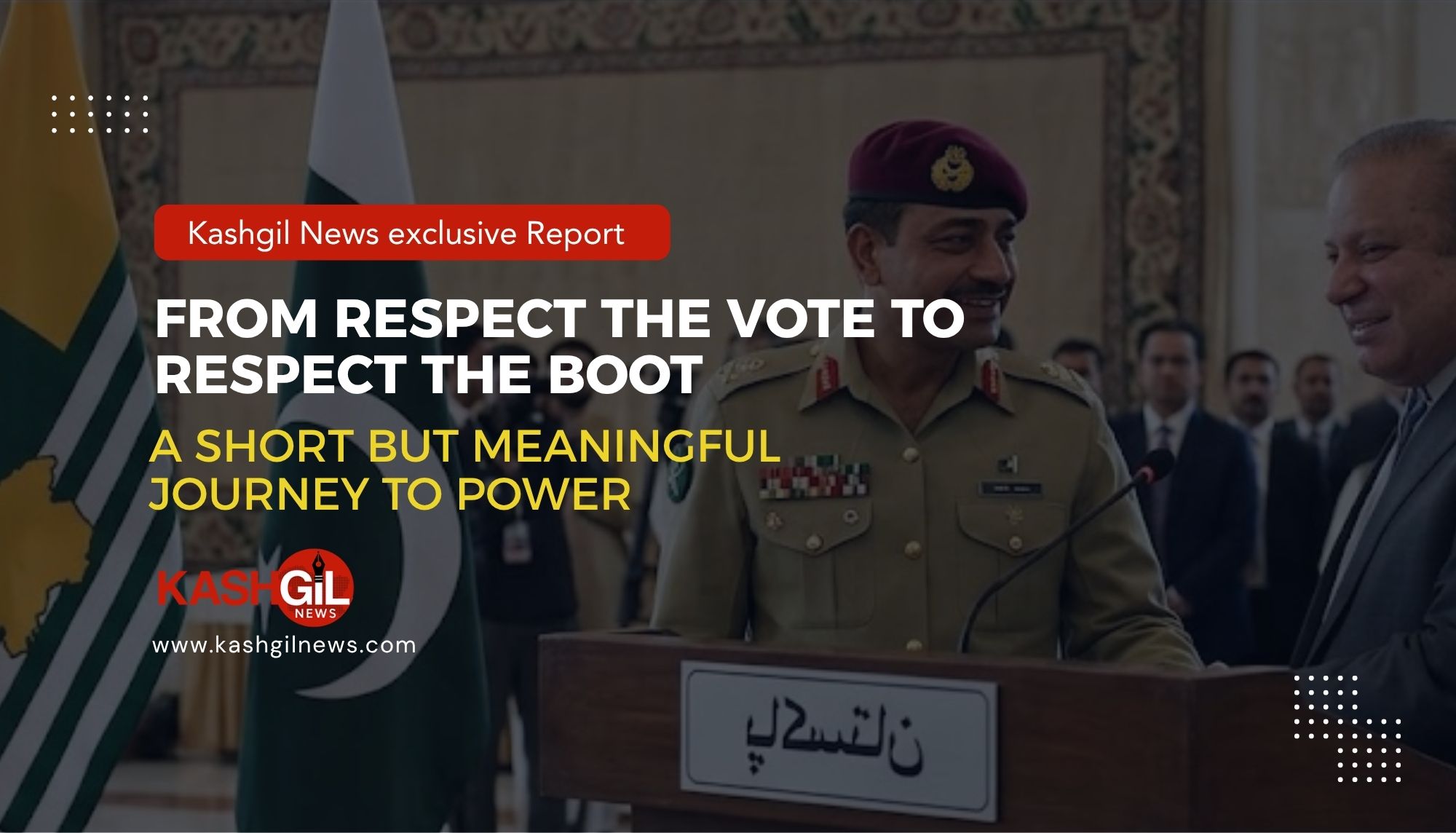
Looking at the recent political events, critics are sarcastically calling it a “short journey from Respect the Vote to Respect the Boot”.
A burden of more than 100 dead bodies?
Before the elections, the Pakistan Peoples Party government was in power and Faisal Mumtaz Rathore was the Prime Minister. During his rule, the movement for public rights intensified and the Joint Public Action Committee took the path of protests and long marches.
Promises and assurances were made between the government and the Public Action Committee on public demands, but despite the passage of the stipulated time according to the movement, they could not be implemented.
Later, the protest call, tension, use of force and various incidents plunged the entire region into a major political crisis.
The deaths during the movement further increased public anger. Critics say that Faisal Mumtaz Rathore bore the burden of a short term of office of more than 100 dead bodies, and left the House shaking hands with Barrister Iftikhar Gilani as soon as his term ended.
This is certainly a political sentence, but there is a very serious question behind it:
Who is responsible for the lives lost? And who will give a political and moral account of these incidents?
Elections and public anger
When the election phase began, the PML-N once again adopted the narrative of public mandate, vote and democratic authority.
But during the election campaign, it faced public questions at many points. The youth and citizens raised questions about what was the role of political parties when force was being used during the popular rights movement?
Somewhere voices of boycott were raised and somewhere political activists expressed their disinterest in traditional electoral politics.
Despite this, the electoral process moved forward and finally the government formation phase began.
Who is the Prime Minister? A public representative or a political arrangement?
After government formation, the biggest question was the candidate for the Prime Ministership.
Barrister Iftikhar Gilani’s name came up. Despite not receiving the mandate of the Prime Minister directly from the people in the general elections, he was elected Prime Minister after reaching the assembly through a technocrat seat.
From here, the political question deepened.
Should the post of Prime Minister be determined only by a numerical majority or should the public mandate, political struggle and sacrifices of workers also have some weight?
First speech and the silence of the Poonch, Sidhanuti
The first speech of the new technocrat Prime Minister also left many questions.
The law and order situation in Poonch and Sidhanoti districts and the recent political tension are a major issue in the region, but the absence of any mention of law and order in these two districts in the Prime Minister’s first speech came as a surprise to political circles.
Was it just a coincidence?
Or is the power of law and order still beyond the reach of the Prime Minister?
This question is also important because if a Prime Minister cannot speak openly about the most sensitive political and administrative crisis in his region, then the public is right to ask where the real power lies?
“Iftikhar Gilani is not from the PML-N”
Another impression is also circulating in political circles that Barrister Iftikhar Gilani is not a traditional political worker or organizational candidate of the PML-N, but has emerged as the elected representative of some other force.
Whether this impression is true or just a narrative of political opponents, time will tell. But if this impression continues to grow, it will be a big question for those workers within the PML-N who have stood with the party for years, fought elections, served jail terms, held rallies and endured political hardships.
Today, if a person bypasses all of them and gets the prime ministership who has been brought forward not through the party’s internal electoral process but through some other political arrangement, then the slogan of respecting the vote itself becomes a question in itself.
Their protocol, someone else’s decisions?
At this time, a sarcastic political phrase may be circulating rapidly:
“Their protocol, someone else’s decisions.”
The crowd of PML-N leaders and workers around the Prime Minister, the pictures, the handshakes and the scenes of them walking side by side may temporarily appear to be a symbol of power. But the real test in politics is not pictures, but authority.
Today, the leaders and workers who are getting their pictures taken with the new Prime Minister, it is possible that in the coming days, many of them will only be seen as spectators standing at a distance and applauding instead of influencing the Prime Minister’s decisions.
Because if the decisions are made elsewhere, then being present in the house of power and having the real authority of power are two completely different things.
The real test of democracy
A person can be elected Prime Minister through constitutional procedures. Votes can also be cast in the assembly and the government can also be formed. But democracy is not just a game of numbers.
Democracy is also the name of public trust, political mandate, workers’ opinions, respect for differences of opinion and autonomy in decisions.
If the decision taken elsewhere gains more importance than the people’s vote, then the question is not just about a prime minister, but about the credibility of the entire democratic system.
History will decide
The era of Faisal Mumtaz Rathore is over. Barrister Iftikhar Gilani has taken over. The faces in the House have changed, the protocol has changed, but the people’s questions are the same.
What will happen to the demands of the Public Action Committee?
How will peace be established in Poonch and Sidhnoti?
Who will account for the deaths in the recent incidents?
And above all:
Will the new government really make its own decisions?
If it does, what will be its practical stance on the public rights movement?
And if the decisions are made from somewhere else, then will the person sitting in the Prime Minister’s House be just the prime minister or also the real center of authority?
Today, the question is not about Barrister Iftikhar Gilani’s personality.
The question is about this system.
If the politics that once chanted the slogan “Give respect to the vote” were to abandon the public mandate and bow down to the decisions of power, history might remember this journey in a single sentence:
“A short journey from giving respect to the vote to giving respect to the boot.”
And the biggest question in this journey will remain:
Where do the people stand, and who has the real power?
٭٭٭
Share this content: