By: Farhan Tariq
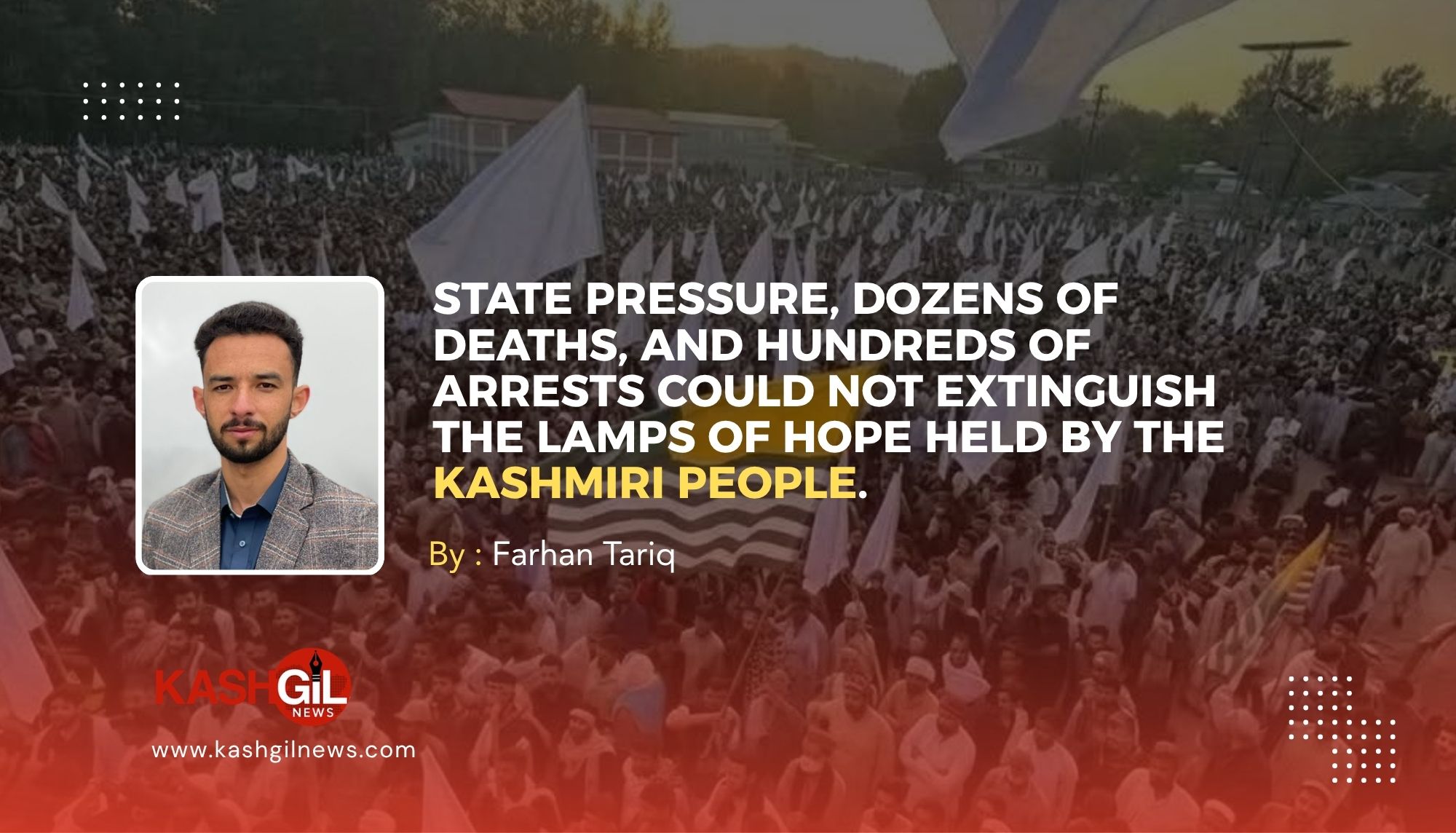
Three months have passed since the launch of the long march and sit-ins by the Jammu Kashmir Joint Awami Action Committee (JKJAAC)—an organization subsequently declared a proscribed entity—in Pakistan-administered Kashmir.
The movement for public rights, which emerged in the region in 2023, rose up against a local political elite and a system that had long operated under the guise of a seventy-year-old, obsolete democratic facade. It rapidly carved out a distinct place for itself among the public, challenging and exposing ruling classes—who had imposed themselves for generations while masquerading as saviors—and demanding accountability from them.
Three months ago, on June 9, the movement took a new turn when, in accordance with its announced plan, a long march began from Bhimber toward the region’s capital. This march was preceded by a prolonged series of crackdowns and arrests that began on June 5 and continues to this day.
September 9 marks the completion of three months of ongoing sit-ins in Poonch. The JKJAAC—declared a proscribed organization by the Government of Pakistan—issued a statement on September 5 calling for a region-wide shutdown strike on September 9.
Could such brutality and terror extinguish these flames of hope?
Although Poonch remains the epicenter of the sit-ins and protests, have the movement’s supporters in other parts of the region vanished? On the surface, and in visual imagery, the answer appears to be “yes.” However, we spoke with various segments of the population across the region; while they are unwilling to speak on camera, they affirm their support for the Action Committee, fearing arrest or violence should they go public. It is as if someone has smothered a spark with ash to stifle it—though a mere gust of wind could sweep that ash away at any moment, fanning the spark into a roaring flame. Only time will tell how this unfolds.
Who will light the lamps needed to dispel the darkness?
Whether traditional politicians or nationalists, the region’s leadership has long misled the public, keeping them chasing a mirage—much like a driver pursuing the distant tail-light of a truck heading toward Srinagar. At the behest of outsiders, attention was diverted from the region’s actual issues to focus on the “liberation of Srinagar,” while the youth on both sides of the ceasefire line were handed weapons, turning human blood into a plaything.
When marginalized groups united to question the seventy-year-old system and demand their rights, they were branded as agents hostile to the state. Yet, this three-year-long popular movement has laid the foundation for a “nursery” where the number of lamps—and the number of “traitors” daring to ask questions—grows day by day. The powerful, ruthless ruling class is frantically trying to blow out these lamps, only to face disappointment.
Three months of stifled screams, sobs, and a prolonged internet blackout!
While the internet shutdown—in effect since June 5 and 6—halted the flow of real-time information to the outside world, the raw reality of the situation could not be contained. Through various channels, the stifled screams and the voices of the people have pierced through the state’s veil of secrecy.
Share this content: