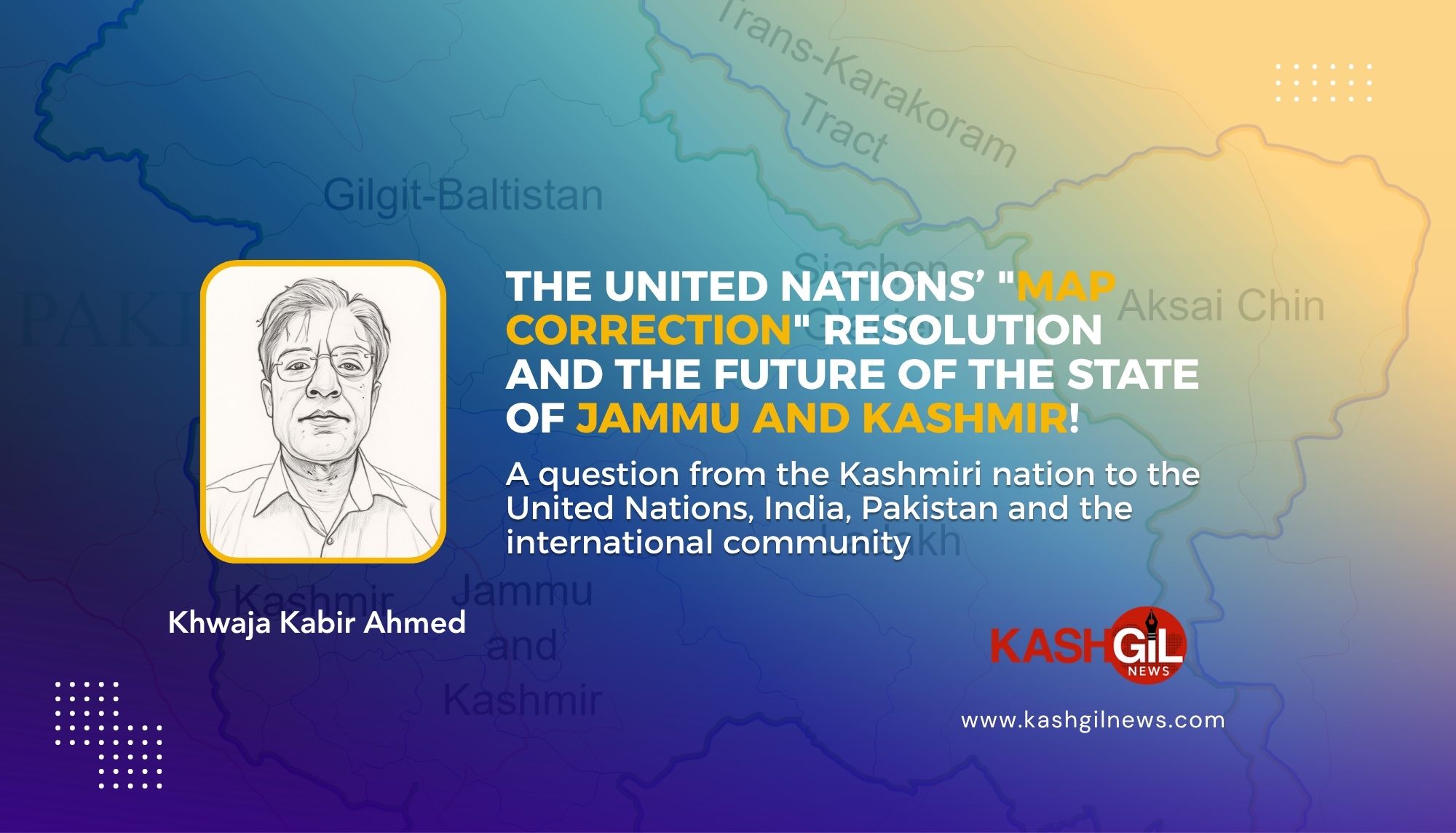
A question posed by the Kashmiri people to the United Nations, India, Pakistan, and the international community.
by: Khwaja Kabir Ahmed
A recent resolution aimed at “correcting the map of the world” has brought what appears to be a geographical and technical issue into the realm of global debate. However, in the context of the State of Jammu and Kashmir, this resolution has revived a fundamental question that has persisted in global politics, diplomacy, and international law for nearly eight decades: if it is deemed necessary to accurately depict the geographical reality of a region on the world map, then when will the political reality of that region’s people—and their right to determine their own future—be accurately acknowledged?
On September 4, 2026, the UN General Assembly adopted a resolution titled “Correct the Map.” Its primary objective was to depict the true surface area of various regions—particularly Africa—more accurately and in a balanced manner on world maps, and to promote equal-area mapping techniques. The resolution was passed with the support of 164 countries; the United States opposed it, while six nations abstained from the vote. Fundamentally, the resolution addressed the geographical issue wherein the centuries-old Mercator projection depicts polar regions as significantly larger than their actual size, while regions near the equator appear relatively smaller. The aim of the new equal-area mapping approach is to mitigate this imbalance. It is important to note that this resolution is not legally binding, nor did it alter the borders of any country or the final political status of any disputed territory. However, the significance of this matter for Jammu and Kashmir increased when India voted in favor of the resolution; subsequently, the Indian government clarified that its support did not imply an endorsement of any specific map or political boundary status. At the same time, India insisted on depicting Jammu and Kashmir and Ladakh in accordance with its official map and made it clear that there had been no change in its stance on the issue.
It is essential to clarify a fundamental point here, as there is a distinction between emotional political rhetoric and international legal reality. It would be incorrect to claim that this UN resolution has once again designated Jammu and Kashmir as a disputed territory. This is not a new political or legal resolution concerning Jammu and Kashmir. Similarly, it would be inaccurate to suggest that by merely voting for this resolution, India has formally acknowledged Jammu and Kashmir as disputed territory; India itself has rejected this interpretation and maintained its official position.
Yet, despite this legal nuance, it would be wrong to overlook the political significance of the event. For the people of Jammu and Kashmir, the core issue is not the color used to depict the region on a map, but rather who ultimately decides the state’s future.
The people of Jammu and Kashmir have consistently maintained a firm position: no part of the state—whether under the administrative control of India, Pakistan, or any other party—becomes the definitive political property of that party simply by virtue of administrative or military occupation. To the Kashmiri people, the entire state is a disputed territory; while every inch of the state may indeed be under the administrative or military control of one party or another, administrative occupation and ultimate political status are two distinct matters—and this distinction is the key to understanding the Kashmir issue. An army may occupy a territory, a government may administer it, and a country may designate a region as part of its territory in its constitution—while another country might label that same area as disputed—yet, despite all these claims, the fundamental question remains: what do the people of that region themselves desire regarding their political future? In the case of Kashmir, this very question has remained unresolved since 1947.
On January 20, 1948, the United Nations Security Council established a commission regarding the issue between India and Pakistan through Resolution 39; subsequently, Resolution 47, adopted on April 21, 1948, incorporated the restoration of law and order in Jammu and Kashmir and the question of a plebiscite into the United Nations’ agenda. Due to this historical background, the issue of Jammu and Kashmir has never completely disappeared from the United Nations’ records.
This is where the stance of the Kashmiri people becomes particularly significant. In their view, a state cannot simply become the property of a particular country merely because that country’s flag happens to be flying over a portion of it at a given time. Were that the case, many historical conflicts around the world would have been resolved permanently through the mere use of force. The history of international politics demonstrates that occupation, administration, and a final political settlement are three distinct matters.
The ceasefire line in Kashmir serves as an example of this reality. It is a practical military demarcation, yet it has never been recognized as a formal international border. Following the 1972 Simla Agreement, the ceasefire line was redesignated as the Line of Control; while both nations agreed to respect it, neither relinquished its respective claims.
Consequently, for the people of Jammu and Kashmir, the recent resolution regarding map-making raises a crucial question: if a map does not determine the final political status of a territory, how can a country’s official map definitively decide the future of that region? This question is addressed to India, Pakistan, and the international community alike.
India maintains that Jammu, Kashmir, and Ladakh are integral parts of its territory—a position it has upheld even after supporting the recent resolution. Pakistan, conversely, regards Jammu and Kashmir as a disputed issue and advocates for the Kashmiri people’s right to self-determination. Yet, for the people of Kashmir, a third and fundamental question arises amidst these two positions: if the future of Kashmir is to be determined, where does the free will of the Kashmiri people themselves figure into that decision? This is precisely where the recent resolution offers a political opportunity.
While it would be incorrect to label this a new United Nations resolution on Jammu and Kashmir, it can certainly be utilized as an opportunity to raise a fundamental question before the world. The global community has acknowledged the principle that a map should accurately reflect reality. The people of Kashmir might now ask: when will the political reality be accurately represented? If correcting a geographical error is essential, is it not equally important to accurately portray the political and human reality? If the misrepresentation of a region’s land area can be viewed as a global injustice, how can the disregard for the political aspirations of its people be deemed fair?
At this juncture, the issue of Jammu and Kashmir transcends a mere bilateral dispute between India and Pakistan, evolving into a matter concerning human rights, democracy, and the right to self-determination.
The people of the state of Jammu and Kashmir have always viewed their state as a unified political entity. To them, the demarcation line represents a barrier that has severed families, regions, and communities. On both sides of this line, there is a massive military and armed force presence, heavy weaponry, and a history of persistent tension; ordinary citizens have been paying the price for this conflict for decades.
It is also crucial that the human rights situation in Jammu and Kashmir not be portrayed in a one-sided manner. The United Nations human rights office has previously examined human rights issues in both Indian-administered and Pakistan-administered Jammu and Kashmir, while also noting differences in the nature and severity of the issues on either side. It is essential to acknowledge the principle that human rights standards do not change based on borders or flags; voices must be raised wherever fundamental human rights are violated.
Global concerns have frequently been voiced regarding civil liberties, arrests, the use of force, freedom of expression, and other human rights issues in Indian-administered Jammu and Kashmir. Similarly, questions have also been raised regarding political freedom, freedom of expression, the right to protest, and public rights in Pakistan-administered Jammu and Kashmir. In recent years, incidents involving fatalities, arrests, and communication restrictions during public protests in Pakistan-administered Jammu and Kashmir have made it clear that the human dimension of the Jammu and Kashmir issue is not one-sided.
There is a principled path available for the Kashmiri people: to raise their voices against violations in Pakistan-administered Jammu and Kashmir with the same intensity as they do against human rights violations in Indian-administered Jammu and Kashmir, and to speak out against abuses in the former just as they address issues in the latter. Such a principled stance can lend greater credibility to the Kashmiri voice on the global stage; the world does not merely look at who is speaking against whom, but rather at who is speaking up for principles. This is precisely where the responsibility of overseas Kashmiris becomes exceptionally significant.
The people living within the state of Jammu and Kashmir exist in a complex and sensitive environment. When there is a heavy presence of armed forces, when political dissent is sometimes viewed as a security threat, and when protests carry the risk of arrest, violence, or loss of life, it is not easy for the ordinary citizen to freely voice their views regarding their political future.
In such circumstances, Kashmiris living outside the state are not merely expatriates; they can become the voice of their compatriots back home—speaking out on matters that those within the region might not be able to articulate with full freedom.
The millions of individuals hailing from the State of Jammu and Kashmir who are settled across the globe—estimated to number between two and 2.2 million—have the potential to become a formidable human, political, and diplomatic force. However, this potential must not be confined merely to protests, slogans, and emotional speeches; overseas Kashmiris need to transform their collective strength into an organized, peaceful, democratic, legal, and evidence-based global campaign.
Kashmiris living in the UK, Europe, the US, Canada, and other democratic nations possess opportunities unavailable to those within the state itself. They can meet with Members of Parliament, initiate parliamentary inquiries, engage with human rights organizations, host seminars at universities and research institutions, publish articles in the media, produce documented reports, gain access to European and British institutions, and influence global public opinion. Yet, the prerequisite for this is a shift in the Kashmiri narrative.
Merely telling the world that “Jammu and Kashmir is ours” is insufficient. The world must be clearly informed about what the people of Jammu and Kashmir desire for their own future. This represents a fundamental distinction: the first statement asserts a claim of ownership, whereas the second addresses the rights of the people—and in the lexicon of global human rights, the latter carries far greater weight.
Overseas Kashmiris must anchor their campaign in the principles of human rights, political liberty, freedom of expression, peaceful assembly, a free press, and the right to self-determination. They need to convey to the world that the Kashmiri people do not seek war against the citizens of any other country, nor do they harbor hatred toward any nation; rather, they seek the right to make a free decision regarding their own political future. This is the language that the democratic world understands. At the same time, overseas Kashmiris must move their campaign beyond emotional slogans and ground it in evidence and research. If an individual has been arrested, details regarding the date, location, and legal status of the arrest should be known. If a life has been lost, there must be credible evidence regarding the victim’s identity, the location and date of the incident, and the circumstances surrounding it. If a journalist has been obstructed, authentic information regarding the incident should be provided. If the internet has been shut down, the dates and duration of the suspension should be documented and made public. While emotions can generate sympathy, global policy is shaped by evidence, research, and consistency. Pakistan also bears a significant responsibility in this regard.
Pakistan has historically recognized Jammu and Kashmir as a disputed issue and has consistently supported the Kashmiri people’s right to self-determination. However, if Pakistan truly upholds the principle that the Kashmiri people should have the right to decide their own future, then this principle must apply not only to the people of Indian-administered Jammu and Kashmir but also to those in Pakistan-administered Jammu and Kashmir. Pakistan must strengthen political freedom, freedom of expression, a free press, peaceful assembly, political activity, human rights, and the rule of law within the territories under its administration.
The strongest stance Pakistan could take before the world is to assert that the very right it demands for Kashmiris in Indian-administered territory is also enjoyed by Kashmiris in Pakistan-administered territory. This principle would not weaken Pakistan’s position; rather, it would significantly strengthen it. India, too, bears a clear responsibility.
If India upholds the principles of accurate representation of geographical reality, territorial integrity, and map accuracy, it must also address issues concerning human rights and political freedom in Jammu and Kashmir in accordance with those same democratic standards. Instead of viewing dissent merely as a security issue, it is essential to create space for political dialogue, respect international human rights standards, allow journalists and human rights activists to operate, and safeguard the right to peaceful political expression.
India may claim Jammu and Kashmir as its own, and Pakistan may do the same; however, a fundamental democratic principle must apply equally to both: ordinary citizens have the right to hold opinions regarding their political future and to express them peacefully.
The responsibility of the United Nations is even more critical.
The United Nations has formally acknowledged the issue of Jammu and Kashmir in its historical records. There are Security Council resolutions, UN documents, and reports from the human rights office concerning the region. Therefore, the UN cannot dismiss Jammu and Kashmir as merely a forgotten historical issue.
It is incumbent upon the United Nations not to ignore the issue, but to independently monitor the human rights situation, strive to de-escalate tensions between the two nations, advocate for effective access to monitor human rights, and help create conditions where the people of Jammu and Kashmir can express their views on their political future free from fear and coercion. The right to self-determination is not merely an abstract concept; if people are denied the freedom to express their opinions, the practical significance of self-determination is lost.
The European Union also bears a significant responsibility. The EU upholds human rights, democracy, and the rule of law as its core values; consequently, it should apply the same standards to the situation in Jammu and Kashmir. It must not overlook issues of human rights, political freedom, and peaceful political processes in its political and trade relations with either India or Pakistan.
The European Parliament and European institutions can keep the debate on the human rights situation in Jammu and Kashmir alive, prioritize reports from human rights bodies and independent sources, and urge both India and Pakistan to move towards a peaceful political solution while respecting human rights and the political aspirations of the Kashmiri people.
It is also the responsibility of global human rights organizations to champion the cause of humanity rather than advocating for any single country.
Bodies such as Amnesty International, Human Rights Watch, the UN Human Rights Office, and other credible institutions should impartially monitor the human rights situation on both sides; compile verifiable documentation regarding political prisoners, arrests, torture, enforced disappearances, civilian casualties, freedom of expression, the press, peaceful assembly, and communication restrictions; and hold governments accountable based on these findings.
The global media also bears a responsibility not to report on Jammu and Kashmir only when India and Pakistan are on the brink of war. Jammu and Kashmir is not defined solely by missiles, cross-border firing, and military tensions; it is home to millions of people—people with homes, children, schools, livelihoods, and dreams—who possess the right to hold opinions about their own future.
International media outlets should provide a platform for the voices of the Kashmiri people and present the Kashmir issue not merely as a conflict between two nuclear-armed states, but as a humanitarian, political, and democratic matter. However, the Kashmiri leadership also bears significant responsibility in this regard.
Kashmiri political parties, organizations, and movements must understand that a difference of opinion is a part of democracy, not a cause for hostility. There may well be disagreements among various political movements in Kashmir regarding the ultimate future solution; some may seek complete independence, others autonomy, some might prefer accession to a particular country, while others may desire a different political arrangement altogether. However, despite all these differences, it is possible to agree on one fundamental principle: the political future of the Kashmiri people should be determined not by guns, force, occupation, or coercion, but by the free political will of the people themselves.
This shared minimum principle can provide Kashmiris with a strong and coherent political voice on the global stage.
The time has come for overseas Kashmiris to redefine their role. An annual demonstration, a few speeches, and some emotional social media posts will no longer suffice. There must be sustained political engagement in every country. Informative briefings regarding Jammu and Kashmir should reach every parliament. Substantiated cases must be presented to every human rights organization. Journalists should be provided with documented evidence. Research within universities and think tanks should be encouraged. Furthermore, Kashmiri organizations across the globe should collaborate on a shared, minimum humanitarian and democratic agenda rather than working at cross-purposes.
The core message of this global campaign should be neither anti-India nor anti-Pakistan, nor directed against any specific nation; rather, it should be humanitarian, democratic, and principled.
The message must be that the Kashmiri people have the right to freely express their views regarding their own future.
It is also essential for the Kashmiri people and their leadership to align their political demands with universal human rights principles. If a Kashmiri demands freedom of expression, they must acknowledge that same right for everyone else. If they seek the right to peaceful protest, they must recognize that same right for those holding opposing political views. If they raise their voices against human rights violations, they must apply this principle to both sides.
It is this moral high ground that constitutes the true strength of any national movement.
The recent resolution regarding the mapping of the region also needs to be viewed through this same realistic lens. This is not a new, decisive resolution regarding Jammu and Kashmir; nor has it nullified India’s claim, legally altered Pakistan’s stance, or determined the future of the state of Jammu and Kashmir. However, it has certainly sparked a global discussion: a map is not merely a set of lines drawn on paper, but a means of understanding reality. If a map is incorrect, efforts are made to rectify it. The people of Kashmir are, therefore, justified in asking: if the world values accuracy in geographical representation, is accuracy in political representation not equally important? If it is essential to accurately depict a region’s actual territory, is it not equally essential to properly heed the political aspirations of its actual inhabitants?
And if India itself maintains that the recent resolution does not determine the legal status of a disputed region, then the same principle should apply to Jammu and Kashmir: simply depicting an area in the colors of a particular state on a map does not, in itself, determine that region’s final political status.
This is where hope arises for the people of Kashmir—though that hope must be realistic. It should not be the hope that a single resolution has liberated Kashmir.
Rather, the hope should be that the fundamental question of Jammu and Kashmir remains alive, and that it can once again be presented to the world in a manner that is more robust, civilized, well-documented, and principled.
The issue of Jammu and Kashmir will not be resolved by a single resolution—nor by any single statement from India, declaration from Pakistan, protest, or global conference. It requires a long-term struggle encompassing political, human rights, diplomatic, legal, and grassroots efforts.
Perhaps the most pivotal role in this struggle belongs to those Kashmiris living outside the state. While a Kashmiri residing within the state might not be able to raise their voice with full force in the face of the gun, those living abroad possess the freedom to reach out to the British Parliament, the European Parliament, the US Congress, the Canadian Parliament, human rights organizations, universities, the media, and global civil society.
This is a historic responsibility.
If the two to two-and-a-quarter million overseas Kashmiris were to organize themselves—rising above factional and personal differences to unite, at the very least, on the agenda of human rights and the right to self-determination; if they approached the world with evidence and research rather than emotional slogans; if they applied the same human rights standards to both India and Pakistan; if they steered clear of fake news and transformed their campaign into sustained diplomatic and political engagement—then the voice of Jammu and Kashmir would undoubtedly gain new strength in global politics. Compelling the world does not mean pressuring it; it means persuading it.
And the most powerful weapon for persuasion is not the gun, but reason; the most effective medium is not hatred, but human rights; the strongest language is not threats, but democracy; and the most credible argument is not an emotional claim, but irrefutable evidence. Ultimately, the question remains: maps can be redrawn, borders demarcated, armies deployed to control territories, and governments can enshrine claims in their constitutions—yet the hearts and minds of a region’s people cannot be altered by the colors on a map. For the people of Jammu and Kashmir, the fundamental question persists: who will decide their future—India, Pakistan, or the people of Jammu and Kashmir themselves? If the answer is India, the question posed by the Kashmiri people remains. If the answer is Pakistan, that question still persists. However, if the answer is that the people of the State of Jammu and Kashmir should have the right to decide their future in a free, non-coercive, and democratic manner, then it becomes the responsibility of every democratic institution and human rights organization worldwide to help create an environment where this right is not merely a slogan but a tangible political reality.
The recent resolution regarding mapping did not settle the issue of Jammu and Kashmir, but it did bring a crucial question back to the forefront—one that cannot easily be ignored: if the world can correct a map, will it also attempt to address the unresolved questions of history, politics, and justice that have persisted for eight decades? Perhaps the most compelling answer to this question can come from the millions of overseas Kashmiris; living in the free world, they can become the voice for their compatriots back home—people whose voices remain stifled on both sides of the Line of Control by the shadow of guns, political pressure, and fear.
The issue of Jammu and Kashmir is not merely about who holds territorial control; the fundamental question is who should decide the future of the people inhabiting this land. If democracy, human rights, and the right to self-determination are indeed universal principles, then the true test of these principles lies where the voice of the people has been most suppressed. While the State of Jammu and Kashmir may appear divided on the map, the fundamental question facing its people remains undivided. It persists today just as it always has: why should decisions regarding our state, our land, and our ownership be made without our consent? And when will we be granted the recognized right to determine our own future?
Share this content: