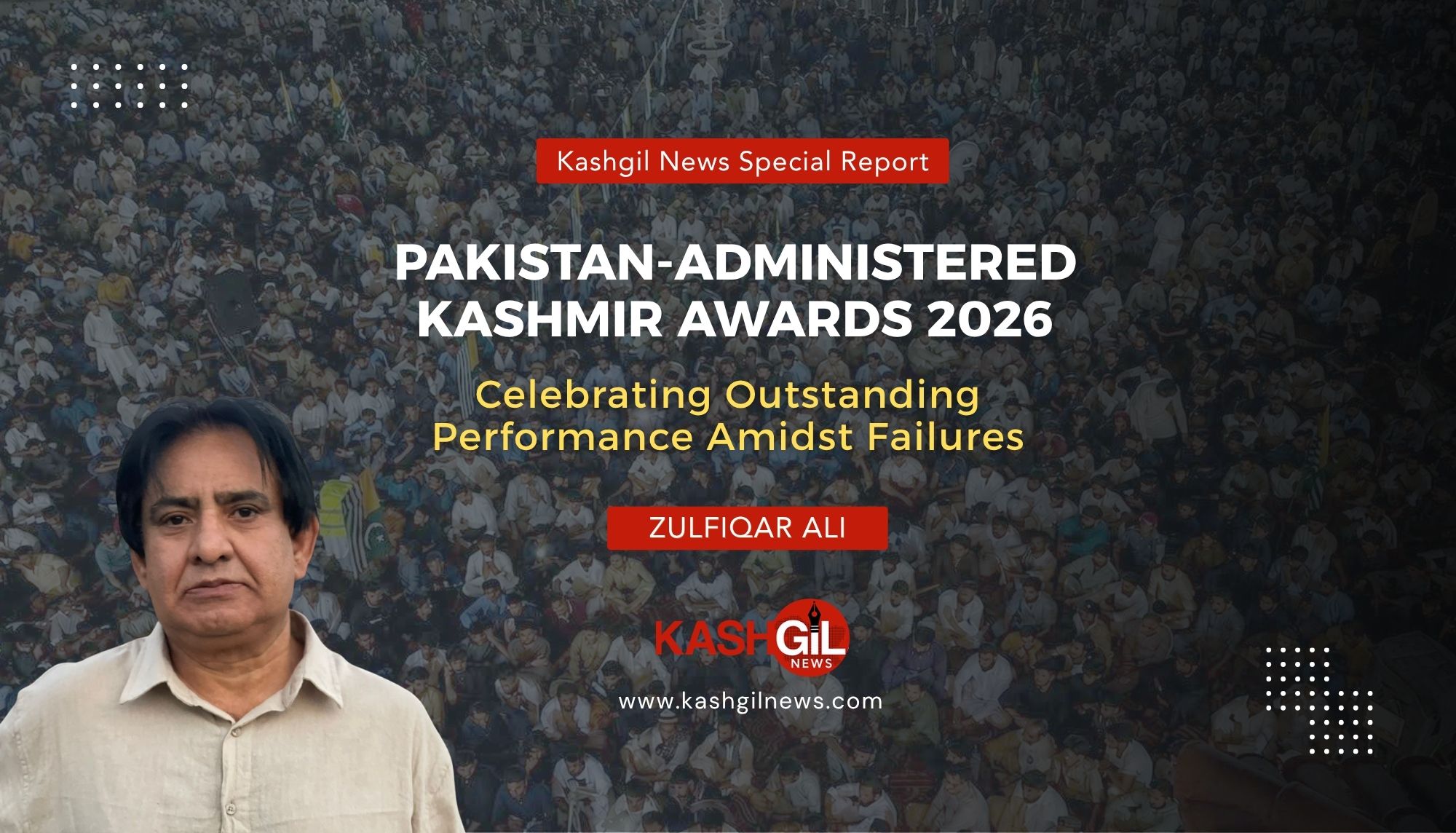
Zulfiqar Ali
(Former BBC Journalist/Correspondent)
A Satirical Review of Governance, Public Spending, Accountability, and Public Services
A unique set of “awards” has been organized in Pakistan-Administered Kashmir—not to celebrate success, but to highlight long-standing governmental failures, administrative decay, and the persistent neglect of public issues. This satirical review sheds light on chronic regional problems—issues that critics have repeatedly pointed out—where public funds are continuously spent and endless promises are made, yet there is absolutely no sign of accountability or answerability.
In this comprehensive report, former BBC journalist and correspondent Zulfiqar Ali exposes the vast chasm between the region’s costly political system—characterized by questionable spending priorities, political patronage, and weak public services—and the harsh realities of daily life faced by the general public, which stand in stark contrast to official government claims.
- Public Spending and Development Projects: A 200-Billion-Rupee System and a Helpless Public
The region’s administrative and political apparatus spends approximately 200 billion rupees annually—solely on salaries, allowances, pensions, and administrative overheads—while the general population remains deprived of basic amenities.
Financial Dependence: Due to insufficient internal revenue, the system relies entirely on the Government of Pakistan and the resources of Pakistani taxpayers to cover its expenditures. Last year, a mere 620 million rupees in revenue was generated from seven key sectors—including agriculture, minerals, tourism, and forestry—while 5.5 billion rupees were spent on salaries within these same sectors.
Muzaffarabad vs. Islamabad: Despite Muzaffarabad holding the status of capital, a significant portion of government affairs is conducted from ‘Kashmir House’ in Islamabad, where government buildings and the Kashmir Council’s lodges are allegedly used for personal and private purposes.
Development Funds: There are serious questions regarding the utilization of grants provided by Pakistan for infrastructure and the Public Sector Development Program (PSDP). In reality, apart from projects in earthquake-affected areas, general development initiatives exist only on paper.
- Political and Administrative Performance: Unconstitutional Appointments and Immunity from Accountability
The report highlights flaws in the political and administrative structure, labeling the procedures for attaining the positions of Prime Minister, Assembly Speaker, and Acting President as ‘unconstitutional.’
Corruption and the Erosion of Merit: Merit has been disregarded in government appointments, with favoritism based on kinship (cronyism) and political patronage taking precedence. The alleged misuse of ‘secret funds’ and corruption are rampant, yet there is no effective system of accountability.
Detachment from the Public: While critical public issues remain unresolved, government officials continue to undertake foreign trips. Ordinary citizens are being crushed by inflation and the economic crisis, whereas the elite enjoy lavish motorcades and lifelong privileges. Restrictions on Freedom of Expression: Legal amendments have been introduced under which those who criticize the ruling elite can face up to seven years in prison and fines. This suggests that criticism is perceived as a greater threat than poor governance itself.
- Destruction of Land, Forests, and the Environment
The region’s valuable natural resources are being systematically degraded:
Alleged Encroachments: Serious instances of land grabbing have been reported, involving abandoned properties left by migrants, forest lands, state-owned land (Khalsa Sarkar), and Waqf (endowment) properties.
Deforestation: The indiscriminate felling of valuable Deodar, Kail, and Fir trees continues. The timber-smuggling mafia allegedly enjoys the backing of the political establishment.
Environmental Crisis: There is mounting pressure on tourist destinations, forests, and glaciers; yet, the government treats environmental protection as a low priority.
- Decline in Education, Healthcare, and Public Services
Crisis in the Education System: Rather than improving the quality of education, the system has been reduced to a tool for political patronage and the distribution of government jobs. Statistics indicate that 71 percent of students failed their ninth-grade examinations. In many schools, staff are present, but there are zero students; in others, there is a complete lack of proper infrastructure or laboratories.
Healthcare and Basic Amenities: Healthcare centers exist largely on paper, lacking both essential medicines and medical equipment. Eighty percent of the population in the capital, Muzaffarabad, lacks access to clean drinking water, while the city itself has been allowed to turn into a heap of garbage. Furthermore, the promised ‘green electric bus service’ has failed to materialize on the roads.
- Employment, Poverty, and Inflation
Approximately half of the region’s population lives in poverty. Through the Benazir Income Support Programme (BISP), millions of families are forced to rely on financial assistance.
Meanwhile, the general public is crushed under the burden of inflation; yet, government-subsidized wheat—intended for ordinary citizens—is instead distributed among the President, ministers, assembly members, and the bureaucracy. This practice has also given rise to corruption scandals involving billions of rupees.
- The Kashmir Cause and Specialized Institutions
The final section of the report criticizes institutions established in the name of the “Kashmir Cause”—such as the Jammu and Kashmir Liberation Cell and the Kashmir Policy Research Institute. Critics argue that these entities serve merely as a means to reward supporters of the ruling parties, providing them with salaries, luxury vehicles, and pensions.
The bitter reality is that this system—which uses the “Kashmir Cause” to reward political loyalists—compels the public to ask a fundamental question: what has actually been done to achieve the right to self-determination?
Conclusion
Governments change, ministers and officials come and go, promises are made, committees are formed, and new projects are announced—yet the questions remain:
Where is the money going?
Who is responsible?
Who will be held accountable to the public?
And when will there be any real improvement in the lives of ordinary citizens?
In Pakistan-administered Kashmir, these “awards” may be satirical in nature, but the questions they raise are not a joke—they represent a grave reality.
Share this content: