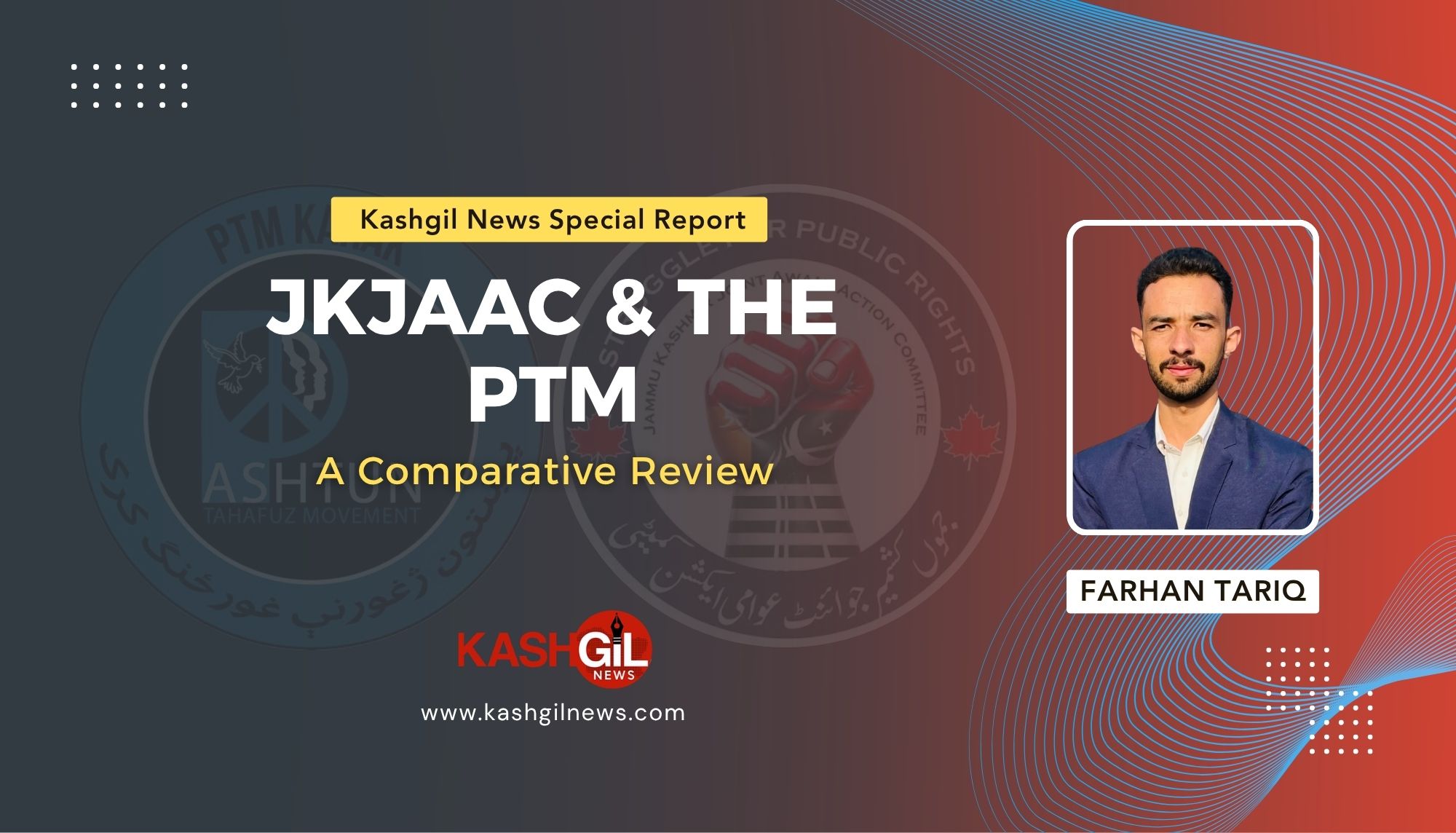
by : Farhan Tariq
Whether it is Pakistan-administered Kashmir or the tribal areas of Khyber Pakhtunkhwa, both have served as major hubs for proxies and state-sponsored jihadist activities. In both regions, one has frequently heard the state employ the terms “good” and “bad” mujahideen (militants).
Those who claim to be the spokespersons and saviors of the major tribes in the tribal areas and in Pakistan-administered Kashmir—such as the Sudhans, Abbasis, Jats, Chaudhrys, Mughals, and Rajas—often appear to be on favorable terms with government circles and the military establishment.
Mahsud Tahaffuz Movement, Local Action Committees, and People’s Rights Forum
Prior to the formation of the PTM, students displaced in 2013 initiated a grassroots movement in South Waziristan, demanding the protection of life and property for members of the Mahsud tribe. Led by Manzoor Pashteen—a vocal advocate for human rights—the Mahsud Tahaffuz Movement (MTM) demanded the clearing of landmines from Mahsud territory, impartial investigations into the enforced disappearances of tribal individuals, and the prosecution of those responsible.
Similarly, between 2020 and 2021, various local-level organizations—such as “Action Committees” and the “People’s Rights Forum”—emerged across different districts of the Poonch Division in Pakistan-administered Kashmir. Initially, their demands concerned issues such as the construction of local school buildings and roads; however, over time, these demands evolved into a broader movement for civil rights.
From Naqeebullah Mehsud to Shazeb Habib, and from Rao Anwar to Liaquat Malik
History shows that state-sponsored oppression and violence often serve to strengthen movements rather than suppress them.
In early January 2018, Naqeebullah Mehsud—an internally displaced person (IDP) living in Karachi—was killed on suspicion of having ties to the Taliban. The then-police officer, Rao Anwar, was accused of this extrajudicial killing. The Muttahida Qaumi Movement (MQM) has also held Rao Anwar responsible for the deaths of thousands of its own workers. Conversely, Pakistan Peoples Party leader Asif Ali Zardari once described Rao Anwar as one of those “brave boys” who survived the fight against the MQM.
Following the killing of Naqeebullah Mehsud, the Mehsud Tahaffuz Movement (Mehsud Protection Movement) leveraged extensive media coverage to draw attention to the violation of their rights. Activists seeking justice for Naqeebullah organized a long march from Dera Ismail Khan to Islamabad. Covering a distance of approximately 300 miles, the caravan passed through various cities in Khyber Pakhtunkhwa and Punjab. Along the way, other Pashtuns from neighboring districts joined the movement in their support. When this caravan reached the provincial capital, Peshawar, it was decided to rename the movement from ‘Mahsud Tahaffuz Movement’ to ‘Pashtun Tahaffuz Movement’ (PTM), as its objective was the protection of all Pashtuns—not just the Mahsud tribe. Thus, a movement that began under the leadership of a single individual evolved into a voice for the rights of the entire Pashtun nation.
Similarly, on the night between June 5 and 6, the government of Pakistan-administered Kashmir declared the ‘Jammu Kashmir Joint Awami Action Committee’ (JAAC) an outlawed organization, triggering a crackdown against its leadership. In the area of Khai Galla—approximately eight kilometers from Rawalakot—Umar Nazir Kashmiri, a core member of the JAAC, was targeted by gunfire from unidentified masked individuals. He sustained injuries, while his close associate, Shazib Habib, was killed.
This was a moment when the public across the region collectively expressed their outrage, breathing new life into the JAAC’s long-standing movement.
Five years later, the court acquitted Rao Anwar. Following this, he asserted that the individual who had been killed was named Naseem—not Naqeeb—and that the photograph circulated in the media did not belong to that person. According to him, the deceased was a wanted fugitive who had been officially declared an absconder in 2016.
A similar line of reasoning was offered by the Inspector General of Police in Pakistan-administered Kashmir, following an operation conducted by security forces regarding the custody of Shazib Habib’s body. When a reporter from an international media outlet asked how many civilians had been killed in the operation, the Inspector General maintained that one police officer had been martyred, while two wanted suspects—both with criminal records—had been killed after opening fire on the police. According to him, the protesters were not peaceful but rather a violent mob. Furthermore, he repeatedly demanded that the journalists provide evidence regarding the civilian casualties.
Not a single splash upon your hem, nor a single stain upon your blade! Whether you commit murder or perform a miracle—it is all the same to you.
Allegations of Foreign Funding: The Chief Minister of Khyber Pakhtunkhwa and Pakistan-Administered Kashmir
On May 26, 2019, an incident occurred at a checkpoint in the Boya area of North Waziristan. Mohsin Dawar and Ali Wazir, accompanied by their supporters, were en route to stage a sit-in when a clash broke out with military personnel at the checkpoint. Conflicting claims regarding the number of casualties on both sides emerged following the incident.
A few months later, the Chief Minister of Khyber Pakhtunkhwa—who had previously labeled PTM activists as “Afghan agents”—arrived bearing a cheque for 2.5 million rupees. It was acknowledged on this occasion that the death toll at the checkpoint was significantly higher than the figures initially reported.
Similar circumstances unfolded in Pakistan-Administered Kashmir, where ministers from the coalition government held a press conference in Islamabad. Waving a “cipher” (a coded diplomatic dispatch), they alleged that the Jammu Kashmir Joint Awami Action Committee (JAAC) was receiving funding from India. However, this narrative—centered on the cipher—did not even last a few days, as it faced intense criticism from the region’s populace on social media.
Subsequently, the JAAC announced a “long march” to press for its demands. In September 2025, clashes between JAAC activists and the police resulted in the deaths of several police personnel and activists. Following this, the government—for the second time—distributed cheques worth millions of rupees among the families of the JAAC activists who had been killed or injured. In a striking contradiction, while the authorities were labeling the movement’s activists as “agents” and “traitors,” they were simultaneously distributing financial aid checks as compensation for these very deaths.
From National Channels to Social Media
Following the killing of Naqeebullah Mehsud, the ‘Mehsud Tahaffuz Movement’—and subsequently the PTM (Pashtun Tahafuz Movement)—received significant coverage in Pakistan’s national media. Over time, however, space for PTM’s activities in the national media became increasingly restricted; coverage of their gatherings and operations all but ceased. Faced with this situation, the PTM turned to social media to sustain its activities.
In contrast, the ‘Jammu Kashmir Joint Awami Action Committee’ had only limited access to national media from the very outset. Consequently, social media became the primary hub for its messaging—a platform the state, despite its best efforts, could not entirely suppress.
National Symbols of Resistance Movements
History has repeatedly shown that seemingly trivial objects can, at times, evolve into powerful symbols for nations and movements.
During the PTM’s first long march in Islamabad, police seized money from one of the activists. Upon learning of the incident, Manzoor Pashteen took the activist’s cap and placed it on his own head. Featuring a combination of red, white, and black, this cap has since become a symbol representing the Pashtun people.
Similarly, during a long march in 2024 in Pakistan-administered Kashmir, a group of young men from Poonch adopted sticks—cut from a local thorny tree known as Tambar—as a symbol of resistance. Before long, these sticks became the defining emblem of the movement. On September 24 and 25, 2025, Federal Minister Dr. Tariq Fazal Chaudhry remarked that attempts were being made to intimidate the state by brandishing sticks. The minister perhaps overlooked historical scenes—such as those at the Race Course Ground in Dhaka, where hundreds of thousands of Bengalis held bamboo sticks aloft. These sticks were not intended for combat but served as a symbol of resistance—a detail also noted by Sagheer Salik in his book, Main Ne Dhaka Doobtay Dekha (I Saw Dhaka Sinking).
Proscription of the PTM and JEC
On October 6, 2024, during the tenure of the Pakistan Muslim League-Nawaz (PML-N) administration, the government banned the Pashtun Tahafuz Movement (PTM), citing an “anti-state narrative.” The government alleged that the PTM maintained links with the Tehrik-i-Taliban Afghanistan and the Tehrik-i-Taliban Pakistan (TTP).
In response, Manzoor Pashteen, the leader of the Pashtun Tahafuz Movement, stated in various interviews that while Pashtuns were being killed and his movement was demanding the elimination of the Taliban, the state was actively pursuing a policy of distinguishing between “good Taliban” and “bad Taliban.” According to him, the PTM advocates for a peaceful struggle and has opposed “Talibanization” since its very inception.
Similarly, on the night of June 5–6—at a time when the PML-N and the Pakistan Peoples Party (PPP) held power in Pakistan—a coalition government comprising these same parties in Pakistan-administered Kashmir declared the JEC an outlawed organization.
From “Da Sang Azadi Da” to “Awaaz Do, Hum Ek Hain”
During the ‘War on Terror,’ reports frequently emerged regarding state operations targeting militants and casualties resulting from drone strikes. Over time, however, accounts of women and children—perishing beneath ash and rubble—began to surface, amplified through microphones and social media. Many individuals whose families had been affected by these operations eventually joined this movement.
From Swat to Quetta, Pashtuns began to emerge with a unified identity. The robust participation of women and youth in public gatherings, processions, and long marches challenged the prevailing narrative that characterized Pashtun society as inherently conservative. In this context, the phrase “Da Sang Azadi Da” (What kind of freedom is this?) became a pivotal slogan for the PTM (Pashtun Tahafuz Movement).
Similarly, the people of Pakistan-administered Kashmir have long endured poverty, exploitation, economic displacement, and systemic deprivation. The ruling establishment and local authorities kept them effectively “on a train bound for Srinagar”—a metaphor for being kept in a state of perpetual, unfulfilled longing—while simultaneously fragmenting them along the lines of caste and clan. Whenever they demanded their rights, they were branded as “agents” and “traitors.”
Women have been involved in the protests organized by the JAAC (Jammu Kashmir Joint Awami Action Committee) since the very beginning; for the past four months, they have been participating in a sit-in in Rawalakot, standing shoulder-to-shoulder with men. The JAAC adopted the slogan “Awaaz Do, Hum Ek Hain” (Raise your voice; we are one), which soon resonated from Bhimber to Neelum. Consequently, this slogan became a defining hallmark of the Jammu Kashmir Joint Awami Action Committee.
From ‘Child’ to ‘Pampered Child’
Initially, some of the PTM’s demands were accepted—much like how demands were met through three separate agreements with the JAAC (Jammu Kashmir Joint Awami Action Committee). At the outset, the military also conceded to certain demands made by the PTM, in a manner similar to the assurances given to the core members of the Jammu Kashmir Joint Awami Action Committee.
Later, the Corps Commander in Peshawar remarked at an event that Manzoor Pashteen is “our child,” adding that even if he is angry, they would still listen to him.
A similar sentiment was recently expressed by the spokesperson for the military’s public relations wing, who referred to Kashmir as “our pampered child.”
It seems the “child” has now become a “pampered child.” How this pampered figure will be treated remains to be seen; only time will tell.
Peaceful Struggle and the State’s Refusal to Negotiate
Both the JAAC and the PTM maintain that they believe in a struggle based on non-violence, whereas the state has consistently accused both groups of being involved in violent activities.
On the other hand, the state has adopted a peculiar stance: it refuses to engage in negotiations with these movements. This is despite the fact that the very same state has previously held talks with a wide array of parties—ranging from Sufi Muhammad and the Afghan Taliban to various groups involved in militant operations within the country.
Why, then, is there an avoidance of negotiations with those who are striving to achieve their demands through peaceful means?
Share this content: