Book Review
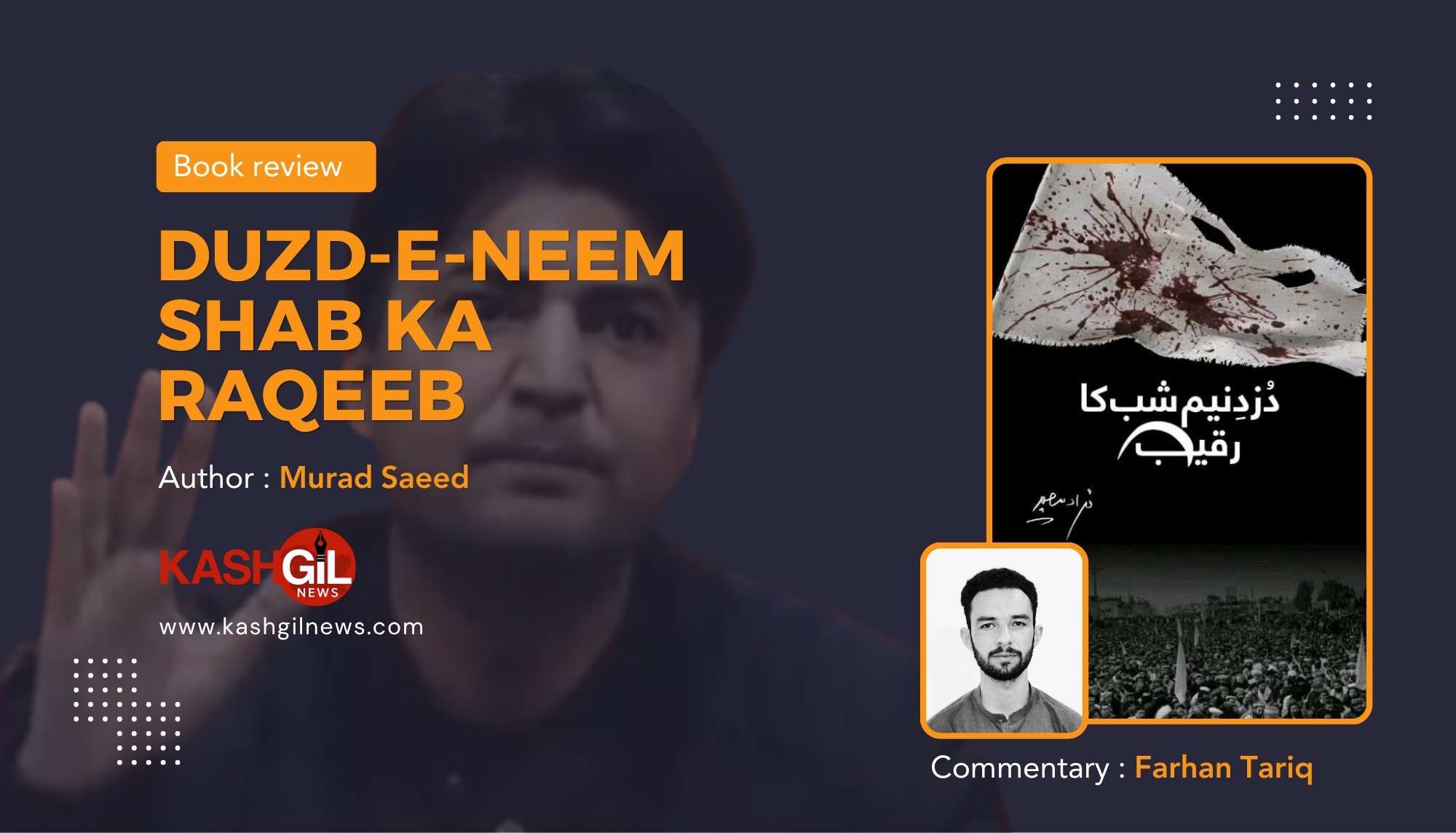
Book: Duzd-e-Neem Shab Ka Raqeeb
Author: Murad Saeed
Commentator: Farhan Tariq
Murad Saeed’s “Duzd-e-Neem Shab Ka Raqeeb” is a detailed book of 384 pages, which is currently not easily available in the Pakistani market. The book is divided into four parts, in which the author combines personal observations, political experiences and national conditions.
The book is attributed in a very emotional and symbolic way. The author attributes it to his “first reader”, the person who inspired him to write. At the same time, he pays tribute to his mother and the countless mothers whose sacrifices do not find a place in the formal narratives of history, but in reality they are the foundation of nations.
Part One: Migration, Terrorism and State Narrative
The first part of the book revolves around the era of terrorism in Khyber Pakhtunkhwa, military operations and their effects. According to the author, the region was in the grip of war for a long time, where military operations sometimes seemed to add complications rather than solve problems.
Murad Saeed also criticizes the national media for how some analysts portrayed the victims as suspicious. He examines the ongoing operations in Waziristan, Khyber Agency and Swat, the local resistance and the complexities of the situation in detail.
The author describes these wars as “dollar wars” and takes the position that they have badly affected the lives of the local population.
Swat: From Peace to Chaos
The book tells a complete story about Swat. The author reminds us that Swat was once a peaceful tourist area, where the culture of weapons was almost non-existent. However, after the rise of Sufi Muhammad and later Mullah Fazlullah, the situation changed completely.
Initially, Sufi Mohammad enjoyed public support because he claimed to provide speedy justice. People, who had been going through the courts for years, were impressed by his system. But over time, this system turned into oppression, with restrictions on TV dishes, clothing and other social freedoms being imposed, and extortion becoming common.
The author raises the question:
How was Sufi Mohammad allowed to go to and return from Afghanistan?
Where was the state when militancy was on the rise?
Why was action not taken despite Mullah Fazlullah’s growing influence?
Operations and human tragedy
According to Murad Saeed, civilians were the most affected during military operations. Mortar shells, airstrikes and displacement devastated thousands of families. He also laments the fact that the loved ones of the victims were sometimes portrayed in the media as terrorists.
According to the author, on some occasions, despite the Taliban and security forces’ checkpoints coming face to face, the operations were carried out on the civilian population, which raised doubts and questions.
Part Two: Political Changes and Tragedies
The second part of the book covers the situation after the 2013 elections. It covers topics such as the Army Public School tragedy, the protests of the people of Waziristan, Imran Khan’s speeches at the United Nations, and the changing role of the establishment.
Part Three: Regime Change and Policy Changes
The third part highlights the narratives of “regime change”, the change in General Bajwa’s stance, and the efforts to bring back the Taliban. The author critically examines these policies and questions whether these measures were in the country’s interest or not.
Part Four: Cipher, Political Tensions, and Recent Events
The final part covers recent political events, including the cipher controversy, the change of government, the Zaman Park incidents, and the growing political tension.
Conclusion
“Duzd-e-Neem Shab Ka Raqeeb” is not just a political book but a narrative, a narrative that describes the complex relationships between the state, war, politics and the people. Murad Saeed has raised several important questions in the light of his experiences and observations, the answers to which are left to the reader to find.
This book is of particular importance to those readers who want to understand the recent political and social history of Pakistan from a different perspective.
٭٭٭
Share this content: