Kashgil News Exclusive Report
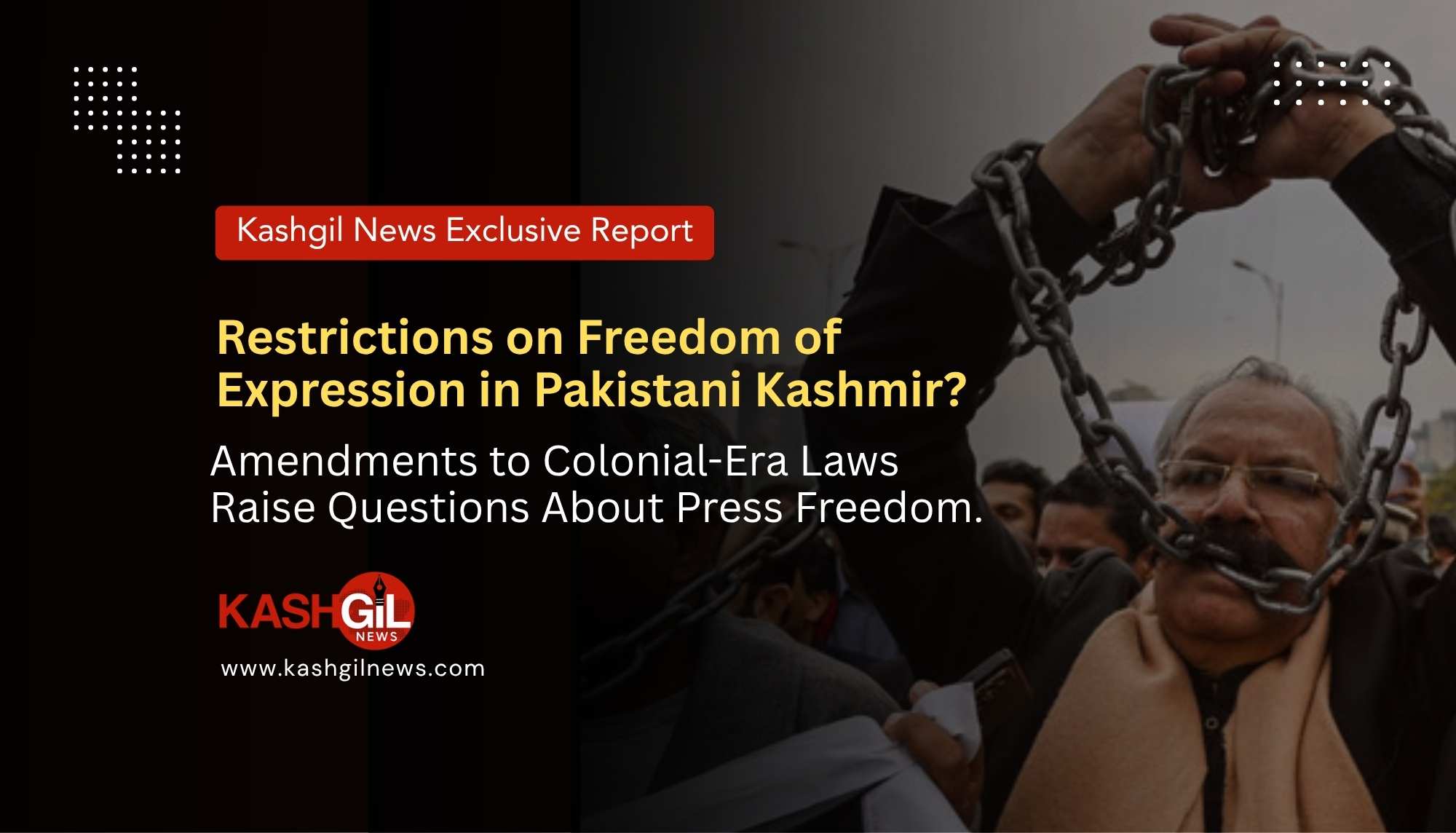
Recent legal amendments in Pakistan-administered Kashmir have sparked a new debate on freedom of expression and press freedom. According to experts, journalists and observers, these measures have not only restricted access to information but also made it dangerous for journalists to perform their professional duties.
Amendment criminalizing criticism:
In September 2024, the coalition government led by Prime Minister Chaudhry Anwarul Haq made a significant amendment to the British colonial-era law. Under this amendment, criticism of the President, Prime Minister, ministers, members of the assembly and government officials was made a crime.
Violation is punishable by seven years in prison and a fine:
A new clarification was added to Section 505 to include the government and state institutions in the definition of “community”. After this change, criticism of government figures or institutions was not free from legal risks.
Political alliance: Rival parties on one page:
Interestingly, the major political parties of the region—Pakistan Tehreek-e-Insaf (Forward Bloc), Muslim League (N) and the People’s Party—appeared together to pass this law.
Prominent figures in the standing committee included Colonel Waqar Noor, Mian Waheed, Azhar Sadiq and Khawaja Farooq, who unanimously supported the amendment, after which the assembly passed it.
Strict measures after the public movement:
This law came a few months after the May 2024 public movement, in which the people protested vigorously against government policies.
According to observers, this law could be a result of government pressure and fear. It is being seen as an attempt to restrict freedom of expression.
Concerns of the journalist community:
According to senior journalist Zulfiqar Ali, “In the absence of access to information, it will become difficult for journalists to verify their news, which is a dangerous situation.”
Nadeem Shah, a journalist from Muzaffarabad, says that the government had promised consultations, but no clear position has emerged so far. Similarly, journalist Shujaat Mir has also expressed serious reservations about the law.
Legal and democratic concerns:
Legal experts are calling this amendment contrary to democratic values. According to one expert, “using colonial laws to suppress criticism reflects fascist tendencies.”
Background of the Defamation Bill and Presidential Ordinance:
This amendment was made at a time when the Defamation Bill introduced in December 2023 could not be passed due to journalistic pressure. A Presidential Ordinance was also issued in 2024, which had to be rejected after public backlash.
Result, growing clouds on press freedom:
Recent legislation has raised serious questions about the future of freedom of expression, journalistic protection and democratic values in Azad Kashmir. If access to information remains restricted and criticism is criminalized, experts say, not only the media but also the overall democratic process could be affected.
***
Share this content: