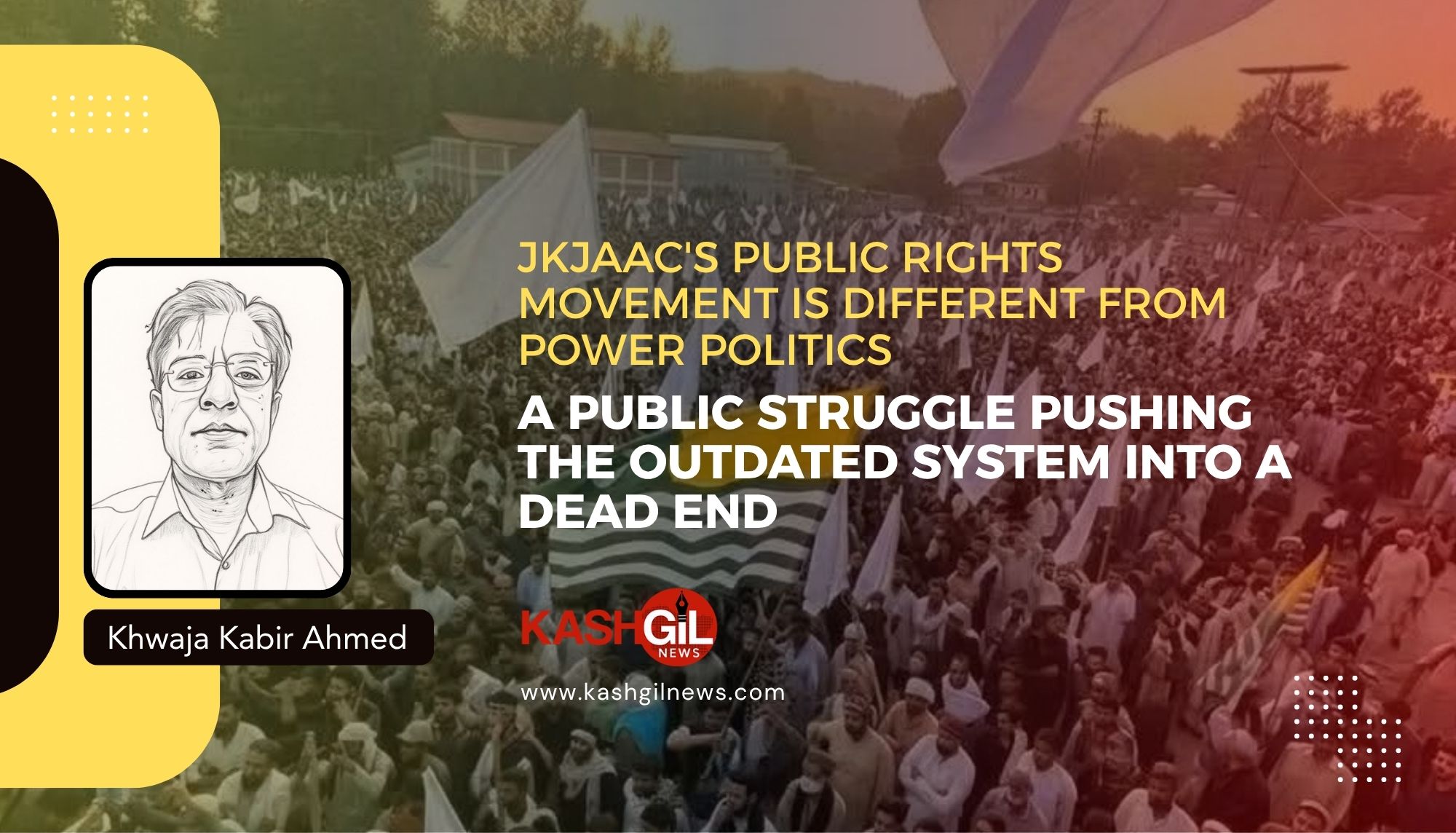
by: Khwaja Kabir Ahmed
Note: The peaceful public rights movement of the Jammu Kashmir Joint Awami Action Committee and the political movement of a political figure or political party in Pakistan are two different movements. Some analysts compare or liken this public rights movement in Pakistan-administered Jammu Kashmir to the political party movement in Pakistan, which is not correct. This article has made it clear how the Jammu Kashmir Joint Awami Action Committee’s movement is fundamentally different from the individual movement in Pakistan.
To understand the ongoing public struggle of the Jammu Kashmir Joint Public Action Committee in Pakistan-administered Jammu Kashmir, it is first necessary to answer the basic question of what this movement is for.
Is this a movement to bring an individual to power? Is this a movement to bring a political party to power? Is this an attempt to establish the political supremacy of a personality?
Or is it a struggle for fundamental questions related to the life of the common citizen, his economic rights, control over resources, political representation, right to property and right to rule?
If this question is answered honestly, it becomes clear that limiting the struggle of the Joint Public Action Committee to mere protests, sit-ins, boycotts of bills or pressure on the streets is a refusal to understand the true nature of this movement.
This is not a movement of a personality, a movement of rights. This is not a movement to gain power, a movement to question the distribution of power. This is not an election campaign of a political party, but a struggle for the right of ownership and right to rule by the people.
Declaring a public organization or movement illegal by the government or state institutions and its becoming illegal among the people are two completely different things.
State order can affect the legal status of an organization, but cannot automatically eliminate the social and political status of a public demand.
If the demands of a movement are born out of real problems of the people, if people take to the streets for these demands, if people from different political affiliations unite around a common agenda, and if the state has to respond to the movement continuously, then simply calling it “banned” does not eliminate its public base. Rather, sometimes declaring a movement as banned becomes an admission that it is no longer possible to ignore it from the normal political discourse.
The real question is not what name the government has given it. The real question is what the people understand it to be and how many people stand with its demands.
It is a fundamental political fallacy to link the JPAC movement with the protest model of Imran Khan or the PTI.
Two movements may have one method of protest, sit-in, boycott, or civil disobedience in common, but that does not make the two movements the same.
Imran Khan’s politics have revolved around the question of gaining power and political control over state and government power in Pakistan. PTI is a regular political party, participates in elections and the main objective of its politics is to gain political power. While the basis of the Joint Public Action Committee is not to bring any one person to power, the question in the Joint Public Action Committee movement is not who will become the prime minister. Rather, the question is who will have control over the resources of the people? The question is how the taxes collected from the people and their natural resources will be used? The question is what are the rights of the people in obtaining basic facilities? The question is how much real power do the people have in deciding their political and economic future? This difference is not insignificant but fundamental. One movement may be to gain power, the other movement may raise the question of the rights and authority of the people in the power structure. Measuring both by the same yardstick is not political analysis but an attempt to create political similarity.
The most important feature of the Joint Public Action Committee is that its real power does not lie in any one personality. It is not a party built around an individual. It is not the political legacy of a single family. It is not a campaign to obtain a ministry or position. Its real power is the collective unity of people belonging to different regions, classes and political affiliations. That is why the attempt to understand this movement through personalities is insufficient. The real character of this movement comes to light when people with different political views put aside their differences and unite on basic public demands. This unity is the real power of this movement.
Now the question is also being raised as to what is the next step left for the movement after continuous protests, shutter-downs, roadblocks and boycotts. This question is apparently logical, but there is another side to it.
If a movement is left with only the path of protest, then this question should be asked not only to the movement but also to the entire political system as to why other paths have not been effective in resolving public demands? If an assembly exists, is it resolving public demands? If political representation exists, are the basic problems of the people being resolved through it? If the path of negotiations is open, are serious and fruitful negotiations taking place? And if negotiations are not taking place, how can the responsibility be placed solely on the protesters? The very fact that a movement takes to the streets is itself a sign that the usual institutional paths have not proven sufficient for the people.
The main purpose of peaceful protest is not to fight the state but to make the state realize that no problem can be ignored anymore. Sit-ins, shutter-downs, wheel jams and boycotts are not destinations in themselves. They are means of creating negotiating power. The state has administrative power. The people have collective power. When the two forces come face to face, the need for a political solution ultimately arises. Therefore, it is correct to say that every protest ultimately comes to the negotiating table. But this does not mean that the road and negotiations are opposites of each other. Often, what is achieved at the negotiating table is behind the public pressure on the road.
It is also a fact that the common citizens are affected by prolonged protests, internet shutdowns, disruptions in business activities and transportation problems. It would not be right to deny this fact. But justice also demands that the movement alone should not be held responsible for every loss. If the internet was shut down, whose decision was it? If business activities were affected, what role did administrative measures play in it? If normal life was affected, was the attempt to end the crisis through negotiations sufficient? The impact of the public movement must be accounted for, but the impact of state measures must also be accounted for with the same honesty. Otherwise, the analysis becomes one-sided.
The decision to boycott electricity, water, gas or taxes is a serious political move and its consequences should be discussed. But this discussion should not only begin with the question of what will happen after non-payment. Rather, the question should also be why the people have reached this point? If people are raising questions regarding electricity rates, taxes, resource distribution and basic amenities, then these questions must also be answered. Disagreement can be expressed in any protest manner, but this disagreement cannot be converted into denial of public grievances. If a patient complains of pain, simply saying that his medicine is bitter is not the answer to his pain. Similarly, objection to the method of public protest is not the answer to public grievances.
It is also not true that in a democracy, only parliament is a legitimate political outlet and street protests are somehow against the parliamentary system. In a democracy, parliament is also the voice of the people and peaceful protests are also the voice of the people. Parliament makes laws. Public movements put pressure on legislators. If both play their respective roles, the democratic system becomes stronger. The problem arises when parliamentary institutions are unable to listen to public demands and the protesters are declared the problem. History is witness that there are countless fundamental rights in the world that were recognized not only through parliamentary debate but as a result of public struggle. It is a fact that the number of people in a protest movement is not a guarantee of its success. But it is also not right to dismiss the number of people as completely unimportant. In a democracy, the number of people is the basis of a political mandate. If thousands of people stand with a demand, their demands cannot be dismissed as simply a “mob”. The real importance is on what demand those people are united, how much public acceptance there is of these demands and how the state responds to them.
During any movement, if the local government and institutions do not pay attention to public demands and do not move towards solving these problems, but rather use force against the people, then the protesters have the full democratic right to raise their voice with international institutions. Appealing to international institutions does not mean that some external force will come and solve the local administrative problem. Rather, contact with international institutions is a means of making violations of human rights, civil liberties, political rights, and state actions part of the international record. Raising an issue at the international level can be important even when there is no immediate political solution to it. Therefore, it is not appropriate to describe contact with international institutions as just an unrealistic hope.
To limit the struggle of the Joint Public Action Committee to electricity, flour, taxes or any single administrative demand is to ignore its broader political meaning. There are fundamental questions behind this struggle, including who owns the property rights? Who has control over the resources? Who will decide on the use of the people’s resources? How much power do the people have in deciding their political future? Should governance be in accordance with the will and interests of the people or only by the will of those with administrative power? These are questions that do not end with the coming or going of a single government.
If a government declares a movement illegal, but the demands do not end, then the question becomes more about the state than the movement. If arrests are made, but the demands remain, then the problem is not only with the protesters. If communication links are restricted, but public questions do not end, then shutting down the internet is not the solution to the problem. If despite attempts at political division, the people remain united on basic demands, then changing personalities will not solve the problem. And if despite the use of force, public consciousness persists, then it becomes difficult to say that the movement itself has become a prisoner of its own strategy. Perhaps the reality is the opposite. Perhaps it is not the movement that is at a dead end, but the old political concept that believes that public demands can be silenced forever through administrative decisions has reached a dead end.
The success of every movement cannot be measured solely by how many demands the government accepts the next day. Movements also create political consciousness. They make the people aware of their rights. They raise questions that cannot be easily suppressed. They force political parties to clarify their positions. They make parliament accountable. And they make the state realize that it is not always possible to ignore the fundamental problems of the people. In this sense, to declare a movement a failure based on its immediate results is to view the process of history very narrowly.
It is not necessary to agree with every decision of the strategy of the Jammu Kashmir Joint Public Action Committee. It is not necessary to declare every move of its leadership correct. The economic impact on the people should also be assessed. The methods of protest should also be criticized. But while doing all this, the basic fact cannot be ignored that the question of public rights is bigger than the method of protest. If there is a difference in any method, the method should be discussed. If there is a difference in any demand, an argument should be given. If a strategy is considered wrong, an alternative strategy should be presented. But the basic public questions cannot be eliminated by simply declaring a movement “null” or by declaring it similar to the movement of another political party.
There are challenges before the Jammu Kashmir Joint Public Action Committee as well as before the state. It is important for the movement to maintain public unity, make peaceful struggle its strength, keep its demands clear and remain firm on basic principles with flexibility in strategy. The challenge for the state is even greater. It is easy to use state power. It is easy to stop a movement by banning it. It is easy to declare an organization illegal. But it is difficult to give a political answer to the basic questions of the people. And this is the real test. The Joint Public Action Committee did not come out to bring any person to power. It did not come out to form a government of any political party. It stands with the questions of basic human rights, economic justice, property rights and the right to rule. Therefore, it is not right to associate it with Imran Khan’s power politics. And it is also not right to consider it “unlawful” just on the basis that it has been decided to declare it illegal at the state level. The state can declare an organization illegal, but not the public demand. The government can ban a movement, but not the public consciousness. The state cannot suppress protests. It can stop, but it cannot stop the question of when the people will gain real power over their resources, their rights and their future decisions. This is why it is premature to declare the Joint Public Action Committee a movement that has reached a “dead end”. Because when a movement is not for a single individual but for the fundamental rights of the people, when its strength is the unity of the people rather than a single personality, and when its basic questions are still unanswered, then the fate of this movement cannot be decided solely on the basis of how many days it has been on the dharna. Public movements make history not with slogans, but with the political consciousness they have created. And the question that has come to the tongue of today’s innocent children, it is possible to silence it but not to eliminate it.
٭٭٭
Share this content: