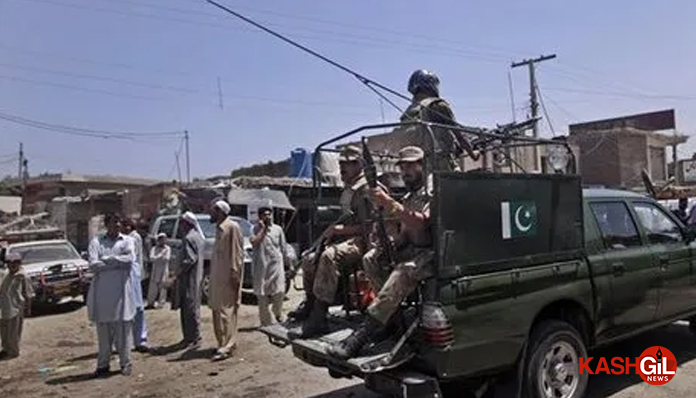
The administration has issued a notice to the residents of the Shorparod area in Balochistan’s Kalat district, directing them to vacate the area by September 28.
Government officials have confirmed that this notice was issued by the Assistant Commissioner of Kalat.
Balochistan Chief Minister Sarfraz Bugti had previously stated during a session of the Balochistan Assembly that an operation would be conducted in Shorparod, preceded by the temporary relocation of the local population to other areas.
Administratively, Shorparod is part of the Kalat district and is situated west of Kalat city.
The area shares a border with the Kharan district and is inhabited by various Baloch tribes.
It is a rugged, mountainous region. According to government officials, Shorparod is considered a stronghold of banned Baloch militant organizations.
A civilian official from the Balochistan government, speaking on condition of anonymity, stated that the Assistant Commissioner of Kalat issued the evacuation notice on September 20 for residents of Shorparod and its adjoining areas.
The notification, issued under the signature of the Assistant Commissioner of Kalat, states that the decision to temporarily evacuate residents from Killi Parod Shumali (North), Parod Janubi (South), Khalili, Khalkhati, and Shoki has been made to ensure the protection of public life and property and to maintain law and order.
Residents have been instructed to finalize arrangements to relocate to safe locations by September 28, 2026, in the interest of their own safety and that of their families. The notification further states that law enforcement agencies are striving to ensure public peace and safety and look forward to public cooperation in completing this process peacefully.
According to a senior government official, notices had previously been issued to the residents of Shorparod in July, though the matter did not receive significant media attention at the time.
He added that, in addition to Kalat, plans to evacuate populations from certain areas of Mastung and Kachhi are also under consideration due to potential operations against militants.
However, a senior police officer, speaking on condition of anonymity, stated that notices have been issued to Shorparod residents in the first phase, while notices for other areas will be issued later in a phased manner.
Balochistan Chief Minister Mir Sarfraz Bugti noted that in the past, populations had been temporarily relocated from Khyber Pakhtunkhwa’s Malakand Division, North Waziristan, South Waziristan, and other regions.
He pointed out that while people had displaced to various parts of Khyber Pakhtunkhwa, not a single village in Balochistan has been evacuated to date.
He clarified that Mastung is not included in the current plan, nor will populations in other areas of Balochistan face displacement.
Mir Sarfraz Bugti described Shorparod as a mountainous region that has, at various times since the 1970s, harbored hideouts for armed individuals and camps for insurgents.
He remarked that the impression that the issue had been completely resolved during periods of peace in Balochistan is incorrect; rather, certain elements continued to prepare for conflict even during those times.
The Chief Minister stated that approximately one thousand people reside in Shorparod, and according to a government survey, the majority of them are nomadic. He stated that notices have already been issued to these individuals, and they will be temporarily relocated.
The Chief Minister said, “The government will fully look after them; all necessary arrangements will be made, and special care will be taken to ensure their dignity and respect—particularly that of women, children, and the elderly.”
According to the Chief Minister, this is not a permanent relocation but a temporary measure to facilitate operations against the safe havens of militants in the area.
He noted that militants use these hideouts to plan attacks, finalize their logistics, and launch assaults on state personnel while using civilians as human shields.
Mir Sarfraz Bugti further asked, “What answer can be given to the children and widows of martyrs, or to the elderly parents whose children are sacrificing their lives in this war every day? At some point, state institutions and the political leadership must also accept their responsibility.”
Share this content: