Farhan Tariq
Twenty-one years have passed since the devastating earthquake struck Pakistan-administered Kashmir and Khyber Pakhtunkhwa on October 8, 2005; yet, the reconstruction process initiated in the wake of that tragedy remains incomplete to this day.
The powerful earthquake that struck on the morning of October 8, 2005, shook vast areas of Pakistan-administered Kashmir and Khyber Pakhtunkhwa to their core.
In a matter of moments, thousands of families lost their loved ones, their homes, and their life savings. In Pakistan-administered Kashmir alone, approximately 46,000 people lost their lives, and more than 300,000 houses were destroyed.
The earthquake did not merely destroy homes; it severely disrupted essential infrastructure—including health, education, water supply, and communications—across approximately 53 percent of the territory of Pakistan-administered Kashmir.
It ranks among the major tragedies in human history, prompting a massive, large-scale operation for relief and rehabilitation in the affected regions.
From Rescue to Reconstruction
Immediately following the earthquake, the Government of Pakistan, the government of Pakistan-administered Kashmir, local departments, and international organizations collaborated to launch rescue and relief operations.
The initial phase focused on extracting survivors from the rubble, providing medical aid to the injured, supplying food and tents, and relocating the affected population to safer areas. Subsequently, a major reconstruction program was launched with the aim not only of rebuilding destroyed structures but also of promoting earthquake-resistant construction to mitigate the impact of future earthquakes.
To this end, relevant bodies—including ERRA and SERRA—provided training on earthquake-resistant designs and construction techniques to professionals in the building sector.
The post-earthquake recovery and reconstruction efforts garnered global recognition; according to records provided by ERRA and SERRA, ERRA was honored with the United Nations Sasakawa Award in 2011.
Losses of 125 Billion; Projects Worth Approximately 198 Billion
According to official records, the estimated financial loss in the earthquake-affected districts of Pakistan-administered Kashmir stood at approximately 125 billion rupees.
In comparison, reconstruction projects valued at approximately 198 billion rupees have been completed to date, with an expenditure of around 168 billion rupees.
This figure includes direct expenditures made by various donors and sponsors.
However, this journey of reconstruction is not yet complete.
7,608 Projects; Hundreds Still Pending
According to records from ERRA and SERRA, a total of 7,608 rehabilitation and reconstruction projects have been underway across the seven earthquake-affected districts of Pakistan-administered Kashmir—Muzaffarabad, Hattian, Neelum, Bagh, Haveli, Poonch, and Sudhnoti.
Of these:
5,878 projects—approximately 77 percent—have been completed.
Work is ongoing on 919 projects—approximately 12 percent.
Meanwhile, 811 projects—approximately 11 percent—could not be initiated due to financial constraints.
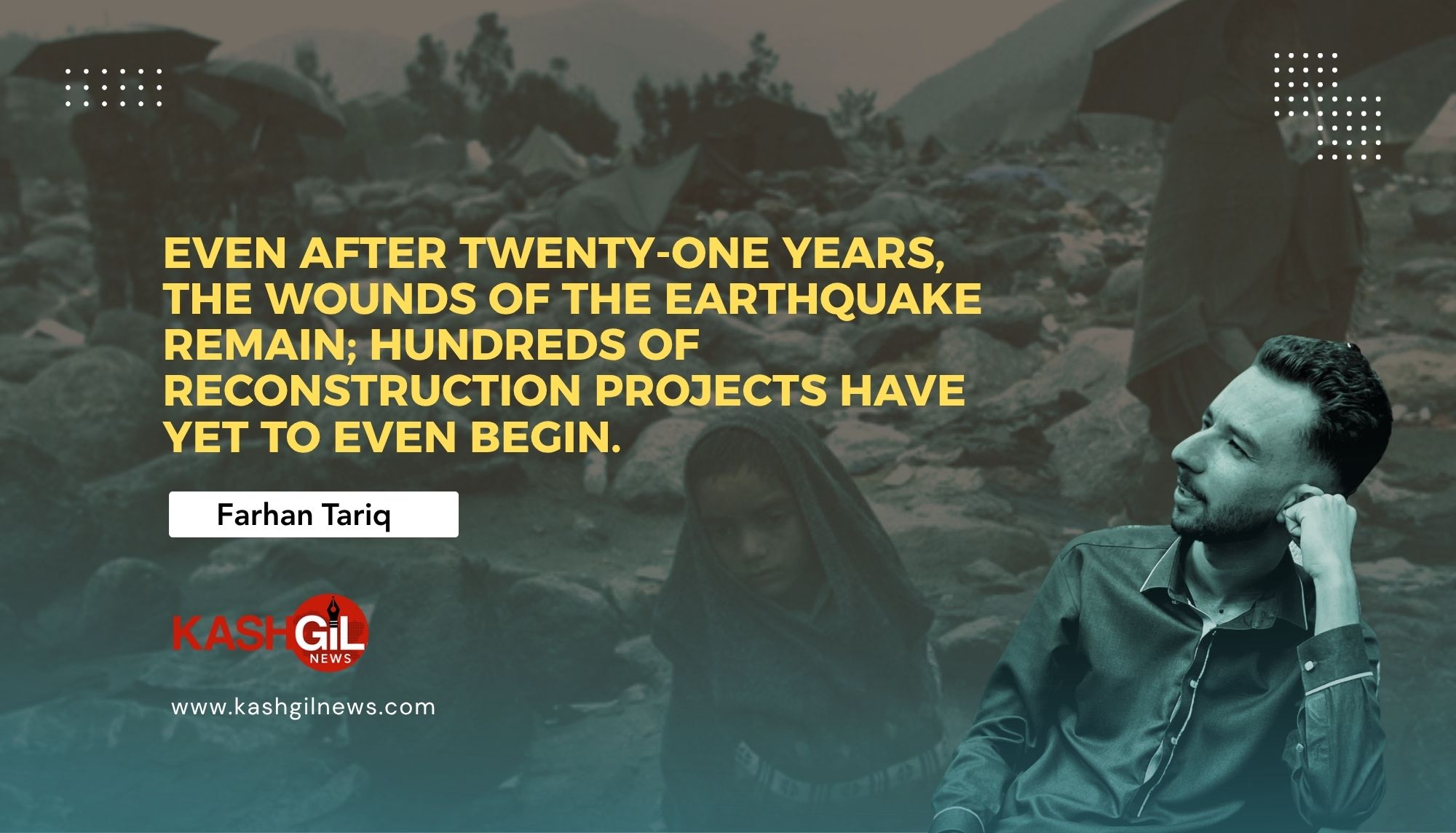
Thus, even after 21 years, there remain hundreds of projects within the reconstruction program that have yet to begin.
Funds Fell Short, Projects Stalled
The reconstruction program has faced financial difficulties for several years.
According to SERRA’s records, only a limited portion of the funds requested for reconstruction across various fiscal years was actually provided.
In the 2010-11 fiscal year, against a demand of approximately PKR 27 billion, PKR 7.5 billion was provided.
In 2011-12, approximately PKR 33.32 billion was requested, but only PKR 5.380 billion was released.
In 2012-13, against a demand of PKR 16.2 billion, PKR 3.564 billion was received.
In 2013-14, against a demand of PKR 14 billion, PKR 1.512 billion was released.
This situation persisted thereafter. In 2014-15, approximately Rs 756 million was released against a demand of Rs 10 billion, while in 2015-16, Rs 1.048 billion was provided against a demand of approximately Rs 6.96 billion.
In 2016-17, approximately Rs 953 million was released against a demand of Rs 8 billion.
In 2017-18, SERRA requested approximately Rs 16.9 billion, but only about Rs 1.026 billion was provided.
In 2018-19, approximately Rs 996 million was released against a demand of Rs 9.504 billion.
In 2019-20, only Rs 731 million was released against a demand of Rs 19.812 billion.
Meanwhile, in 2020-21, a mere Rs 373 million was provided against a demand of approximately Rs 9.604 billion.
Rs 5.559 billion over seven years
An analysis of the figures reveals that a total of approximately Rs 5.559 billion was released to SERRA over the past seven years.
This amount is less than even some of SERRA’s single-year demands.
According to SERRA, despite these financial constraints, approximately 463 projects—particularly in the education and health sectors—were completed over the last seven years.
These projects include the rehabilitation of schools, hospitals, and other basic amenities, which are considered vital for restoring normalcy to the lives of the earthquake-affected population.
Rs 30 billion still required
However, the journey of reconstruction is not yet complete.
According to SERRA, a total of approximately Rs 30.107 billion is required to complete the remaining projects of the reconstruction program. Of this amount, Rs 2.429 billion is required for liabilities related to completed projects, Rs 12.615 billion for the completion of ongoing projects, and approximately Rs 15.061 billion for projects that are yet to be undertaken.
This situation raises concerns about further delays in completing the remaining projects of the reconstruction program.
The Question Remains the Same After 21 Years
Twenty-one years have now passed since the earthquake of October 8, 2005.
During this period, thousands of buildings were reconstructed, schools and hospitals resumed operations, roads were restored, and life in the affected areas largely returned to normal.
However, the scale of the devastation was so immense that, despite the passage of two decades, not all reconstruction targets have been achieved.
While large-scale reconstruction work was carried out to address the damage caused by the earthquake, a lack of financial resources hampered the pace of the remaining projects.
Twenty-one years later, the memory of the earthquake is not limited to the families who lost their loved ones; it also lingers in these unfinished projects.
Share this content: