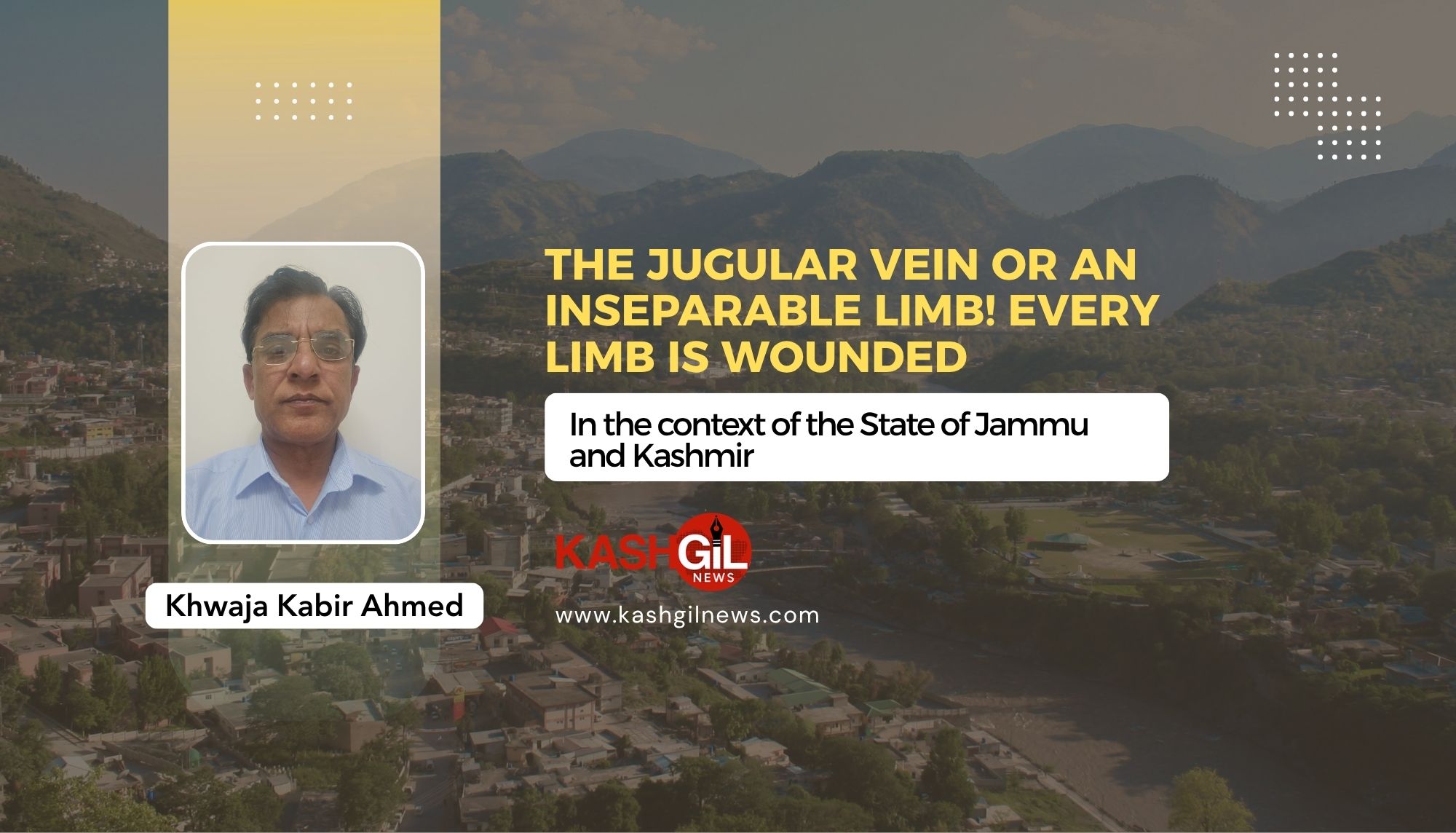
By: Khawaja Kabir Ahmed
The State of Jammu and Kashmir is a single body—a body whose limbs, heart, mind, eyes, arteries, and veins were once interconnected; yet, the wars, political decisions, military interventions, and persistent partitioning that followed 1947 have fragmented this body into distinct parts. Today, one segment is administered by India, another by Pakistan, and a third by China. Conflicts between the two nations—India and Pakistan—have torn apart individuals, families, valleys, marketplaces, and human bonds. People who once shared a common identity as citizens of a single state now live under disparate administrative systems, legal frameworks, and political narratives. Political, administrative, and humanitarian barriers—far more formidable than mere geographical distances—now stand between them. The tragedy of this partition is not limited to the fragmentation of territory; it also represents a fracturing of a nation’s historical, cultural, social, and political experience.
The most striking aspect of this situation is that the two major powers asserting claims over the existence and future of Jammu and Kashmir—India and Pakistan—describe this very same body through their own distinct rhetoric and political visions. India maintains that Jammu and Kashmir is an atoot ang—an integral part—meaning a component that cannot be severed from the nation. Conversely, Pakistan has long characterized Jammu and Kashmir as its “jugular vein”; viewing it as an unresolved international dispute, Pakistan demands a resolution based on the Kashmiri people’s right to self-determination and in accordance with relevant United Nations resolutions. On one hand, there is the claim of it being an “integral part,” and on the other, the characterization of it as the “jugular vein”; yet, amidst these narratives, a fundamental question looms large: if the State of Jammu and Kashmir is a single body, what is the condition of that body? In what state do the people inhabiting its various parts—the limbs of this body—find themselves? Who will account for their wounds, and upon whom does the responsibility for healing them rest?
Merely declaring a part of the body “integral” does not heal its wounds; likewise, labeling a region one’s “jugular vein” does not guarantee the fundamental rights, political agency, economic well-being, or human dignity of the people living there. While state claims regarding a region hold their own significance, they inevitably raise the question of the extent to which the inhabitants enjoy freedom of expression, access to justice, political participation, economic opportunities, and a say in their own future. If the State of Jammu and Kashmir is indeed envisioned as a single body, then understanding the pain of any one part requires an assessment of the condition of all its limbs—whether they are under Indian, Pakistani, or Chinese administration.
Since 1947, the history of the State of Jammu and Kashmir has been marked by wars, ceasefires, political decisions, and geographical partitions that have severely compromised its unity. The ceasefire line did not merely divide the land; it disrupted families, severed relationships, separated people from their ancestral homes, and upended the routines of daily life. Many families found their members stranded on opposite sides, turning the simple human need to meet loved ones into a matter contingent upon administrative permits, border restrictions, and prevailing political conditions. People living in different parts of the same state share commonalities in language, culture, history, and many social traditions; yet, there are obstacles to travel, communication, and interaction among them that cannot be attributed merely to geographical distance. Such division has impacted not only the map of the state but also the collective consciousness of its people and their vision of a shared future.
India regards the Jammu and Kashmir region under its administration as an integral part of the country, framing its position in the context of national unity, constitutional integration, development, and administrative reforms. In August 2019, the Indian government revoked the special constitutional status granted to Jammu and Kashmir under Article 370 of the Constitution and bifurcated the former state into two Union Territories: Jammu & Kashmir and Ladakh. This move brought about fundamental changes to the region’s constitutional and administrative structure. While the Indian government views this action through the lens of its constitutional authority and administrative policy, critics describe it as the dismantling of Jammu and Kashmir’s former autonomy or special status and a move toward the further centralization of political power. Although assembly elections were held in Jammu and Kashmir in 2024, the conduct of elections is distinct from the resolution of issues concerning the region’s political future, constitutional status, and the aspirations of its people. Consequently, the question remains: what is the actual state of civil and political rights for the citizens living in this region—which India claims as an integral part of itself—and to what extent are their political aspirations reflected in decision-making processes?
International bodies have repeatedly expressed concern regarding human rights, freedom of expression, journalism, political activities, and the use of state power in Indian-administered Jammu and Kashmir. Human rights organizations, including Human Rights Watch, have published reports detailing arrests, restrictions, and alleged violations targeting journalists, human rights activists, and other individuals. These organizations have also highlighted allegations of violence, extrajudicial killings, and other grave violations committed by security forces. It is essential to consider the nature of such allegations, the need for independent investigations into them, and the stances of the relevant authorities; however, these questions cannot be dismissed simply because a state claims the region in question as an integral part of its territory. The significance of human rights is not contingent upon geographical claims or political positions. If a citizen faces obstacles in voicing their views, expressing their political ideology, or criticizing government policy, raising questions about this is a legitimate civic and human right.
In a report by the US-based organization Freedom House, Indian-administered Kashmir was awarded a score of 38 out of 100; this ranking by a non-governmental international body must be understood within the context of its own assessment criteria and methodology. Nevertheless, such reports reinforce the argument that alongside designating a region as part of national unity, it is equally important to examine the rights, political participation, and freedoms of its citizens. The fundamental question is not merely how India characterizes Jammu and Kashmir, but rather the extent of agency the people of this region—described as an “integral part”—possess regarding their political, social, and civic lives.
On the other hand, Pakistan has consistently referred to Jammu and Kashmir as its “jugular vein.” In the Pakistani state narrative, this term signifies immense geographical, political, and strategic importance. Pakistan regards Jammu and Kashmir as an unresolved international dispute and advocates for the Kashmiri people’s right to self-determination. Pakistan’s official stance is that the final resolution of the dispute must align with the aspirations of the Kashmiri people and the relevant United Nations resolutions. While this stance holds its ground, another question arises: to what extent are the people living in the region—which Pakistan terms its “jugular vein”—guaranteed political agency, fundamental rights, justice, economic opportunities, and a role in governance? Should the concept of the “jugular vein” remain confined merely to state narratives, diplomatic speeches, and national sentiment, or should its practical manifestation be visible in the lives of the local citizens?
Issues regarding civil rights, economic grievances, governance, political agency, and resource distribution in Pakistan-administered Jammu and Kashmir have frequently surfaced through public protests. Since 2023, the movement led by the Jammu and Kashmir Joint Awami Action Committee has highlighted demands concerning the provision of basic amenities, electricity and flour shortages, reforms in government expenditure and privileges, public representation, and accountable governance. Human rights organizations have also expressed concern over the actions taken against this movement—including arrests, internet shutdowns, the use of force, and fatalities. In June 2026, Amnesty International raised questions regarding the crackdown on the protest movement and the decision to ban the organization. While a thorough and impartial inquiry into these events—considering the perspectives of various stakeholders and available evidence—is essential, the fundamental question remains: if citizens demand their basic rights and accountability in governance, upon whom does the responsibility fall to heed these demands and seek a peaceful, constitutional, and democratic resolution?
In any system of state governance, dismissing public grievances merely as political opposition, disorder, or external interference does not eliminate the root causes of those grievances. If people raise questions regarding electricity, flour, education, healthcare, employment, the equitable distribution of resources, and political empowerment, those questions must be addressed through reasoned argument, transparency, and concrete actions. Wherever state authority exists, the obligation of accountability accompanies it; this principle applies equally to territories under Indian administration and those under Pakistani administration. If human rights are acknowledged as universal principles, their application cannot be restricted solely to territories administered by an adversary state. Raising one’s voice against alleged violations in one location while remaining silent on similar issues elsewhere amounts to subordinating the principle of human rights to political expediency.
It is here that the true human tragedy of the state of Jammu and Kashmir comes to the fore. India claims it as an integral part, while Pakistan calls it its “jugular vein”; yet, amidst these competing narratives, the question posed by the Kashmiri citizen often recedes into the background: “Where do I stand? What is my political status, and how much weight does my own voice carry in decisions regarding my future?” This is not merely an emotional query but a fundamental question concerning political, constitutional, and human rights. If a citizen of Srinagar raises questions about freedom of expression or political empowerment, their voice matters. If a citizen of Muzaffarabad questions governance, fundamental rights, or resource distribution, their voice is equally significant. Similarly, if a citizen of Gilgit-Baltistan questions their constitutional status, political representation, and authority, that question, too, must be heard with the same level of seriousness. Similarly, issues concerning the rights, identity, land, and political future of the people living in Jammu, Ladakh, and other parts of the state cannot be subordinated to a single state narrative.
To comprehend the wounds of the state of Jammu and Kashmir, it is essential to view the experiences of the people inhabiting its various regions through a common lens. This does not imply that conditions, laws, political systems, or human rights issues are identical across all areas; rather, it means that citizens’ rights in every region should be evaluated based on uniform principles. There must be independent investigations into allegations regarding the use of state power, freedom of expression, and political agency in Indian-administered territories. Likewise, grievances concerning the use of force against public protests, political freedom, civil rights, and government accountability in Pakistan-administered territories must be taken seriously. The political, social, and civic situation of the people in the Chinese-administered region cannot be excluded from this discourse either. Similarly, violence against civilians or human rights violations committed by armed groups in any region must not be overlooked. The pain of a citizen is not diminished or amplified by the state, organization, or ideology to which the perpetrator of the rights violation belongs.
The impact of the division of Jammu and Kashmir has not been confined merely to politics and administration; it has also affected human memory, familial ties, and collective identity. For a mother whose son lives on the other side of the Line of Control, this line holds a significance that is far more personal than any military or diplomatic term. For an elderly person whose ancestral village was left on the other side, that line symbolizes their past, their memories, and a lost part of their life. For families separated across the divide, the desire to reunite became contingent upon political negotiations and administrative permissions. For the younger generation, connecting across different parts of the region, understanding a shared history, and becoming familiar with one another’s experiences has become impossible. Thus, political division has not merely partitioned the land; it has also driven a shared social experience in divergent directions.
Another deep wound afflicting the State of Jammu and Kashmir is that, while much has been said and done in its name—wars fought, armies deployed, diplomatic campaigns launched, speeches delivered at international forums, elections held, and various political movements emerged—the question of its people’s political future remains unresolved. Throughout this history, various parties have held their own stances, responsibilities, and claims—all of which ought to be examined in light of evidence and historical records. Yet, the fundamental question persists: when and how will the people of Jammu and Kashmir be afforded the opportunity to express their views regarding their future in a genuine, free, and dignified manner? Will there be a serious effort to hear their aspirations independently of the state interests, national security concerns, territorial claims, and power-centric political narratives of the two rival powers? Will their political voice be valued only when it aligns with the stance of one state, or will it command equal respect even in the event of dissent?
This question concerns not only the governments of India and Pakistan but also the entire political leadership, human rights organizations, the international community, and Kashmiri society itself. If the State of Jammu and Kashmir is viewed as a single body, the process of healing should not begin with a debate over which part constitutes an “integral part” or a “jugular vein” of a particular state. Instead, the remedy must begin by addressing the needs, rights, political aspirations, and visions for the future held by the body’s limbs—the human beings residing within it. What form of governance do they require? What do they desire regarding their resources, land, and political agency? Does an environment exist that fosters dissent, a free press, peaceful protest, and accountable governance? And is their own voice accorded genuine importance in decisions regarding their future?
If India declares Jammu and Kashmir an integral part of itself, then upholding the rights, freedoms, and political dignity of every citizen there becomes its responsibility. If Pakistan refers to Jammu and Kashmir as its “jugular vein,” then the practical implication of this term must be reflected in the fundamental rights, democratic agency, justice, and self-respect of the people living there. Similarly, if the Kashmiri political leadership claims to represent the state’s future, it too must engage in self-accountability regarding its conduct, public inclusion, respect for dissent, and principles of accountability. The credibility of any political movement or leadership is defined not merely by its slogans, but by the extent to which it prioritizes the rights and agency of the ordinary citizen in its practical agenda.
The state of Jammu and Kashmir remains a body wounded by history, divided by wars, partitioned into various administrative zones by political decisions, and labeled differently by two state narratives to suit their respective interests. India calls it an integral part, while Pakistan terms it a jugular vein; yet, the people inhabiting the mountains, valleys, cities, and villages of this state are not merely components of a state’s anatomy—they are complete human beings possessing their own history, identity, rights, aspirations, and future. Their wounds are not limited to border issues; they are deeply intertwined with political agency, freedom of expression, justice, employment, education, healthcare, family ties, and human dignity. To truly comprehend these wounds, it is essential to place the experiences of the true heirs of Jammu and Kashmir at the center of the discourse, alongside the competing claims of the two states. Therefore, the question is not merely whether the State of Jammu and Kashmir is an “integral part” of India or the “jugular vein” of Pakistan. The real question is: who will heal the wounds afflicting every part of this state—a territory that two nuclear powers claim as an intrinsic part of their own bodies to serve their respective national and political interests? An even greater question is whether the people of this state will ever be granted a genuine and dignified opportunity to decide their future in accordance with their own free will. For no matter how grand the claims regarding a region may be, they cannot supersede the rights and human dignity of its inhabitants. Whether viewed as an “integral part” or a “jugular vein,” when the body is wounded, the pain cannot be alleviated by slogans; it requires justice, empowerment, accountability, and the protection of human rights. True healing for the wounds of Jammu and Kashmir will only be possible when its people are recognized not merely as pawns in a territorial dispute, but as the primary stakeholders in their own future.
For whether the wounds are inflicted by those who call it an “integral part” or by those who call it a “jugular vein,” it is the true heirs of Jammu and Kashmir who bear the pain.
Share this content: