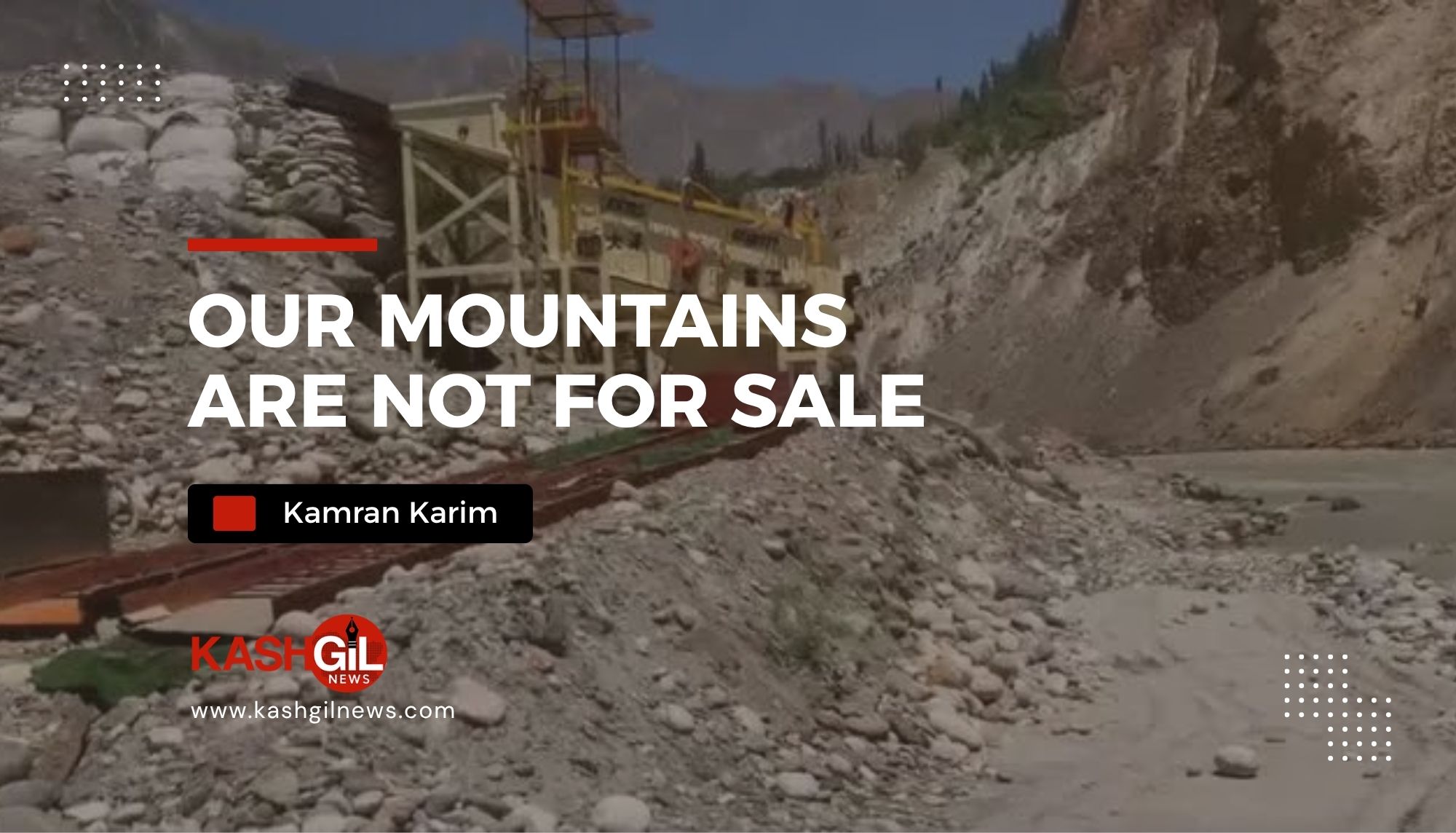
By: Kamran Karim
On October 18, U.S. Chargé d’Affaires Natalie A. Baker met with the Governor of Gilgit-Baltistan, Syed Mehdi Shah, in Skardu and visited the Satpara Dam alongside him. According to an official report (APP), their discussions covered education, the Satpara Dam, water, electricity, and tourism, as well as student exchange programs such as Fulbright and Humphrey. The report also quotes Baker as stating that her country is establishing partnerships with local universities, which includes providing support for professional training in the fields of critical minerals and mining.
Diplomatic visits do not occur in a vacuum. In June 2025, this same diplomat invited investors from her country to enter Pakistan’s mining sector. This August, an official from the U.S. Embassy in Islamabad informed journalists that investors are interested in the rare minerals of Gilgit-Baltistan and the copper deposits of Khyber Pakhtunkhwa; furthermore, Washington is prepared to provide financial backing for major projects through the EXIM Bank and the DFC. The official also noted that the U.S. government has identified 60 minerals as critical for artificial intelligence, semiconductors, and defense technology. When these points are considered together, the meaning behind the smiles in Skardu takes on a different significance.
A primary lesson from colonial history is that, before plunder can take place, the land must first be rendered “empty.” Edward Said referred to this as the “representation” of the Orient. Earlier this year, the head of an American mining company described Pakistan as a “virgin territory” for mineral exploration. But our mountains are not uninhabited; they are populated. They contain the villages of Baltistan, the valleys of Hunza and Ghizer, the pastures of Diamer and Astore, and the very snow that provides water for our children. When a land is labeled “empty,” the people living there are effectively erased from the map.
The most significant lesson comes from America’s own history. The United States possesses rare minerals; at one time, the Mountain Pass mine in California was the largest of its kind in the world. However, repeated leaks of toxic water contaminated the protected Mojave region, leading to legal action in 1997 and the eventual closure of the mine in 2002. While China’s lower prices were a factor, the strictness—and the associated costs—of environmental regulations also played a role. Consequently, the United States largely offloaded the “dirty” work of mining and refining onto China. An American publication described this as exporting one’s own pollution to others under the guise of environmental protection. An expert from the environmental organization Earthworks acknowledged that such operations are inherently “dirty” and polluting—which is precisely why they have been taking place in China.
Even today, when Washington seeks to open new mines within the U.S., local communities—such as those in a town in Texas—have voiced concerns over the potential for pollution. The question, therefore, is straightforward: if the United States deemed these activities too dangerous for its own people and abandoned them, are they truly suitable to be carried out near our villages? This is “environmental colonialism”—where the benefits are reaped in one place, while the toxic consequences are dumped in another.
And for us, this danger is far more grave. The process of extracting rare minerals involves the use of acids and chemical substances, resulting in the generation of toxic—and in some cases, radioactive—waste. In China, such projects have led to complaints regarding air and water pollution, the destruction of farmlands, and the emergence of illnesses. Our valleys are narrow, and villages are situated along streams fed by glacial meltwater—the very water that residents drink and use to irrigate their fields. If a mine or its associated debris is located upstream, toxic substances can quickly reach the villages below. Furthermore, there is an escalating risk of glacial lake outbursts, while activities such as blasting, road construction, and the generation of dust can accelerate the melting of ice. These are potential risks rather than certain outcomes; yet, they are so significant that not a single pickaxe should be swung without independent environmental assessments and health monitoring.
What is even more bitter is that our mountains are being bartered away without our involvement. To this day, Gilgit-Baltistan has not been granted constitutional status; we have no representation in the National Assembly or the Senate, and decisions that will shape the destiny of our future generations are made at tables in Islamabad and Washington. In post-colonial thought, this is termed “internal colonialism”—the center acts as an intermediary for foreign capital, while the people of the periphery are not even consulted. The opposition has already leveled allegations of secrecy regarding mineral agreements between Pakistan and American companies, yet the terms of these contracts have never been disclosed to us.
And now, a pointed question for those among us who are regarded as intellectuals and opinion-makers: An American diplomat visited various locations in Gilgit-Baltistan—including Hunza, as we ourselves witnessed. The atmosphere of effusive warmth and praise that followed in places like Hunza is, to us, quite baffling. We are not opposed to hospitality; it is our tradition, and honoring a guest is a duty. However, there is a distinction between showing respect and remaining silent. Several days have passed since the visit, yet no organization, jirga, bar association, university faculty member, or writer has—with due courtesy and decorum—asked the guest what investors from their country are seeking in our mountains, or why the “Mountain Pass” scenario might not be repeated here. There has been no joint memorandum, no open letter, no peaceful gathering. Does this silence stem from ignorance, a sense of being overawed, the hope for future opportunities—such as scholarships, funding, or connections—or is it simply fear? We do not cast aspersions on anyone’s intentions. However, Frantz Fanon warned against this very role played by the local elite—acting as an intermediary for the powerful—and emphasized that the task of an intellectual is not to applaud, but to ask questions. The best way to pose a question is through respectful inquiry, not silence.
In this picture, the role of military institutions cannot be overlooked. The $500 million agreement signed in September 2025 with the American firm US Strategic Metals involves Pakistan’s Frontier Works Organization (FWO)—the engineering arm of the Pakistan Army. The Special Investment Facilitation Council (SIFC), which paves the way for mineral investments, is described by critics as an entity under military influence. A glimpse of this can be seen in Khyber Pakhtunkhwa, where the Awami National Party (ANP) has announced a movement against the Minerals Act 2025. Aimal Wali Khan alleges that the region’s mineral resources are already under the control of military institutions, and that the new law serves to provide legal legitimacy to this occupation. Within local circles, concerns have also been raised that military operations and the resulting displacement—seen in areas like Bajaur—serve as a pretext for clearing resource-rich territories. While we do not present these allegations as established fact, the experience in Khyber Pakhtunkhwa serves as a mirror for us. Where mineral resources exist, security concerns and commercial deals often emerge in tandem; and where a voice is constitutionally weak, such developments can unfold all the more easily. We demand—respectfully yet unequivocally—that the military establishment refrain from becoming a party to the mineral affairs of Gilgit-Baltistan, and instead leave decision-making in the hands of those to whom this land belongs.
The promise of employment is the primary pledge of any colonial-style project. Yet, Pakistan lacks the infrastructure to refine rare minerals; to date, exports have consisted solely of raw materials or concentrates. In other words, while our mountains will be excavated, the true value—along with the technology and the profits—will accrue to the nation that processes these resources. Our youth, meanwhile, may be left with nothing more than low-wage, backbreaking labor, precarious employment, and the resulting debris. This mirrors the classic colonial model: a colony provides raw materials, only to purchase finished goods back at a premium. Furthermore, note that Baker himself, while in Skardu, spoke of collaborating with universities to provide professional training in mining and the extraction of critical minerals. Does this educational cooperation aim to cultivate a local workforce—one tasked with extracting raw materials, yet denied any share in the value or the technology derived from them? It is also a valid question to ask: for what kind of technology will the resources from our mountains be used? Given that American officials have explicitly linked these minerals to defense technology—and considering our region’s proximity to the Chinese border—we fear that our land could be turned into a battleground for a mineral-driven rivalry between the United States and China. While there is no evidence that these resources will be used against us, we have a right to know where they are ultimately destined.
Now the question arises: what should we do? The answer lies not in clamor, but in an organized, peaceful, and constitutional struggle. The first step should be the creation of a well-articulated, collective memorandum—endorsed by organizations, jirgas (councils), lawyers, educators, students, and religious scholars from every valley—to be submitted to both the U.S. Embassy and the government of Gilgit-Baltistan. This document should address the issues raised earlier: the public disclosure of all mineral agreements; a prohibition on any project proceeding without the free, prior, and informed consent of local communities; a ban on mining and processing activities near human settlements; independent environmental and health impact assessments; a local share in royalties and ownership; the establishment of processing facilities within the region; and, above all, the granting of constitutional rights and representation to Gilgit-Baltistan. The people of Gilgit, Hunza, Nagar, Ghizer, Diamer, Astore, Skardu, Ghanche, and Shigar must set aside their sectarian and regional differences to speak with a single voice—for our division is the greatest weapon in the hands of others. Resolutions should be passed; the Gilgit-Baltistan Assembly should be pressed to debate these matters and provide copies of the agreements; the right to information laws should be utilized; legal petitions should be filed in the courts; peaceful rallies and seminars should be organized; and well-researched facts should be disseminated via social media. Violence will only weaken our movement, whereas knowledge and unity will make it impossible to ignore.
It is also important to consider the opposing perspective. The government and proponents of such investments argue that mineral extraction will generate revenue and employment, while reducing reliance on the IMF. The United States has already resumed operations at its Mountain Pass mine, and supporters claim that modern extraction methods are far cleaner than those used in the past. According to official government records, out of 4,917 mining licenses issued in Khyber Pakhtunkhwa, only one was granted to an entity affiliated with the military; furthermore, the military itself facilitated the cancellation of approximately 40 licenses held by former officers. It is also a fact that claims regarding the extent of mineral reserves have been exaggerated, and Pakistan’s rare mineral deposits do not feature in the listings of the United States Geological Survey. Those who welcome a guest may well be seeking to foster positive relations; indeed, a warm welcome and the raising of questions can go hand in hand. Our objection is not to investment itself, but rather to a process that proceeds without ever consulting the local population. Development is welcome if it arrives with our consent and participation; if, however, it is imposed over our heads, it is merely a new chapter in an old, familiar story. The time for decision-making is before any deals are struck—not after.
***
Share this content: