By: Khawaja Kabir Ahmed
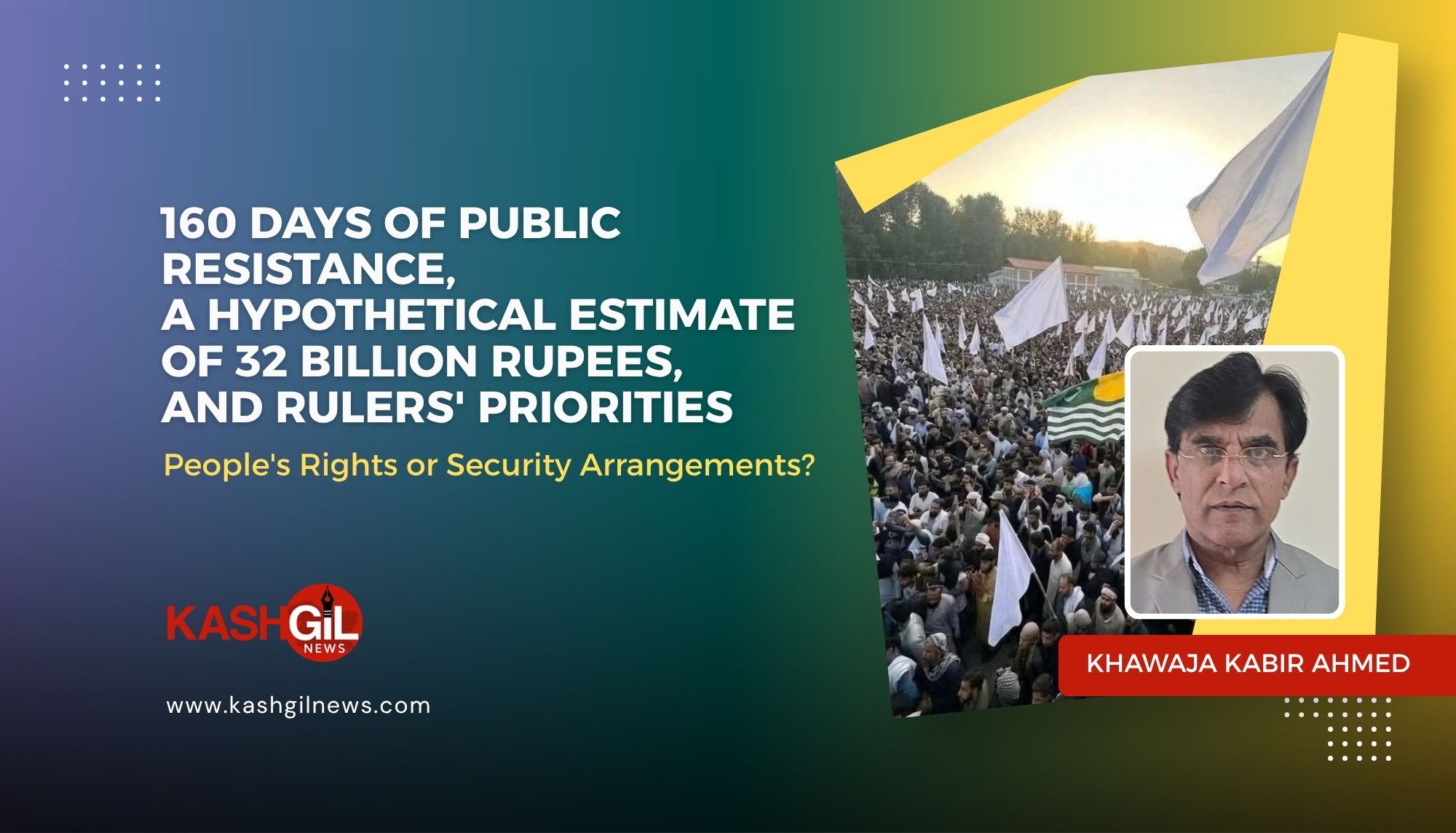
Public rights resistance in the Pakistan-administered State of Jammu and Kashmir has completed 160 days (from late night on June 5 to November 11). This is not merely a movement of a few demands or temporary protests; rather, it reflects long-standing issues tied to the political, economic, social, and fundamental rights of the state’s people, for which the public has been raising its voice for a prolonged period of three and a half years. The 38-point Charter of Demand by the Jammu Kashmir Joint Awami Action Committee (JKJAAC) has given these issues a clear public agenda, which includes cheap electricity, provision of flour, better health and education facilities, employment for youth, interest-free loans, public ownership of natural resources, reduction in government privileges, powers for local governments, and other fundamental demands.
In the context of this prolonged public resistance, a crucial question also relates to the utilization of state resources and governmental priorities. Imagine a hypothetical calculation and think about how different the picture would look if potential expenses incurred on extensive security arrangements responding to public demands were viewed in the context of public welfare.
If it is assumed that 20,000 security personnel were deployed in the state during these 160 days and expenses averaged 10,000 rupees per personnel daily, the total financial cost amounts to an estimated 32 billion rupees. This hypothetical daily cost includes categories such as food, fuel, accommodation, transport, vehicle maintenance and repair, medical facilities, protective equipment, weapons and ammunition-related expenses, tear gas shells, and extra duty allowance.
To clarify this calculation further, 20,000 personnel at 10,000 rupees per head daily make a total daily amount of 200 million rupees. Expenses for 30 days reach 6 billion rupees, and total expenses for 160 days reach up to 32 billion rupees.
A clarification is necessary here: both the number of 20,000 personnel and the daily expense of 10,000 rupees per personnel have been taken purely as computational hypotheses. This is neither a claim of the actual number of deployed personnel nor a verified statement of actual government expenditures of 32 billion rupees. Doing so would require official records, budgets of relevant departments, and financial audits. However, this hypothetical calculation certainly provides an important starting point for considering the potential use of state resources and governmental priorities.
Now the question is: if plans had been made to spend this same hypothetical 32 billion rupees on public welfare, what could have been provided to the people of the state?
Major progress could have been made toward providing MRI machines, CT scans, modern diagnostic equipment, medical facilities, and necessary medical staff in the state’s government hospitals. Basic health units in remote areas could have been made functional so patients would not have to turn to major cities for ordinary treatment. Comprehensive projects could have been launched to improve maternal and child health, emergency services, and medical facilities in rural areas.
In the education sector, steps could have been taken to repair and construct government school and college buildings, establish modern science and computer laboratories, fulfill teacher shortages, and strengthen technical and vocational education institutions. Pathways could have opened for youth employment, skills training, and starting small businesses through interest-free loans.
Efforts to grant the Kashmir Bank the status of a scheduled bank for the state’s economic autonomy could have been financially and administratively strengthened. Resources could have been allocated for practical progress on long-standing public projects like the Mirpur Airport. Economic activities within the state could have been expanded by promoting local industry, tourism, agriculture, hydro-electricity, and small businesses.
Solid steps could also have been taken to protect public rights regarding electricity generated from the state’s natural water resources, provide cheap electricity, and bring real economic benefits to the local population from its resources. Similarly, work could have been done on social protection projects for low-income families, especially the provision of basic necessities like flour, and reductions in health and education expenses.
These are the fundamental issues that the Jammu Kashmir Joint Awami Action Committee has presented to the public in its 38-point charter. Treating these demands merely as protest slogans is essentially ignoring the gravity of these issues. These demands are not for the acquisition of power by any single political party, group, or personality, but concern fundamental changes in the daily lives of the people and a fair share in state resources.
However, the question is not only what the people of the state could have received if these billions of rupees had been spent on public welfare, but also what actually happened despite these heavy expenses? For what purposes were these resources ultimately utilized, and what was their human outcome? The future of those demanding public rights in this region—over a hundred youths lost their lives. A large number of them were university students, PhD scholars, doctors, lawyers, and other educated youth, while innocent children also fell prey to this violence. Incidents of deaths and injuries resulting from the use of war-grade weapons, firing, and other actions against citizens plunged numerous families into irreparable trauma. Reports and concerns also surfaced regarding hundreds of injured individuals being deprived of proper medical facilities and forced to live underground out of fear of arrest or further actions. Arrests, alleged abductions, enforced disappearances, and allegations of silencing those raising their voices for fundamental rights have made the situation even more critical.
This human tragedy cannot be expressed merely in statistics. Behind these deaths are mothers losing their laps, sisters deprived of brothers, families losing supports, innocent children being orphaned, and women being widowed. With the loss of every life, a family’s future was affected, many dreams remained unfulfilled, and the happiness of many homes turned into mourning. If such massive resources were indeed spent on these security arrangements, this question becomes even more significant: did the outcome of these resources manifest as public safety, peace, and the restoration of trust, or did the gulf between the state and the people deepen further?
Here, the responsibility of the 53 members present in the assembly and the government also comes under discussion. The primary duty of public representatives is identifying public issues, legislating for their resolution, ensuring the fair distribution of resources, and holding government institutions accountable. If the public is forced to remain on the streets for months for their fundamental rights, and political negotiations and practical steps are met with prolonged security arrangements rather than responses to their demands, it is natural for questions to be raised regarding the performance of elected representatives and government priorities.
The effects of this policy were not limited to possible financial costs. Prolonged tension has affected business activities, put pressure on the local economy, disrupted educational activities, and created an atmosphere of uncertainty among the public. The bond of trust between state institutions and citizens has weakened. Along with this, serious allegations of human rights violations and concerns regarding citizen safety have also emerged, for which impartial investigations and transparent accountability are essential.
In this situation, another fundamental question is: which institution bore the expenses when security forces were deployed on such a massive scale? Did this financial burden fall on Pakistan’s federal budget, did the relevant security agencies pay from their own resources, or was any amount allocated from the budget of the Pakistan-administered State of Jammu and Kashmir? If expenses were drawn from either state treasury, their details should be brought before the public. Details of the actual personnel strength, duration of deployment, daily expenses, transport, logistics, extra duty, and other financial heads should be published so that the people of Pakistan and Pakistan-administered Jammu and Kashmir can know where and for what purpose the resources of the state system established in their name are being used.
Both governments must also understand that the fundamental problems of public movements cannot be resolved by merely labeling them administrative or security issues. The demands for political, economic, and fundamental rights of the people are answered not through the use of force, but through serious negotiations, transparent governance, justice, and the restoration of public trust. Setting a clear timeline for implementing the agreement and public charter accepted on October 4, 2025, and making progress transparent to the public is imperative.
The people of Jammu and Kashmir have every right to ask why public welfare is not given primary importance in government priorities when their hospitals lack modern machinery, educational institutions are deprived of basic facilities, youth are distressed for employment, electricity and flour issues exist, and demands are made for the fair distribution of benefits derived from natural resources.
The 160 days of public resistance, the (hypothetical) count of 20,000 personnel, the (hypothetical) expense of 10,000 rupees daily per personnel, and the calculation of 32 billion rupees certainly raise a question: what is the best utilization of state resources? Solving people’s problems or maintaining prolonged security arrangements against public protests?
This debate is not meant to prove any hypothetical figure as absolute reality, but to prompt rulers to reconsider state priorities. Even if this hypothetical estimate of 32 billion rupees turns out to be lower or higher in reality, the core question will remain: to what extent are the state’s limited resources being utilized to improve people’s lives?
Rulers must now adopt political sagacity, negotiations, and the path of justice instead of stubbornness, ego, and force. They must ensure the implementation of agreements by accepting public demands. Because the strength of any state is determined not by the breadth of its security arrangements, but by public trust, economic prosperity, the protection of fundamental rights, and the delivery of justice.
The state’s treasury is a trust of the people; it should be spent on improving people’s lives, not on arrangements to indefinitely suppress demands for fundamental rights.
Explanatory Note: The estimated calculation of 32 billion rupees presented in this article is based on an approximate calculation made by human rights legal expert Yasir Shafaat. Various hypotheses form the basis of this calculation. The credit for this estimate and calculation goes to Yasir Shafaat. This is not certified official financial statistics, but an estimated calculation of potential expenditures.
٭٭٭
Share this content: