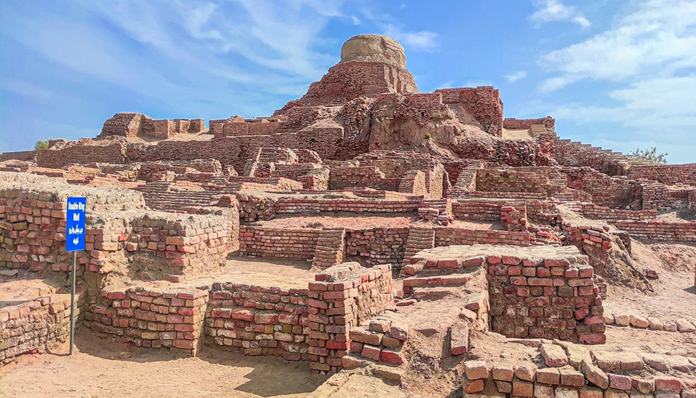
A recent post on social media by the Indian Ministry of Culture has sparked a new debate between Pakistan and India regarding the historical heritage of Mohenjo-Daro and its ownership. This 4,500-year-old historical site, which is part of the Indus Valley Civilization, is located on the banks of the Indus River in Larkana district of Sindh province of present-day Pakistan and was declared a World Heritage Site by the United Nations Educational, Scientific and Cultural Organization (UNESCO) in 1980.
The Indian Ministry of Culture made a detailed claim by sharing a picture of an ancient seal (seal made of steatite stone) discovered at Mohenjo-Daro on the social media platform ‘X’ (formerly Twitter).
The Indian ministry said, “This approximately 4,300-year-old seal is one of the most powerful symbols of India’s continuous cultural heritage. It depicts a figure seated in a yogic posture (Milabandhasana), commonly believed to be ‘Shiva Pashupati’.”
The ministry further wrote, “Although the ancient ruins lie on the other side of the modern-day border (in Pakistan), the real custodian of this heritage is India.”
According to Indian officials, the yogic posture, Shiva-related symbols and spiritual thought seen in the Pashupati seal are still alive and active in Indian temples, daily worship, yoga traditions and cultural life, and have been a continuous cultural chain from the Vedic period to present-day India.
On the other hand, historians, experts and Pakistani consumers have rejected this claim as contrary to reality.
According to the Pakistani position, geographically and historically, the ancient cities of Mohenjo-Daro and Harappa are located within the boundaries of present-day Pakistan, so history is related to the land where it takes place.
Experts say that the Indus Valley Civilization had nothing to do with Hinduism or Shiva, it was a separate and unique civilization that is now completely within the geography of Pakistan.
During the partition of the subcontinent in 1947, the rare artifacts recovered from this place were divided between the two countries, but since it is in Pakistan, Pakistan has the right to maintain and own it.
This post by the Indian ministry has received strong reactions from users of both countries.
Pakistani users’ reaction:
Senior journalist Raza Rumi wrote that “This is the heritage of the Indus Valley Civilization and in fact Mohenjo-Daro is located in Pakistan.” Journalist Mehwish Ijaz sarcastically wrote, “Mohenjo Daro is in Pakistan. The audacity to claim something that is currently in Pakistan, by this logic, we should claim the Taj Mahal.” Another user said that what happened in Germany is German history, not French, similarly what happened in Pakistan is Pakistani history.
Reaction from Indian users:
Some Indian users appreciated the post, saying that it reminded them of their ancient roots. However, there were also several Indian users who disagreed with the official position and raised the question that this seal has no connection with Shiva.
Mohenjo Daro: ‘Mound of the Dead’:
It should be noted that Mohenjo Daro (in Sindhi: mound of the dead) was a very modern and organized city of its time, where around 40,000 people lived in 2500 BC. The city was excavated by the efforts of British archaeologist Sir John Marshall and Indian officer R.D. Banerjee. The city is considered a world-class example of cleanliness and urban planning, with a more advanced sewage system, covered drains, private toilets in homes, and a large ‘Great Bath’ compared to its contemporaries (Egypt and Mesopotamia).
Share this content: