by: Khawaja Kabir Ahmed
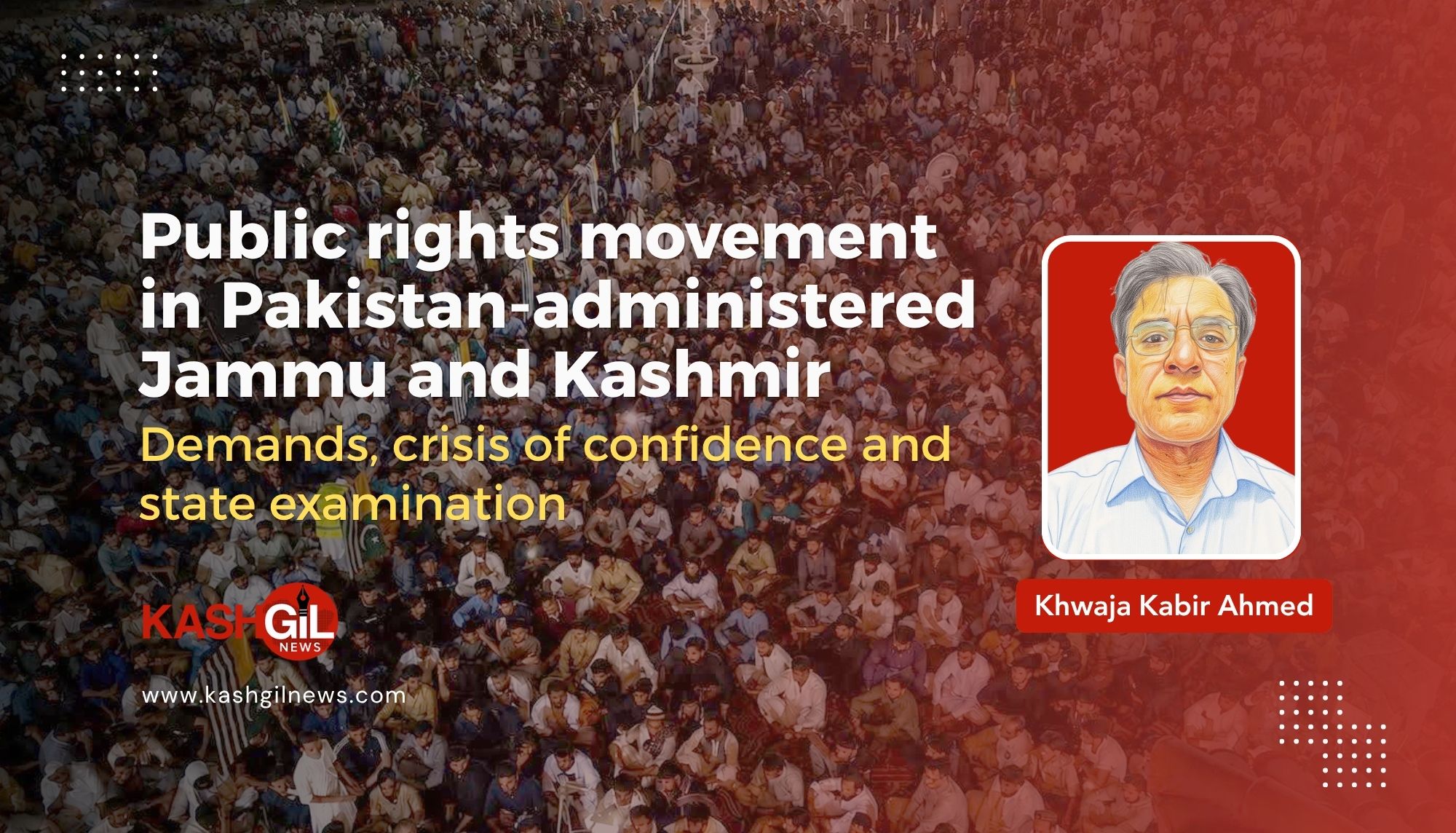
The ongoing public rights movement in the Pakistan-administered state of Jammu and Kashmir has once again entered an important and sensitive phase. The movement, launched from the platform of the Jammu and Kashmir Joint Public Action Committee, has long oscillated between public demands, protests and negotiations, and is now once again taking the form of a major public march and protest wave.
An indefinite shutter-down and wheel-jam strike has been announced in the entire region from June 9, while a major protest march will start from Bhimber and Mirpur on the same day, passing through Kotli and reaching Rawalakot. People from all the cities and towns along the way will join this march. On June 10, the convoy will advance from Rawalakot towards Muzaffarabad, where other protest marches from Muzaffarabad division will also join it. After this, a peaceful sit-in and siege will be held in front of the assembly, which has been announced to continue until there is practical progress on the Charter of Demands.
The circles associated with the movement maintain that all their demands have not only been recognized as legitimate, but have also been promised to implement them by the government and state institutions on various occasions. Now the main question is to put these promises into practice so that the growing crisis of trust between the people and state institutions can be ended.
The Charter of Demands includes basic points such as the abolition of refugee seats, the abolition of special privileges enjoyed by the elite, the right of ownership and control of state resources by the local people, and strengthening public representation. The movement maintains that true democratic governance is possible only when the people have direct control over their resources and future decisions.
The most important aspect of this long-running popular movement is its peaceful character. The Jammu Kashmir Joint Public Action Committee has been continuously proving for the past three years that its path of struggle is not violence but public pressure, political awareness and peaceful resistance. During this period, the committee did not damage any government building, nor did it target public or private property, nor did it resort to any armed action.
On the contrary, in the past stages of protest, precious human lives were lost due to government incompetence. These same incidents left deep wounds in the public memory and even today, distrust and anxiety are still alive among the people. That is why this time, when another peaceful protest movement has been announced for June 9, the eyes of the people are focused on the behavior of the state institutions.
This time, reports of deployment of a large number of additional forces and armed commandos in different areas of the state have come to light long ago. This situation has created concern not only among the local population but also among millions of Kashmiris living around the world. Kashmiris living abroad are expressing concern for their families and homelands and are questioning why such extraordinary arrangements are needed before a peaceful protest.
This situation also raises questions because a few days ago, Prime Minister Faisal Mumtaz Rathore had said in a media interview that cold water and medical facilities would be arranged for the participants of the protest march. If the government considers this protest to be a democratic and peaceful process, then the public is right to ask what is the purpose of the deployment of additional forces and tight security arrangements.
In such circumstances, the government should opt for confidence-building instead of a show of force. If the Joint Public Action Committee has repeatedly assured that this protest will be peaceful and its struggle for the last three years is also a witness to this claim, then state institutions should also avoid such steps that could increase public anxiety.
This movement is not limited to internal administrative matters but is also having an impact on the overall political narrative of the region. This is also an important opportunity for Pakistan to set an example of public rights, transparent governance and political inclusion in its administered areas that can further strengthen its international position.
The circles associated with the movement are of the opinion that the relationship between the state and the people should be based on mutual consent, public inclusion and trust rather than force. According to them, a sustainable and peaceful political system can be formed only when the voice of the people is heard and the demands that have been justified by various government and state circles in the past are implemented.
The current situation has entered a phase where the real test is the implementation of promises, restoration of public trust and political insight. If the government and state institutions make immediate and practical progress on the previously recognized demands, not only can potential tensions be avoided but also the relationship of trust between the people and state institutions can be strengthened. Otherwise, this crisis could deepen and push the region towards a new political and social conflict.
The next few days could prove decisive in this regard. The question is not just how big the protests will be, or what the nature of the government’s violence against peaceful people will be, but rather whether the state will pursue dialogue, trust and a political solution with its people or once again try to solve a problem through force and pressure whose permanent solution lies only in public trust and the practical implementation of the Charter of Demands.
***
Share this content: