by: Khwaja Kabir Ahmed
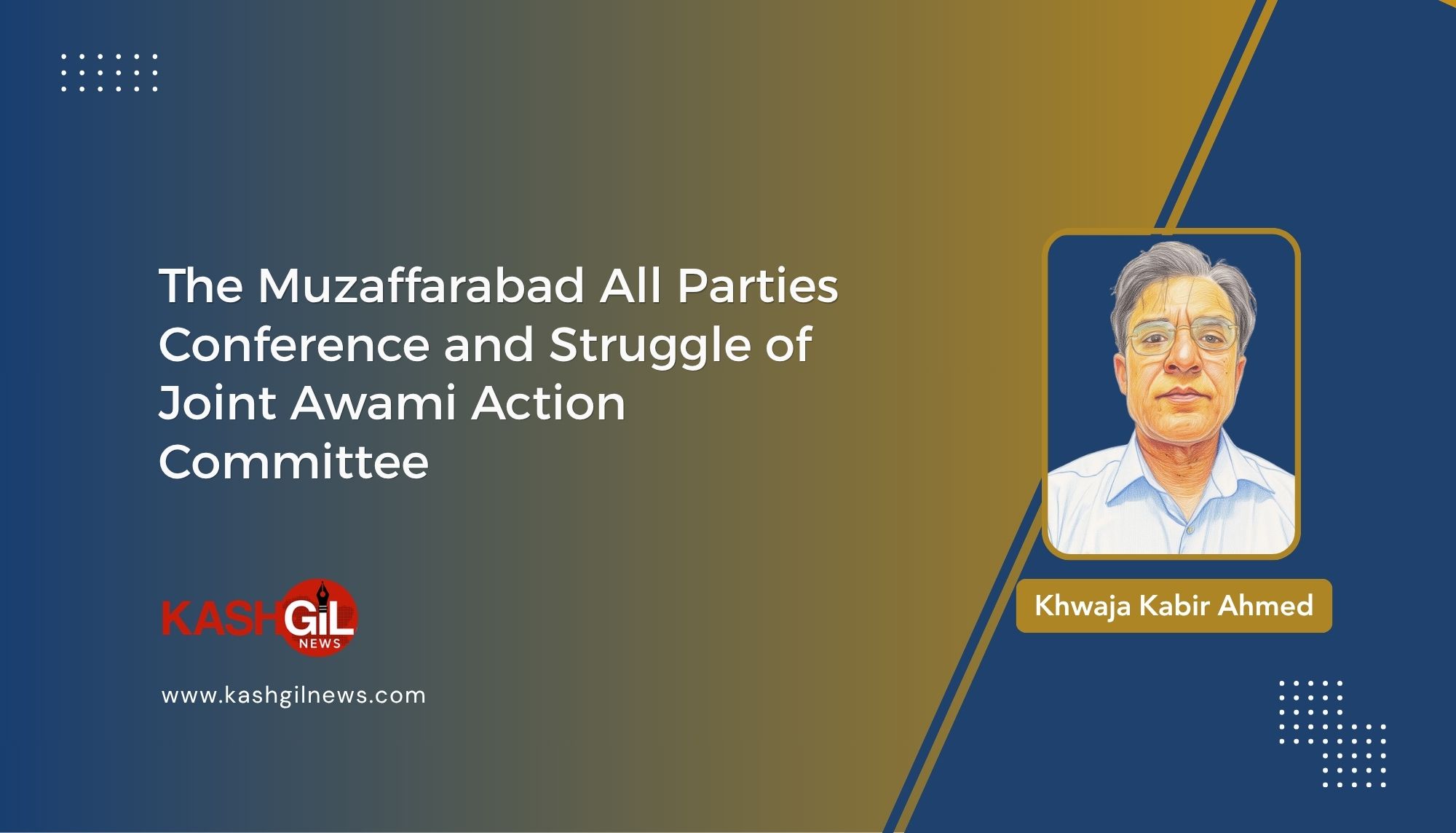
No matter how much the participants tried to present the Emergency All Parties Conference held in the administrative city of Muzaffarabad in Pakistan-administered Jammu and Kashmir in flattering terms, facing the ground realities, it seems more appropriate to call it a conference for the protection of political interests rather than public interests. After reading the declaration of this conference, the first question that arises is that how do those political parties that have been sitting in the halls of power for the past several decades, being the guardians of public resources and the owners of decisions, have the moral standing to give advice to a non-partisan movement that is rising for public rights today?
The movement of the Jammu and Kashmir Joint Public Action Committee is not a product of any election season. This movement was organized around the real problems faced by the people for the past three years. High electricity prices, unfair taxes, skyrocketing prices of flour and essential commodities, people’s rights over state resources and demands for better governance have been the main agenda of this movement. These are the issues that the common citizen faces every day, not the political elite who live under the protection of government privileges, protocols and power.
The All Parties Conference declaration attempted to give the impression that the public demands have been largely fulfilled and there is no room for further protests. If this is indeed the case, then the question arises as to where the points of the Charter of Demands of the Joint People’s Action Committee on which consensus was reached during the negotiations were implemented? The people still remember the promises made repeatedly, they also remember how the negotiating table was set up, announcements were made, assurances were given and these same promises were abandoned as soon as the situation returned to normal.
The biggest problem of political parties is not that the Joint Public Action Committee is wrong, but rather the real problem is that it has taken the people out of the traditional sphere of influence of political parties and united them on their issues. This is why whenever a non-partisan movement for public rights gains strength, there is unrest in the centers of power. Sometimes it is declared as an external agenda, sometimes it is called anarchist and sometimes it is presented as a threat to the democratic process.
The shutter-down, traffic jam and sit-in in front of the Legislative Assembly announced on June 9 are not the result of a sudden situation but a logical reaction to continuous broken promises, ignoring public problems and government indifference. If the problems of the people had really been resolved, the streets would have been populated as usual without any appeal. The people protest when they feel that their voice has stopped reaching the houses of power.
It is also important to understand the background of this conference. At a time when preparations are being made for a large public gathering and protest on the call of the Public Action Committee, the coming together of all the traditional political forces is not a mere coincidence. This gathering actually gives the impression of a political alignment in the face of public pressure. It seems that the real concern is not public issues but the political status, electoral influence and privileges that are at stake with the emergence of a powerful public movement.
The beauty of democracy lies in disagreement, but the greatest principle of democracy is also that the voice of the people should be heard. If millions of people are ready to take to the streets, then wisdom requires not to defame them but to take their demands seriously. Political parties have to accept the fact that the people are no longer just a crowd of election rallies but have become conscious citizens raising questions about their rights, resources and future.
You have the right to disagree with all the demands of the Joint Public Action Committee, they can be discussed, but they cannot be dismissed through mere political propaganda. The real test of the government and political parties is how much they fulfill their promises and how much accountability they provide to the people.
The serious call of the time is that the ruling forces and the government should understand the public sentiments, ensure immediate and complete implementation of the Charter of Demands recognized by the Joint Public Action Committee and stop the series of anti-people policies and continuous breach of promises. Because public problems can be suppressed by temporary announcements but cannot be eliminated. When the people rise up for their rights, even the most powerful political alliance cannot silence their voice for long. And the people of Pakistan-administered Jammu and Kashmir have now risen up.
Share this content: