Kashgil News Special Report
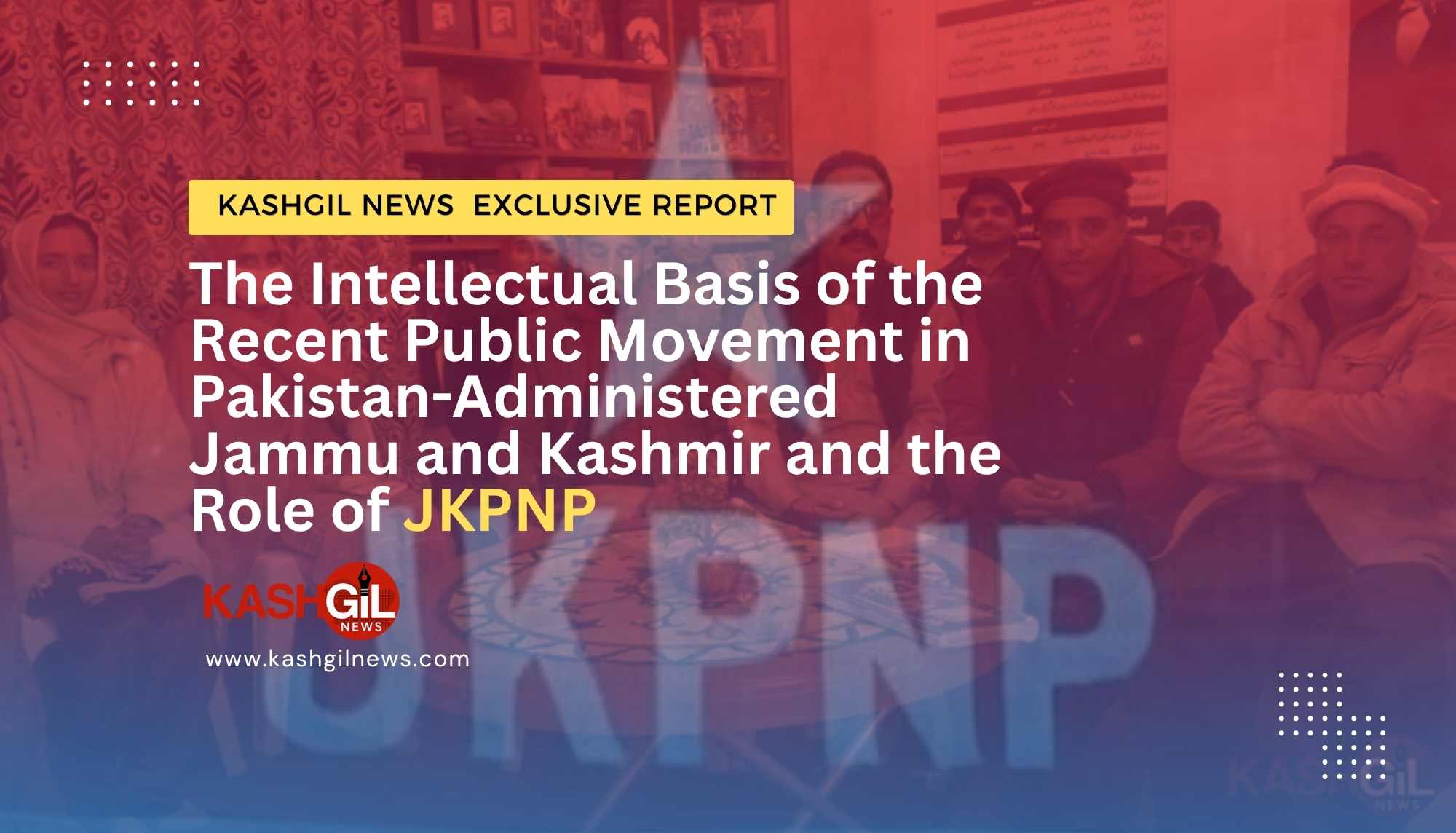
To understand the recent popular movement in Pakistan-administered Jammu and Kashmir, it is essential to examine its historical and political background. The intellectual roots of this movement go back to the period when General Zia-ul-Haq’s military government was in power in Pakistan and the environment for political activities, freedom of expression and dissent was extremely limited.
During this stifling period, the Jammu Kashmir People’s National Party (JKPNP) presented its position on the political status of the region, people’s rights and democratic principles. At a time when it was impossible to openly discuss many sensitive issues due to state power and political pressure, the JKPNP did not compromise on its ideological stance and boldly highlighted the long-standing political problems of the region.
Jammu Kashmir Peoples National Party (JKPNP) is the first left-wing political party in Jammu and Kashmir, which took a categorical and unambiguous stand that Pakistan was the first aggressor and occupier of Jammu and Kashmir. As a result of this principled, progressive and freedom-loving politics, the party has been facing continuous state repression, political revenge and systematic targeting since the first day of its inception.
At that time, these revolutionary ideas of the party faced severe opposition and were considered controversial. However, with the passage of time, there has been a clear change in the political situation of the region, public consciousness and perception of the ground issues. The points under discussion in this vast public movement today have a deep similarity to the same questions and demands that JKPNP raised many decades ago.
To crush this awareness of rights and the public movement in the region, the state is now using extraordinary and brutal tactics, due to which the state brutality that has been going on for more than a month has made the situation extremely tense.
Today, the entire current leadership of the party—including Central Chairman Wajid Ali Wajid Advocate, Secretary General Ilyas Kashmiri, former Chairman Zulfiqar Advocate, Kiran Kanwal, Shahzad Hasrat, Salma Hameed and several other leaders and women leaders—are under attack, harassment, arrests, threats and severe political pressure. The bank accounts of these active leaders and workers have been frozen, while their CNICs (National Identity Cards) and passports, along with other travel documents and mobile SIMs, have been blocked, severely restricting their movement, causing them severe difficulties in their daily affairs, financial transactions and communication facilities.
Although no official position has been taken by the relevant authorities on the legal basis of these measures, these fascist measures are not just against a few individuals, but are a systematic attempt to forever silence the leftist thought in the region that opposes imperialism, militancy, occupation and all forms of oppression.
The scope of these retaliatory measures to suppress the movement has now spread to public properties and academic centers, under which the famous ‘Kimon Library’ established in Bagh district has also been sealed. Local circles have expressed deep concern over the decision to close educational and academic centers, saying that it will adversely affect students, researchers and general readers. At the same time, active government employees involved in the movement are being dismissed from their jobs, and the houses, shops and private properties of those leading the protest are being taken into government custody.
According to regional reports, during raids, forces are violating the sanctity of the chador and the four walls, entering houses and subjecting women and children to torture and harass them, while an attempt is being made to economically paralyze them by wiping out cash, gold and other valuables in the houses in order to silence the public voice.
According to the party manifesto, this is not just an individual issue of the Jammu Kashmir Peoples National Party, but a question of the future of democratic politics, freedom of expression, political pluralism and left-wing politics in Jammu and Kashmir. If a peaceful political party is walled up simply on the basis of its ideology and advocacy of public rights, it clearly means that the entire democratic process is at stake.
In this context, the role of the JKPNP can be seen as an important and fundamental chapter in the political history of the region, where voices raised in a limited and violent political environment became part of a wider popular movement and debate in later periods. Today, it has become imperative for all democratic forces, human rights organizations, intellectuals and the international community to condemn this political vendetta, because silence always strengthens oppression, while democracy is strengthened only by respecting dissent and protecting political freedoms.
Share this content: