Story: Farhan Tariq
Following the tribal incursions of 1947 and the subsequent war, a line was drawn across the state of Jammu and Kashmir—a line that not only severed families and communities from one another but also fragmented a centuries-old religious, cultural, and historical heritage.
Hindu and Sikh families once resided in significant numbers across various regions of the state of Jammu and Kashmir. Their religious centers—temples, gurdwaras, and other historical structures—were integral to the local society and culture.
However, during the violent events of 1947, a large number of these people were forced to abandon their homes, properties, and businesses, migrating to safer locations.
Over time, many of the religious centers belonging to these communities fell into desolation.
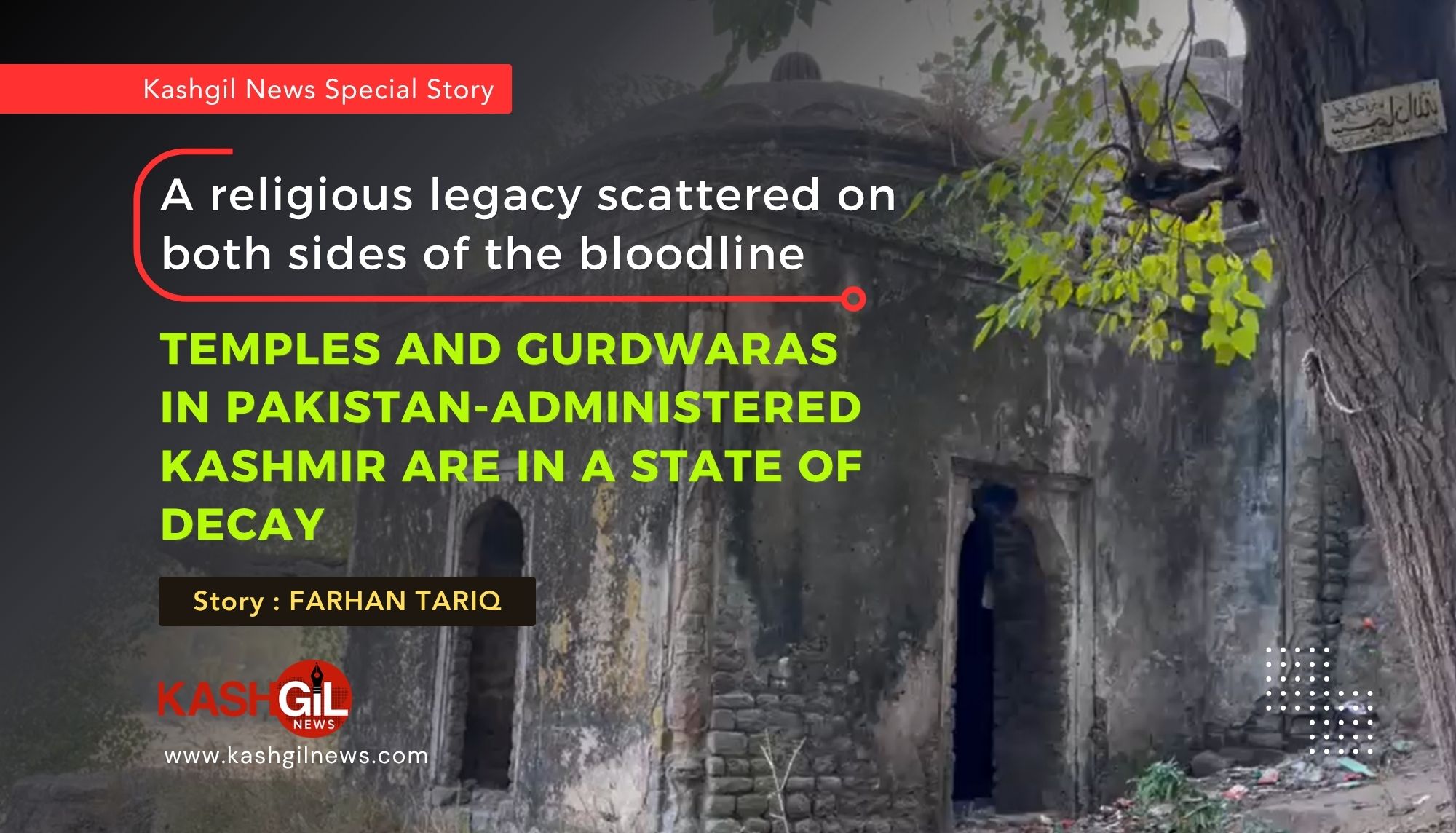
Today, numerous ancient temples and gurdwaras still exist in Pakistan-Administered Kashmir; however, many are in a state of severe disrepair due to a lack of proper maintenance. In some instances, these religious structures have lost their original identity, while in others, new construction has encroached upon or surrounded them.
In the Kotli district—one of the major districts in Pakistan-Administered Kashmir—there are several such religious and historical buildings; their dire condition raises questions about their future.
According to local residents, in some places, the pathways or portions of these ancient places of worship have become so hemmed in by new construction that preserving their original identity is becoming increasingly difficult. Meanwhile, other structures are gradually crumbling into ruins. Beyond Kotli, remnants of historical places of worship associated with the Hindu and Sikh communities can also be found in various areas of the Muzaffarabad and Poonch divisions.
In Muzaffarabad, the regional capital, some ancient temples and gurdwaras have become hemmed in by large, modern buildings. In certain instances, there have also been local complaints regarding the encroachment upon land associated with these religious sites.
In the Poonch division as well, numerous ancient temples and gurdwaras have either been demolished or have fallen into a state of severe disrepair.
Local residents argue that these structures should not be viewed merely as places of religious worship; rather, they serve as markers of the region’s shared history and cultural diversity.
The Department of Archaeology—but where is the preservation?
While a Department of Archaeology exists in Pakistan-administered Kashmir to oversee the preservation of historical buildings and sites, the question remains: what practical steps have actually been taken to protect these historical places of worship associated with minority communities?
Is there an official record of all the ancient temples and gurdwaras located in the region?
What is the legal status of these buildings and the land attached to them?
Do they hold the status of “historical heritage”?
And if the condition of these structures continues to deteriorate, how will the markers of this region’s shared history be preserved for future generations?
To address these questions, it is essential to consider the perspectives of the Department of Archaeology, the district administration, and other relevant authorities.
More than just religious heritage—a shared history
According to historians, ancient religious structures in any given region are not merely places of worship; they also serve as a record of the area’s social, cultural, architectural, and religious past. The temples and gurdwaras found in Pakistan-administered Kashmir serve as symbols of the centuries-old presence of diverse religious communities in the region.
Following the Partition in 1947, the populations associated with these structures largely migrated away; however, the buildings and religious sites they constructed remain, serving as a reminder of that era.
Preserving these vestiges of the past is not merely a concern for any single religion or community; rather, it is a matter of safeguarding the collective history of the entire region.
For when an ancient temple or gurdwara falls into ruin, it is not just a building that is lost—a chapter of the region’s history is erased along with it.
The line drawn in 1947 divided families across the divide; today, however, the passage of time and a lack of attention threaten to extinguish these historical and religious landmarks forever.
Share this content: