Written by: Sardar Aftab Khan
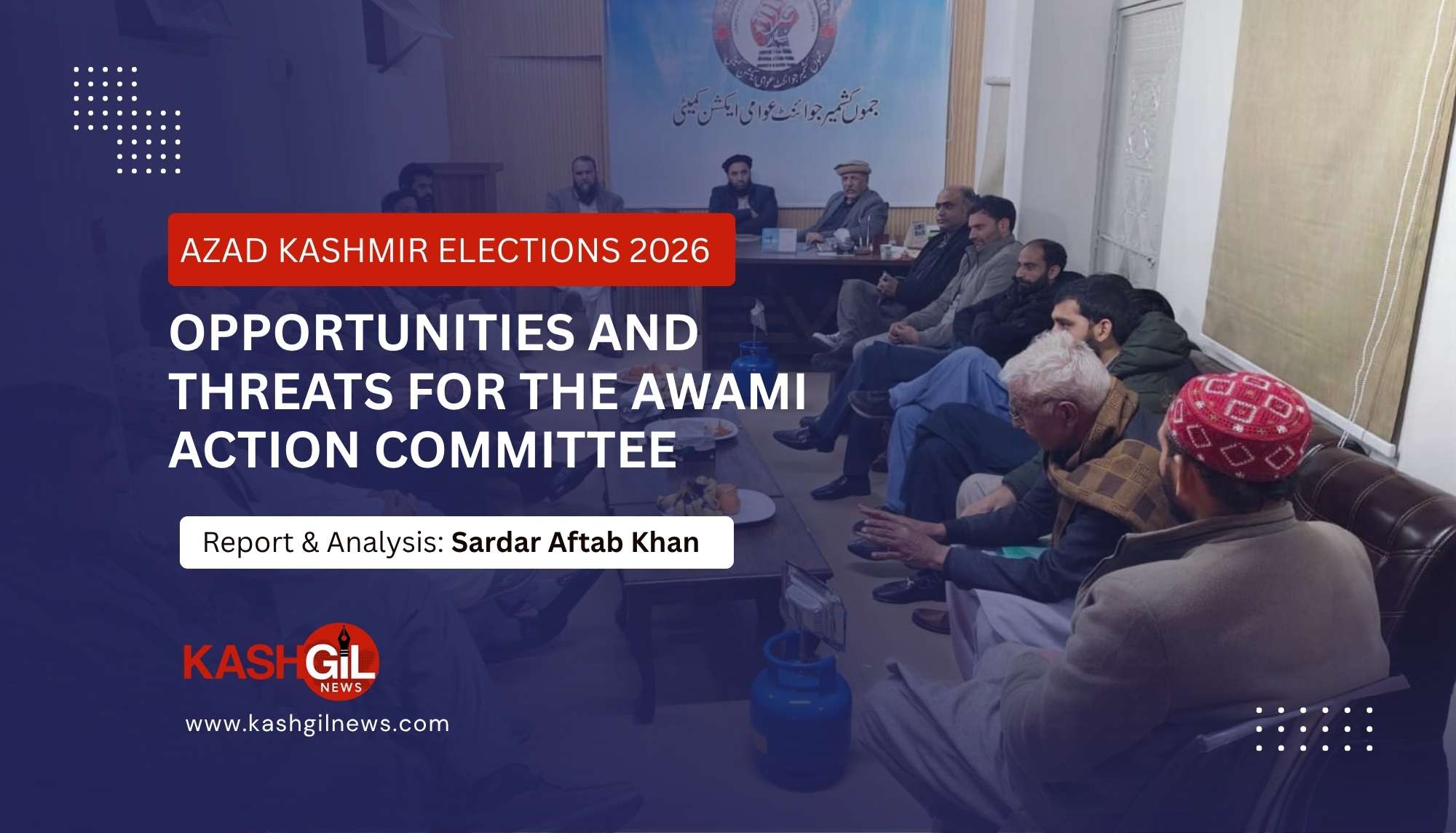
An analysis of the political situation of the Jammu Kashmir Joint Awami Action Committee with regard to the 2026 elections to the Pakistan-administered Kashmir (Azad Jammu and Kashmir) Assembly has been presented.
Azad Jammu and Kashmir is entering the 2026 election phase at a juncture where three realities stand out simultaneously:
- The growing public disenchantment with traditional political factions
- The still incomplete progress arising from the Muzaffarabad Agreement of 3-4 October 2025, and
- The public expectations that this rights movement will now have to show not only moral courage but also political maturity.
The Jammu Kashmir Joint Public Action Committee did not emerge as an electoral alliance. It emerged from the realization that the common people were being subjected to long-standing injustice in the areas of electricity, daily amenities, accountability, representation and ownership of state resources and the democratic right of the people to govern themselves. This real truth and public awareness is the greatest strength of the Jammu Kashmir Joint Public Action Committee, because it has not earned its credibility through the patronage of any family, powerful institutions or the door of power, but through the struggle of the people.
Therefore, the real question is not just whether the Jammu Kashmir Joint Public Action Committee should fight the elections or boycott them. The real question is how the movement can transform its influence into constitutional and democratic power while maintaining its unity, public trust and moral superiority.
- The current political moment
The Muzaffarabad Accord brought about a fundamental change in the politics of Azad Kashmir. For the first time, public grievances were formally acknowledged at the government level and decision-making centers, demands were formulated into actionable points, and a monitoring and implementation structure was established. This was not just a temporary political compromise but an acknowledgement that peaceful public pressure had forced the state to respond seriously.
But the implementation of this agreement has not been uniform. There has been progress on some issues, such as the reduction in the number of administrative departments and ministries, the release of political prisoners and the reinstatement of dismissed employees, payment of compensation to the families of martyrs and injured persons, open merit, some measures related to tariffs, some progress in education boards, and a few decisions related to telecom and health cards and public amenities. But the issues that are at the heart of trust, justice and political equality are still unresolved or controversial. So the biggest crisis is not just one of delivery, but of credibility.
Progress has been made, but unevenly. Therefore, the Jammu and Kashmir Joint Public Action Committee can rightly say that the organized and peaceful struggle has produced results.
The trust gap persists. The question of refugee/non-territorial seats, the framework of abstentions stipulated in the agreement, judicial accountability, and the fundamental points of transparency are yet to be fully resolved.
Public expectations are higher than ever. Once a government signs an agreement, delay is seen not just as laziness but as a potential betrayal.
Election time has added pressure. Now every incomplete point is taking on political significance and every statement is being read in an electoral context.
- Public mood: Hope, hurt, caution
The public mood of Azad Kashmir is not simple or one-sided. People remember the sacrifices, feel the daily hardships, and have now also understood that collective and organized struggle can move institutions. That is why the public is both hopeful and skeptical. They want change but do not want another political outlet.
That is why the most important voter for the Jammu and Kashmir Youth Public Action Committee is one who values honesty, discipline, and evidence more than slogans. The people will trust more a leadership that speaks the truth, defines the boundaries, and shows a workable path rather than impossible promises.
When bread, electricity, employment, and dignity are linked to a rights narrative, the public response becomes more powerful.
People do not want permanent chaos; they want protection from protest and a credible path from grievance to institutional resolution.
There is clear scope for alternative leadership among the youth, the middle class, affected families, and citizens who are fed up with traditional politics.
However, if the movement gives rise to the impression of chaos, egoism, or unprincipled compromise, these same people can also react strongly.
- Strengths of the Jammu Kashmir Joint Awami Action Committee
Moral legitimacy. The credibility of the Jammu Kashmir Joint Awami Action Committee and the Awami Rights Movement did not arise from the court of power but from the public arena.
Class and geographical breadth. It gave a common language to workers, traders, students, government employees, affected families, and people from different districts.
Thematic superiority. The narrative on issues like power justice, representation reform, transparency and accountability was established by the Jammu and Kashmir Joint Awami Action Committee.
Documented seriousness. Through letters, minutes, scorecards and Terms of Reference (TORs), the movement established itself as an evidence-based people’s force.
Believable story. The movement can honestly say that it demanded rights, not privileges; acknowledged progress; and demanded evidence where there was none.
- Weaknesses and Threats of Jammu Kashmir Joint Awami Action Committee
Organizational Pressure. Internal differences on the question of elections can lead to division if not handled in a principled manner.
Lack of administrative experience. A different kind of preparation is required for vetting candidates, financial transparency, legal requirements and policy implementation.
Rhetorical Attacks. On the one hand, opponents will try to portray the movement as an irresponsible protest force and on the other hand, as hypocrites if they are elected.
The risk of the movement being taken over. If personal desires prevail over collective order, the movement will also start looking like traditional politics.
The risk of excessive resistance. Calls to stop or stall the elections can go against the movement without broad public, moral and legal justification.
- The Real Strategic Choice
A total of four paths emerge at this point, and each path has its own implications.
Complete boycott. This path can preserve the movement’s original non-electoral identity and can also send a moral message against disloyalty. But if there is no strong public consensus behind it, it will vacate the field for the same old political characters that the movement has been challenging.
A movement to stop the elections until implementation. It may have emotional appeal, but politically it is the most risky path. This could shift the focus of the struggle from accountability to resistance to the electoral process, which could weaken the constitutional position of the movement.
Direct entry of the Jammu and Kashmir Joint Public Action Committee into the elections in a party-based manner. This may give immediate recognition, but for now it is a premature step. This could lock the entire movement into an electoral mold for which complete institutional readiness is not yet in place.
Supporting like-minded independent candidates on the basis of the manifesto while maintaining the movement. This is the most balanced path. In this, the movement can also enter the institutional arena while preserving its original identity, and the people can be united around a legal program instead of personalities.
- Possible future scenarios
It is wise to adopt a strategy that is viable in more than one possible scenario.
Scenario A: Some progress continues but the core political issues remain stuck
This seems the most likely scenario. In this, the Jammu and Kashmir Joint Public Action Committee should neither reject every development nor remain silent despite incomplete implementation. The right path would be to acknowledge where real progress has been made, and where core issues are pending, the next step would be to take a manifesto and public oversight.
Scenario B: Sudden announcements and concessions come before the elections
This is certainly welcome, but the difference between announcement and implementation should be kept clear. Every claim should be accompanied by documentary evidence, notification, timeline and public oversight.
Scenario C: Democratic space shrinks or vindictive atmosphere increases
If such an environment is created that democratic participation, freedom of expression, or the process agreed upon in the Muzaffarabad Agreement becomes unsafe, then the movement can take steps such as protest, legal action, and review of the conditions of participation in the Monitoring and Implementation Mechanism under its constitutional right.
Scenario D: Public pressure increases to such an extent that it is no longer possible to avoid participating in elections and representation in the assembly
If the people themselves demand in large numbers that the movement should now represent them in the elected decision-making bodies as well, then this demand should be answered not with haste or personality cultism, but with a strong manifesto, scrutiny, and strict public accountability.
The strongest political position for the Jammu and Kashmir Joint Public Action Committee is neither complete isolation nor hasty formation of a party. The better path is for the movement to retain its original public and monitoring identity, keep the issue of implementation of the Muzaffarabad Accord alive, and if internal consensus and public atmosphere permits, enter the electoral arena only on the basis of a strong public legal charter.
The people do not want another noisy political machine. They want a force that is principled in protest, mature in strategy, and reliable on the issue of governance. This is the historic opportunity before the Jammu and Kashmir Joint Public Action Committee in 2026.
Documentary Base and Source Notes:
This document has been prepared in the light of the implementation records of the Muzaffarabad Accord, official correspondence of the Jammu and Kashmir Joint Awami Action Committee, Public Compliance Scorecard, ToRs of the Monitoring and Implementation Committee, minutes of the meeting of 5 January 2026, notifications and correspondence of the High-Powered Committee on Non-Regional/Refugee Seats, and the principles of the International Covenant on Civil and Political Rights. Its aim is not traditional election propaganda but rather to provide a serious public document based on public interest, democratic governance, and civil rights. Amount
٭٭٭
Share this content: