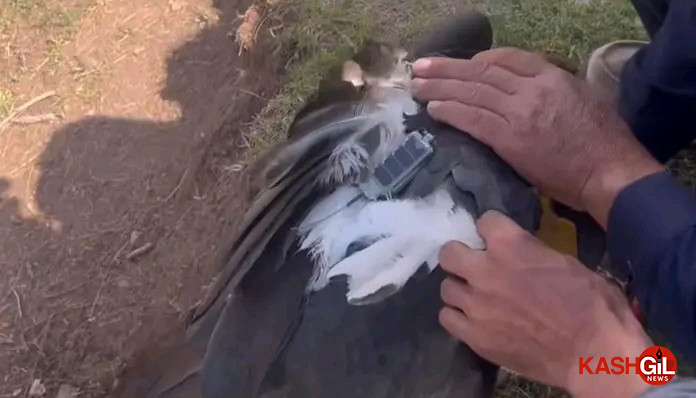
A rare and critically endangered vulture equipped with a modern GPS tracking device has been found in the mountainous areas of Pir Chanasi, a tourist destination in Pakistan-administered Kashmir, and the Wildlife Department will soon release it back into the wild.
According to the viral video, the vulture was recorded on Monday by local resident Zain Raja, in which it can be seen that the bird landed in a weak state due to hunger and exhaustion. Locals surrounded it and examined it closely.
According to the Wildlife Department, the bird is a “White-rumped Vulture”, scientifically known as Gyps bengalensis. It was identified by the white mark on its lower back. The bird was also equipped with a solar-powered GPS transmitter and a yellow wing tag, on which “F49” was written.
The International Union for Conservation of Nature has declared this species as “critically endangered”.
According to Dr. Shaista Ali, Monitoring Officer of the Wildlife Department, the vulture reached Kashmir through the Himalayan corridor, traveling more than 1,000 kilometers from Nepal. He said that GPS tagging, the “Jatayo Restaurant Project” and the Kasara Breeding Center are playing an important role in the ongoing programs for the conservation of vultures in Nepal.
According to Dr. Shaista Ali, the presence of “F49” in Pir Chanasi is evidence that these rare vultures are reusing the historical migration routes connecting Nepal, India and Pakistan.
He added that the population of the white-rumped vulture had decreased by about 99 percent in the 1990s due to the veterinary drug diclofenac, but recent conservation measures are now giving hope for their return.
The wildlife department’s range officer, Jazba Shafi, said the bird was temporarily kept at the military installation in Pir Chanasi to check the installed equipment and ensure that it was not being used for any other purpose.
He said the bird was being provided with proper food and would soon be handed over to the wildlife department and released back into the wild.
According to experts, the presence of this rare vulture is a sign that the Himalayan region still serves as an important ecological corridor for global biodiversity and wildlife migration.
Share this content: