Islamabad / Kashgil News
Despite government claims of progress in the education sector in Pakistan, the situation remains alarming.
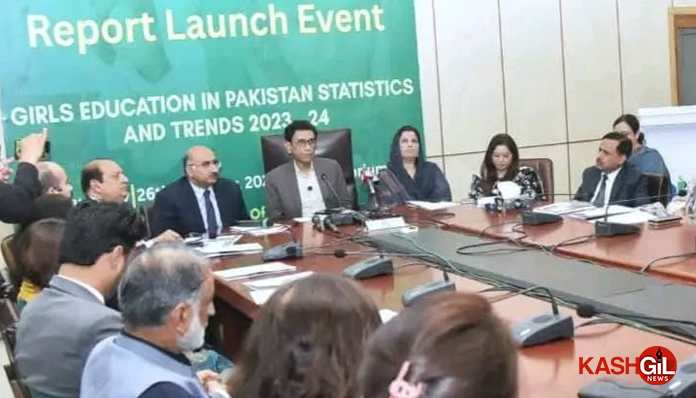
According to the Girls Education Statistics and Trends report released by the Federal Ministry of Education, 26.2 million children are still out of schools in Pakistan, including 13.4 million girls, while the total youth population has reached 140 million.
According to experts, these figures raise serious questions about the claims of national development.
At the launch of the report, Federal Education Minister Khalid Maqbool Siddiqui admitted that the main reasons for dropping out of school include social attitudes, domestic restrictions and lack of opportunities. He said that “the girl in whose hands the state gives a degree, she must also be given the right to move forward,” which is an indication that the obstacles faced by girls at the practical level still persist.
While the report mentions the primary completion rate of 89 percent for girls and the solid buildings of 96 percent of schools, several harsh facts have also come to light. The education budget has been reduced from 13 percent to 11 percent, while 94 percent of the funds are spent on salaries, due to which resources for development projects have been left almost non-existent.
According to the data, only 23 percent of schools have ramps for disabled students, the facility of digital devices is limited to only 19 percent of institutions and the special education system seems almost ineffective. Malnutrition has also been declared a major obstacle to the mental and physical development of children.
Interestingly, in the National Achievement Test, girls are performing better than boys in English, Urdu/Sindhi, mathematics and science subjects, however, their representation in the practical field does not exceed 24 percent. According to experts, “the talent is there but the opportunities are missing.”
The report warns that due to increasing population pressure, the availability of schools per thousand children is decreasing, while the rate of trained teachers in girls’ schools is only 23 percent, which raises further questions about the quality of education.
Education experts say that the report reflects that Pakistani girls, despite being talented, are victims of state priorities, limited budgets, weak infrastructure and social restrictions. If timely reforms, a significant increase in the budget, provision of modern facilities and a safe educational environment for girls are not ensured, the current number of children out of school may increase further.
The government’s claims of success are justified, however, the ground realities indicate that millions of Pakistani girls still remain the biggest evidence of the system’s weaknesses.
Share this content: