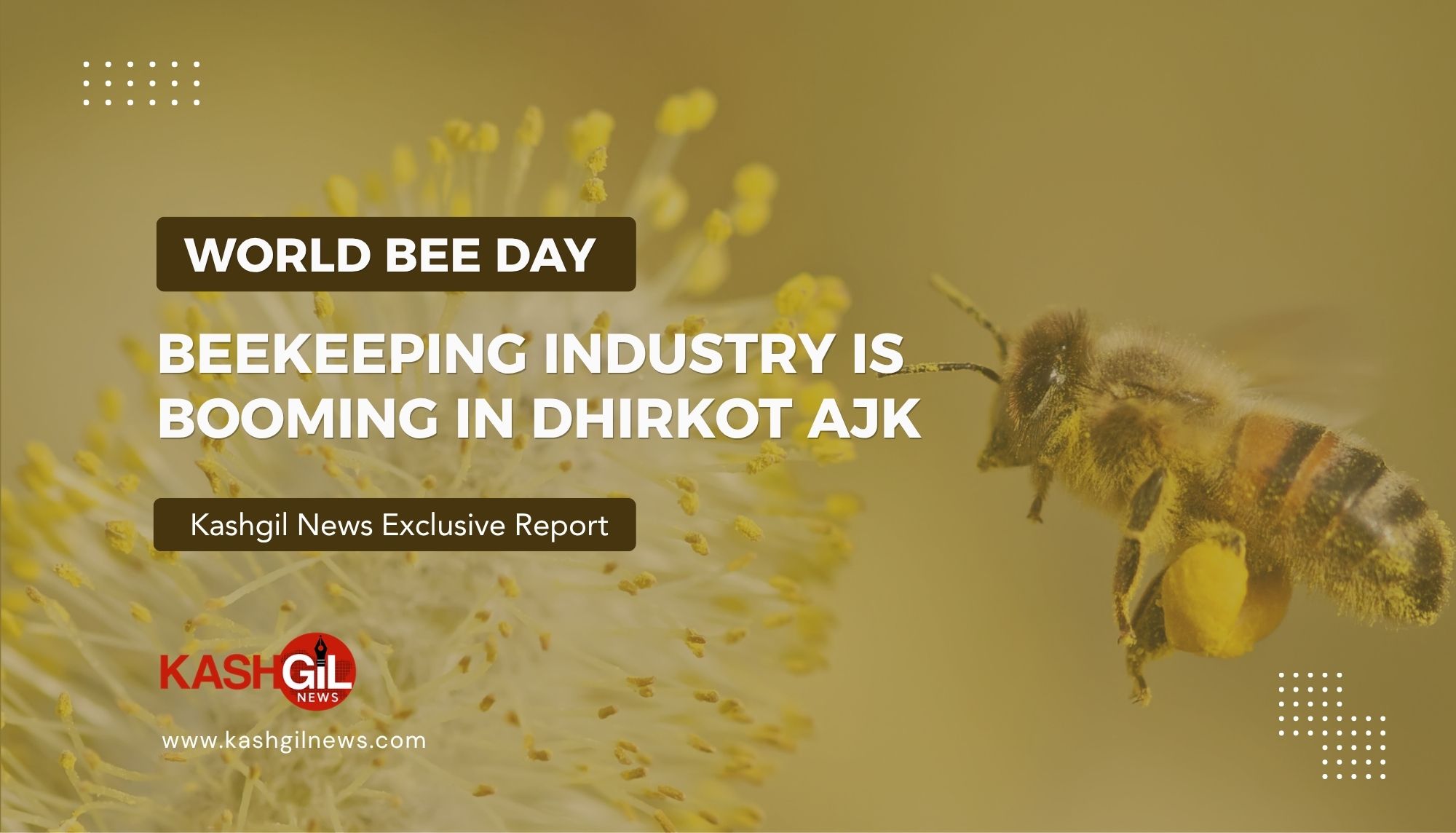
Kashgil News Exclusive Report
Every year on May 20, World Bee Day is celebrated all over the world to raise awareness about the importance of bees, their role in agricultural production and environmental protection.
In the last few years, the beekeeping industry has also emerged rapidly in Dhirkot tehsil of Bagh district of Pakistan-administered Kashmir, where people are earning lakhs of rupees by keeping bees at home.
In Dhirkot, famous for its natural beauty and lush hilly areas, beekeeping is no longer just a traditional hobby but is becoming an important source of local economy. A large number of youth and working women in the area have also taken up this sector and are increasing their income through honey production at the household level.
According to locals, a honey exhibition is also organized in Dhirkot every year where different types of natural honey are presented. According to a conservative estimate, honey worth about Rs 10 million is sold annually in Dhirkot tehsil, but locals stress that there is vast scope for further development in this industry.
Beekeeping in Pakistan-administered Kashmir has also been carried out under centuries-old traditional methods. In the old style of beekeeping, bucket-shaped boxes made of clay were installed in the mud walls of houses, while in some areas, wooden boxes are coated with clay and fitted into the walls. This traditional hive is called “Kathali” in the local language. Although this method is still practiced in some rural areas, there is now a growing trend towards modern boxes and scientific methods.
The region is mostly home to the mountain breed of bees, which are relatively smaller in size than the Australian honeybee but are able to survive in harsh climatic conditions. According to local beekeepers, a mountain bee hive produces honey twice a year on average and 6 to 12 kilograms of honey can be obtained from one hive annually.
Talking to Kashgal News, citizens associated with the beekeeping sector said that last year, bees in different areas of Bagh district faced diseases and attacks from various enemy insects, as a result of which a large number of mountain bees either died or left their hives and migrated. They said that climate change, deforestation and indiscriminate use of agricultural chemicals are also becoming a threat to bees.
Locals say that although small-scale exhibitions and training workshops are organized at the government level, the industry is not able to achieve the desired development due to low budget, government indifference and lack of technical support.
Flycatchers have demanded that the government provide them with modern training, financial assistance, technical guidance for disease prevention, and marketing facilities so that flycatchers can be given the status of a regular industry in the region.
Share this content: