By: Prof. Sikandar Khan
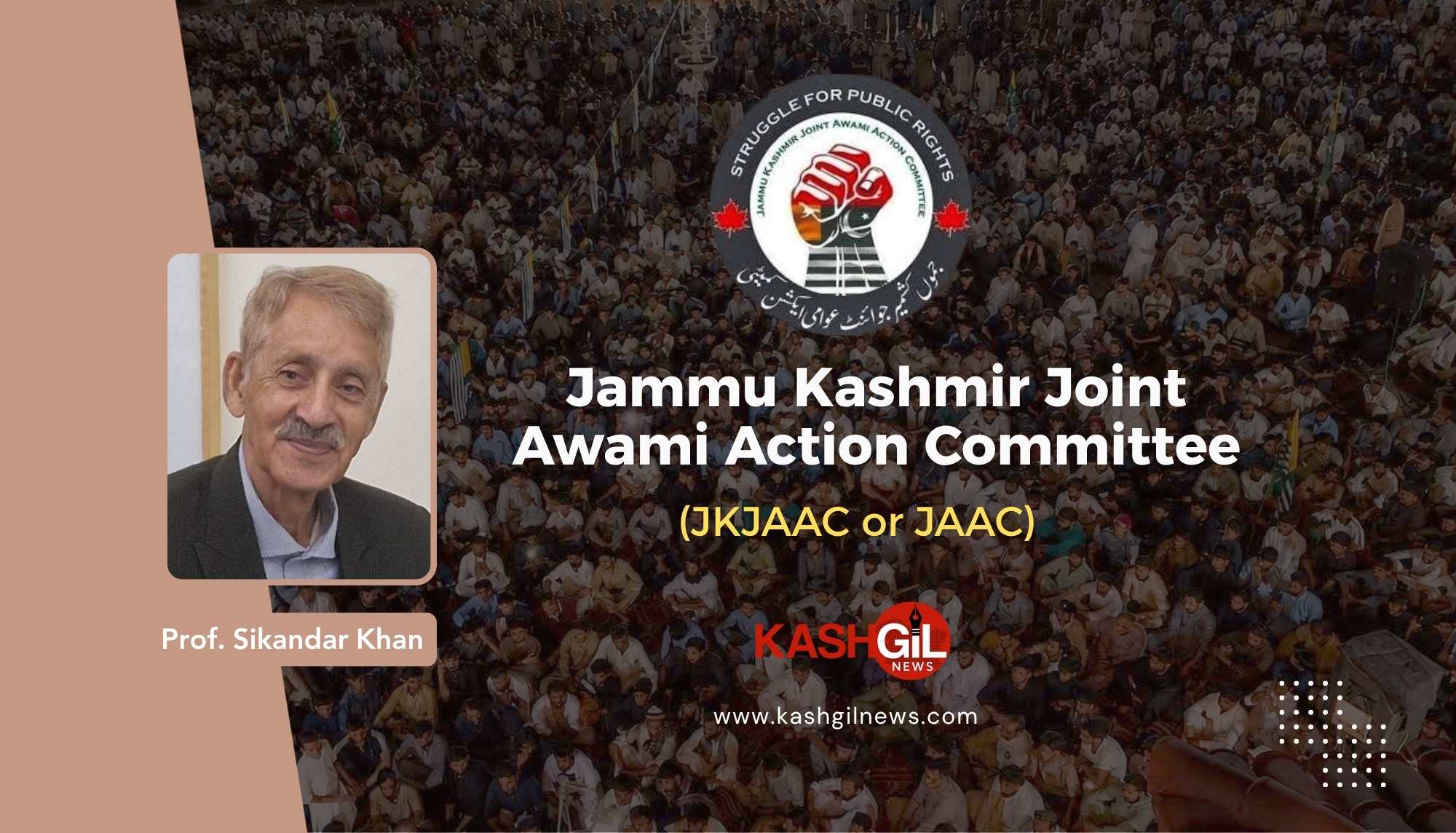
This is a prominent and dynamic coalition of public civil society based in Pakistan-administered Kashmir (Azad Jammu and Kashmir or AJK). The circumstances surrounding this organization have changed rapidly, resulting in very significant and urgent changes in the last 24 to 48 hours.
- Structure and Basic Demands
Unlike traditional political parties, the Public Action Committee (JAAC) was established as a decentralized coalition, bringing together local traders, transporters, lawyers, students and civic groups on a single platform. The movement is being run under its comprehensive 38-point Charter of Demands, which is mainly divided into two categories:
Economic relief: provision of subsidy on flour and significant reduction in electricity tariffs. The Action Committee argues that electricity prices should be based on the cheap production costs of local hydroelectricity (such as the Mangla Dam) rather than the national grid tariff.
Structural and governance reforms: Reduction of government privileges and privileges of the political and bureaucratic elite, and most controversially, the abolition of 12 reserved seats in the Azad Kashmir Legislative Assembly for Kashmiri refugees living in other provinces of Pakistan. The Action Committee argues that these seats are used by Pakistan’s main political parties to engineer governments of their own choosing in Muzaffarabad.
- Background to major protest movements and agreements (2023-2025)
Late 2023: This alliance took formal shape as a result of strikes led by local businessmen, which triggered large rallies across the region.
May 2024: Large-scale “Long March” and region-wide shutter-down strikes paralyze major cities. The government temporarily surrenders, slashes flour prices, and significantly reduces electricity tariffs.
September/October 2025: Accusing the government of failing to fulfill structural promises, the Action Committee initiates a severe and indefinite regional lockdown. Violent clashes between protesters and law enforcement agencies result in at least 9 to 15 deaths (including civilians and police personnel) and hundreds of injuries.
October 10, 2025 (Peace Agreement): A formal peace agreement is signed between federal ministers, the Azad Kashmir government, and the Action Committee leadership. The government promises a 90-day period to consider the cancellation of refugee seats and the extension of regional health cards.
- Current Crisis and Government Restriction (June 2026)
The temporary peace that was established late last year has been completely shattered in the past few weeks due to the general elections in Azad Kashmir to be held on 27 July 2026:
Deadlock in negotiations (31 May 2026): The 9-hour marathon talks between the federal negotiators (led by Rana Sanaullah) and the 16 core members of the Action Committee failed. Although the government claimed that 98% of the socio-economic demands had been accepted, the talks came to a complete standstill after the elimination of the 12 refugee seats. The Azad Kashmir Legislative Assembly strongly defended the retention of these seats.
Strike call: After the failure of the talks, the Action Committee leadership refused to back down and called for a large-scale wheel jam and shutter-down strike across the region from 9 June 2026. This is the same day that the Azad Kashmir Election Commission is opening nomination papers for candidates.
Formal ban (June 5, 2026): The Azad Kashmir government has formally banned the Joint Public Action Committee under the Anti-Terrorism Act (ATA). The Home Department notification accused the group of being involved in terrorism, spreading anarchy and attempting to violently sabotage the democratic electoral process. Outsiders and tourists were ordered to leave the area immediately.
Mass arrests and law and order crackdown (June 6, 2026): A massive security operation is underway. Azad Kashmir police have confirmed the arrest of several high-profile leaders and activists associated with the banned Action Committee. Authorities claim that communication equipment and weapons have been recovered during the raids, and allege that some elements within the committee were planning to disrupt the law and order situation on a large scale.
The region is under intense tension as the scheduled June 9 strike approaches, with heavy deployment of troops and local communication links being suspended to prevent further public mobilization.
Steps taken by the Government of Pakistan and the Government of Azad Kashmir to curb the political activities of the Jammu Kashmir Action Committee
In response to the failure of negotiations and the subsequent call for a strike on June 9, 2026, the Federal Government of Pakistan and the regional government of Azad Jammu and Kashmir (AJK) have jointly launched a comprehensive and multi-pronged crackdown. The strategy includes strict legal restrictions, administrative lockdown, and deployment of heavy security forces to formally dismantle the organizational structure of the Jammu Kashmir Joint Public Action Committee (JAAC) and prevent public agitation.
- Legal Ban (Anti-Terrorism Act)
The main legal weapon used by the state structure of Azad Kashmir is the formal ban on the Action Committee.
Prohibition Order: Acting on administrative advice, the President of Azad Kashmir authorized the Home Department to include JK-JAAC (and other names associated with it) in the First Schedule of the Azad Kashmir Anti-Terrorism Act (ATA, 2014).
Legal Basis: The official notification clearly accuses the alliance of “involvement in terrorism,” “acting in a manner that is prejudicial to peace and security,” spreading anarchy, intimidating the public, and creating social insecurity. This move makes any public activity, fundraising, or facilitation by the committee a crime.
- Administrative Lockdown and Deployment of Security Forces
The state has imposed a strict administrative lockdown to prevent the Action Committee from holding rallies or enforcing “Peah Jam” and “Shutter Down” strikes:
Implementation of Paramilitary Forces: The federal government in Islamabad has deployed and deployed federal paramilitary forces (including Frontier Constabulary and Rangers) to assist the local Azad Kashmir Police in sensitive areas like Muzaffarabad, Mirpur and Rawalakot.
Strict Travel Restrictions: The Azad Kashmir Information Department (PID) has issued an emergency and mandatory travel advisory effective from June 5 to June 20, 2026.
Outsiders and Tourists: All tourists and non-local residents have been ordered to leave Azad Kashmir immediately. There is a legal ban on entry of new travelers into the region.
Evacuation of hostels: In districts like Mirpur, the local administration has ordered the complete vacating of all government and private hostels, guest houses and boarding houses.
Commitment to protect the assembly: Azad Kashmir Prime Minister Faisal Mumtaz Rathore and the Azad Kashmir Legislative Assembly have passed official statements rejecting the Action Committee’s basic political ultimatum. State institutions have made it clear that there will be no change in the 12 reserved seats for refugees and the July 27 general elections will be held as scheduled.
- Police action, preventive arrests and counter-coercion strategies
Instead of simply controlling the crowds, law enforcement agencies have now adopted a preventive approach:
Targeted campaign of arrests: Law enforcement agencies have taken at least 72 key organizers, local businessmen and student leaders associated with the committee into protective custody in midnight raids.
Action against forced shop closures: The government has imposed a strict ban on the use of the Action Committee’s traditional slogan “Band, Matal Band”. Azad Kashmir authorities have warned that if committee workers try to force shop closures or block major commercial thoroughfares, they will be dealt with strictly under anti-terrorism laws, as a forced strike will not be considered democratic expression but public harassment.
Digital restrictions: Digital surveillance has been stepped up to thwart the Action Committee’s highly effective and decentralized public campaign, and the local administration is preparing for a mobile data and internet blackout ahead of the nomination filing date on June 9.
Azad Kashmir Prime Minister Rathore has publicly defended these strict measures, saying that while peaceful dissent is protected, the state is drawing a clear line against “mob rule”, blockades of public infrastructure, and intimidation of state institutions.
“The Action Committee is trying its best to keep its demands peaceful, so how can the authorities declare it a terrorist organization and ban it? Isn’t this an act of state overreach?”
This is the most central and deeply divisive question of the current crisis. The stark contrast between the way the People’s Action Committee (JAAC) views its movement and the way the state authorities view it is the real reason why the situation has deteriorated so rapidly. To understand how a civil society coalition can legally be labeled a “terrorist organization” despite its public commitment to peaceful protest, it is necessary to examine the mechanisms of counter-terrorism laws and the specific arguments of both sides.
Legal Framework: How Does the State Justify a Ban?
The legal definition of “terrorism” under the Azad Jammu and Kashmir Anti-Terrorism Act (ATA) — which is closely aligned with Pakistan’s federal anti-terrorism laws — is not limited to armed militancy or physical violence. This law allows the state to ban an organization if it finds that the group’s actions are intended to:
coerce, harass, or intimidate the government or any section of the public.
Create a serious threat to public safety or disrupt civil life on a large scale.
Deliberately destabilize state institutions or sabotage constitutional processes (such as elections).
Using the Anti-Terrorism Act (ATA), the Department of Homeland Security has transformed this issue from a political dispute over inflation and seats to one of national security and public order.
Two conflicting perspectives
The debate over whether this action is “over the top” depends entirely on which perspective you are looking at it:
- The Action Committee and Civil Society Perspective: “Democratic Dissent”
From the perspective of the Action Committee, local businessmen, and human rights activists, the state’s move is seen as a harsh and undemocratic tactic to crush a legitimate rights movement. Their argument is based on a few key points:
Economic grievances: The movement began over the basic necessities of life, namely the price of flour and high electricity bills, that too in a region that generates large amounts of hydroelectric power. They see these as purely civic and economic demands, not an uprising.
Political weapons: Observers and legal experts say governments often use the shortcut of anti-terrorism laws to avoid political dialogue. By labeling the Action Committee “terrorists,” the state has criminalized anyone who participates in the strike, waves their flag, or posts support on social media.
Silencing the opposition: Since the Action Committee’s demands have now escalated to challenging the 12 refugee seats — a system that traditional political parties rely on to maintain power — the committee says the ban is a political move to protect the ruling elite ahead of the July elections.
- The government and security establishment’s perspective: “Survival of the state”
From the perspective of the Azad Kashmir government and Pakistan’s federal security establishment, the Action Committee’s methods have crossed the line from “peaceful protest” into “coercion and paralysis.” Their justifications for the ban include:
The threat of economic sabotage: While the protest gatherings themselves may be unarmed, the state views “peyjams and shutter-down strikes” as an attempt to forcibly paralyze life, disrupt food supplies, close hospitals, and paralyze the economy until the government is brought to its knees.
Fear of past violence: Authorities point to the unrest of May 2024 and late 2025, where public protests ended in violent clashes, property damage, and deaths of civilians and police officers. The state argues that even if the leadership appeals for peace, their protests can result in public anarchy.
Obstruction of the constitutional process: Enforcing a complete shutdown on the very day that nominations for candidates for the general election begin is, in the eyes of the state, an illegal attempt to hijack the constitutional process through public pressure rather than the ballot box.
Is this an overreaction? This is the biggest and most important debate in the region at the moment. For independent observers and human rights organizations, the application of anti-terrorism provisions to a decentralized coalition of lawyers, businessmen, and citizens is an extremely harsh and disproportionate measure that closes the doors to peaceful democratic discourse.
For the state, it is considered a necessary and preemptive measure to maintain its writ, protect public property, and ensure that regional elections are not suspended due to a major civil lockdown. The final analysis is that by choosing legal restraint over negotiations, the authorities have increased the stakes. It has eliminated the middle ground, turning a protest movement into a direct legal confrontation between the writ of the state and a deep-rooted popular campaign.
Possible Future Scenarios and Strategies for the Success of the Popular Movement
Considering the illustrious history of the People’s Action Committee (JAAC), its current resolve, and the state crackdown, the movement stands at a historical turning point.
- What is likely to happen in the future? (Potential Trajectory)
If we examine how mass movements and state crackdowns typically play out, three basic trends could shape the future of Azad Jammu and Kashmir (AJK):
A. Short-term surge and “test of resolve” (June-July 2026)
The upcoming June 9 strike and July 27 general elections are major flashpoints:
Decentralized Struggle: Since the top leadership has been arrested, the movement may now take the form of a decentralized resistance at the neighborhood and local level. Shutterdown strikes may still occur spontaneously as local traders are the backbone of the Action Committee.
Severe Risk of Conflict: With the ban on Action Committees under the Anti-Terrorism Act (ATA) and the deployment of army and paramilitary forces, any attempt to hold public gatherings will be met with state force. This increases the risk of clashes and sudden shutdowns of internet and communications at the local level.
B. The State’s Strategic Confusion
The state cannot maintain such a security lockdown indefinitely without destroying the local economy and completely destroying the credibility of the July elections. Independent media (such as Dawn) are right to recognize that imposing a ban does not eliminate public grievances. Ultimately, the federal and regional governments will have to provide some political outlet to resume negotiations, possibly through the use of impartial mediators (such as senior lawyers or retired judges).
C. Structural Change in Kashmiri Politics
Regardless of the immediate consequences, the political fabric of Azad Kashmir has now changed permanently. The Action Committee has successfully linked economic survival (subsidies) to deeper constitutional questions (12 refugee seats). Even if the movement is temporarily suppressed by force, a new generation of politically conscious, unconventional leadership has emerged that will continue to challenge the monopoly of traditional political parties.
- Suggested Action Plan for the People’s Movement
To maintain its past successes and avoid falling into the state trap of the Anti-Terrorism Act, a large civil movement like the Action Committee can benefit by shifting its strategy from street confrontation to long-term institutional pressure:
Strategy 1: Turning to the legal and constitutional arena
The use of the Anti-Terrorism Act (ATA) is currently the state’s sharpest weapon. The movement’s first priority should be a systematic legal response.
Challenging the ban: The legal wings of the Action Committee should immediately challenge the ban and protective detentions in the Azad Kashmir High Court and the Supreme Court.
Changing the narrative: In court, the Action Committee can formally document its commitment to peaceful protest, which will strip the state of its legal justification that the group is an “anarchist or terrorist” organization. Winning the legal battle will weaken the state’s administrative legitimacy.
Strategy 2: Protecting the Fundamental Principle of Nonviolence
The current state strategy relies on the movement becoming violent, which would justify their label as “terrorist” and allow for the use of maximum force.
Avoiding the Trap: The movement must strictly avoid clashes with law enforcement agencies or damage to public property.
Alternative protest models: If “sit-in” strikes lead to immediate arrests, the movement could shift to less risky and more visible symbolic protests. Such as symbolic hunger strikes, black armband campaigns, simultaneous market closures for just an hour, or large-scale digital campaigns that can keep the message alive without causing physical harm to the public.
Strategy 3: Political use of the July elections
Since it is not possible to resolve the delicate constitutional reforms regarding the 12 refugee seats on the streets during the security lockdown, the movement could use the upcoming elections as a weapon.
Power of the ballot: Instead of trying to block the electoral process (which reinforces the state narrative of sabotaging democracy), the network of action committees could put pressure on the main candidates.
Litmus test: They could demand that every local candidate running in the election sign a public, legally binding pledge in support of the Action Committee’s economic and structural demands. Candidates who refuse could be peacefully boycotted, automatically turning the election into a referendum on the Action Committee’s 38-point charter.
Strategy 4: Transform from a “committee” into a formal institutional voice
Ad hoc committees are great for mobilizing angry crowds, but they are vulnerable to crackdowns if the leadership is arrested. To survive in the long term, the Action Committee needs to institutionalize itself. By organizing as a recognized civil rights league, a permanent coalition of syndicates (businessmen, lawyers, labor), or an alternative new political organization, the movement can ensure that its struggle lives on long after the current election cycle.
٭٭٭
Share this content: