Islamabad / Gilgit ( Kashgil News Exclusive Report )
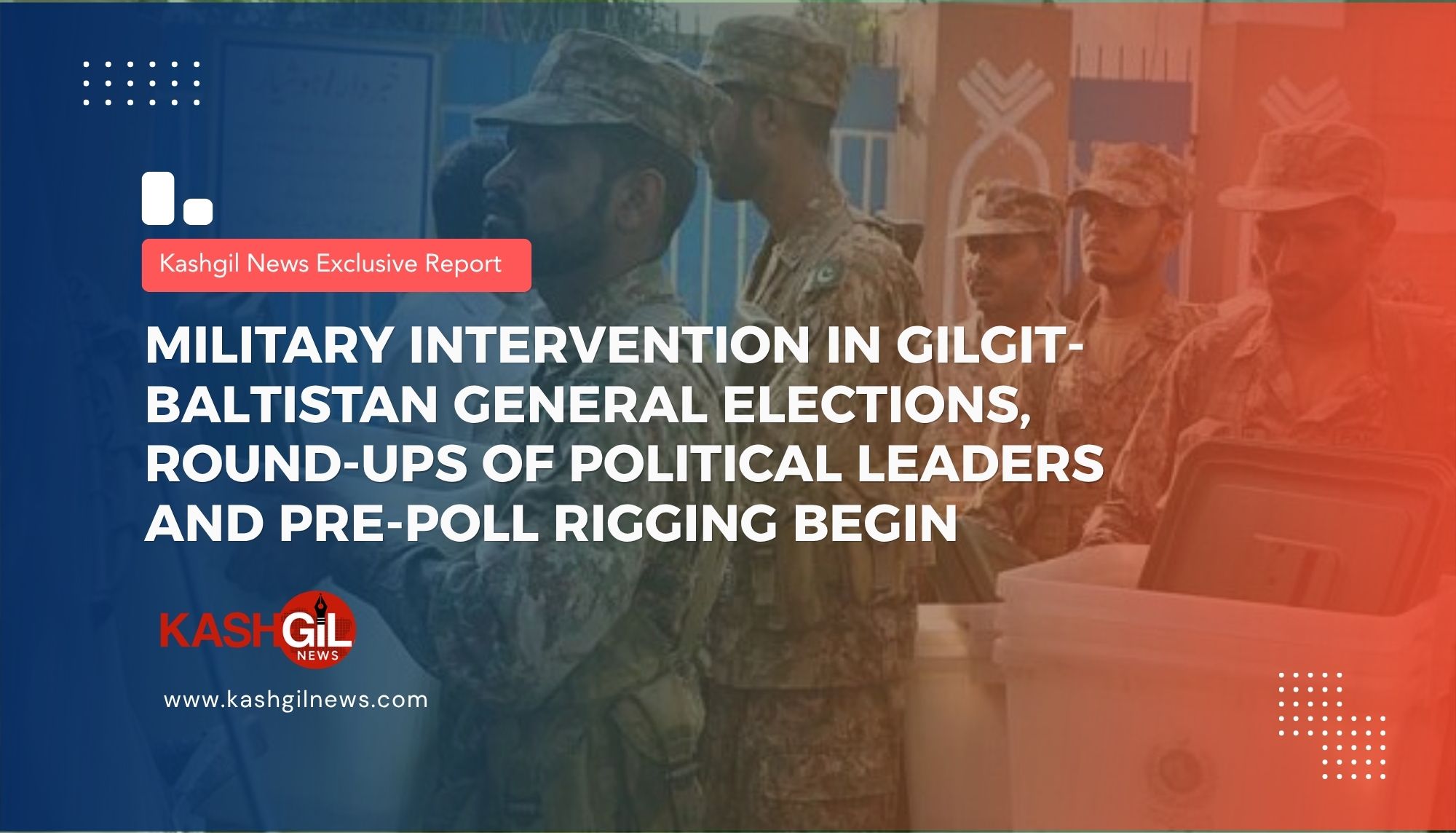
Political activities have reached their peak in the disputed region of Gilgit-Baltistan, which is under Pakistani administration, for the general elections scheduled for the 7th of this month, but serious questions have been raised about the transparency of the electoral process. Local and regional sources claim that like in past electoral records, this time too, attempts are being made by the Pakistani army and the intelligence agency (ISI) to block the path of genuine public representatives in Gilgit-Baltistan through “pre-poll rigging” (rigging before the elections) and allegedly hijacking the electoral process.
Incident of preventing PTI leader Asad Qaiser from going to Gilgit
In recent days, there has been a sharp political conflict between Islamabad and Rawalpindi due to security and road closures. Senior Pakistan Tehreek-e-Insaf (PTI) leader and former Speaker National Assembly Asad Qaiser, who was leaving for Gilgit-Baltistan to campaign for his party’s candidate, was allegedly stopped by Rawalpindi police by blocking roads. Due to this sudden road closure, his flight was delayed and he could not leave for Gilgit.
It is being alleged that this incident took place after Pakistan Tehreek-e-Insaf leader Junaid Akbar was expelled from Gilgit-Baltistan during the election campaign, who was there with his team to campaign for the June 7 elections.
Interestingly, this road closure did not only affect the opposition but also the leader of the ruling party in the federal government and Punjab, Pakistan Muslim League (Nawaz), Khawaja Saad Rafique, who was also going to Gilgit for his party’s election campaign and could not go due to missing the flight. According to sources, this sudden action by the police has caused severe financial and travel losses not only to political leaders but also to many ordinary travelers going to Gilgit.
Arrests of nationalist leaders and political repression
There are reports of a crackdown on local nationalists and public rights activists in Gilgit-Baltistan before the elections. Prominent leaders of the Public Action Committee, Advocate Ehsan Ali, Shabbir Mayar and other active political activists have been jailed on various charges. According to reports, many other local and public leaders have gone underground due to fear of state repression and possible arrests, which is severely affecting the free election campaign.
Deprivation of election symbol and fear of “Form 47”
There is concern in political circles that like the last 2024 general elections in Pakistan (where the PTI was deprived of its traditional election symbol ‘bat’ and PTI founder Imran Khan is still in jail), the same pattern is being repeated in the Gilgit-Baltistan elections. Public sources allege that the ISI is paving the way for the victory of favored candidates. There is public fear that if the people vote for the opposition or independent candidates despite all the hardships as in the past, then through tactics like managed results or “Form 47”, the public mandate will be stolen and power will be handed over to favored candidates.
International Impact and Propaganda Opportunity for India
Political analysts and observers say that due to the geographical and controversial status of Gilgit-Baltistan, making the electoral process controversial here could prove to be detrimental to Pakistan internationally. These actions of open rigging and human rights violations could provide a golden opportunity to neighboring India to prove at international forums that there is no real democracy in Pakistan and that the army there is abusing power and denying the fundamental, political and freedom rights of the people of the disputed regions.
Additional Facts and Background (Analytical Perspective)
The following facts are important for a deeper understanding of the electoral environment of Gilgit-Baltistan:
Long-standing demand for constitutional status:
The people of Gilgit-Baltistan have long been demanding full constitutional rights and representation in parliament as the fifth province of Pakistan. Assurances have been made in the past regarding the establishment of an interim province, but the matter remains as it is, due to which there is already a sense of deprivation among the local population.
Influence of the Public Action Committee:
In Gilgit-Baltistan, the ‘Public Action Committee’ is a large coalition that agitates on basic public issues such as wheat subsidy, tax implementation and load shedding, rather than a traditional political party. The arrest of leaders like Advocate Ehsan Ali has caused great anger among the local people, as these leaders are generally considered to be strong voices for the rights of Gilgit.
Traditional influence of the federation:
Historically, the party that is ruling in Islamabad (the federation) has always won elections in Gilgit-Baltistan, as the budget and administrative control of the region lies directly with the ‘Gilgit-Baltistan Council’ and the Ministry of Kashmir and Gilgit-Baltistan Affairs, which work under the federation. In the current setup, the alliance of PML-N, PPP and the establishment is seen as an attempt to maintain this traditional continuity.
Global attention and CPEC:
Gilgit-Baltistan is the gateway to the China-Pakistan Economic Corridor (CPEC). Political instability, public protests or disputed elections are considered highly sensitive from a security perspective, which is why the ruling circles make every effort to keep the election results under their complete control.
Share this content: