Written by: Khwaja Kabir Ahmed
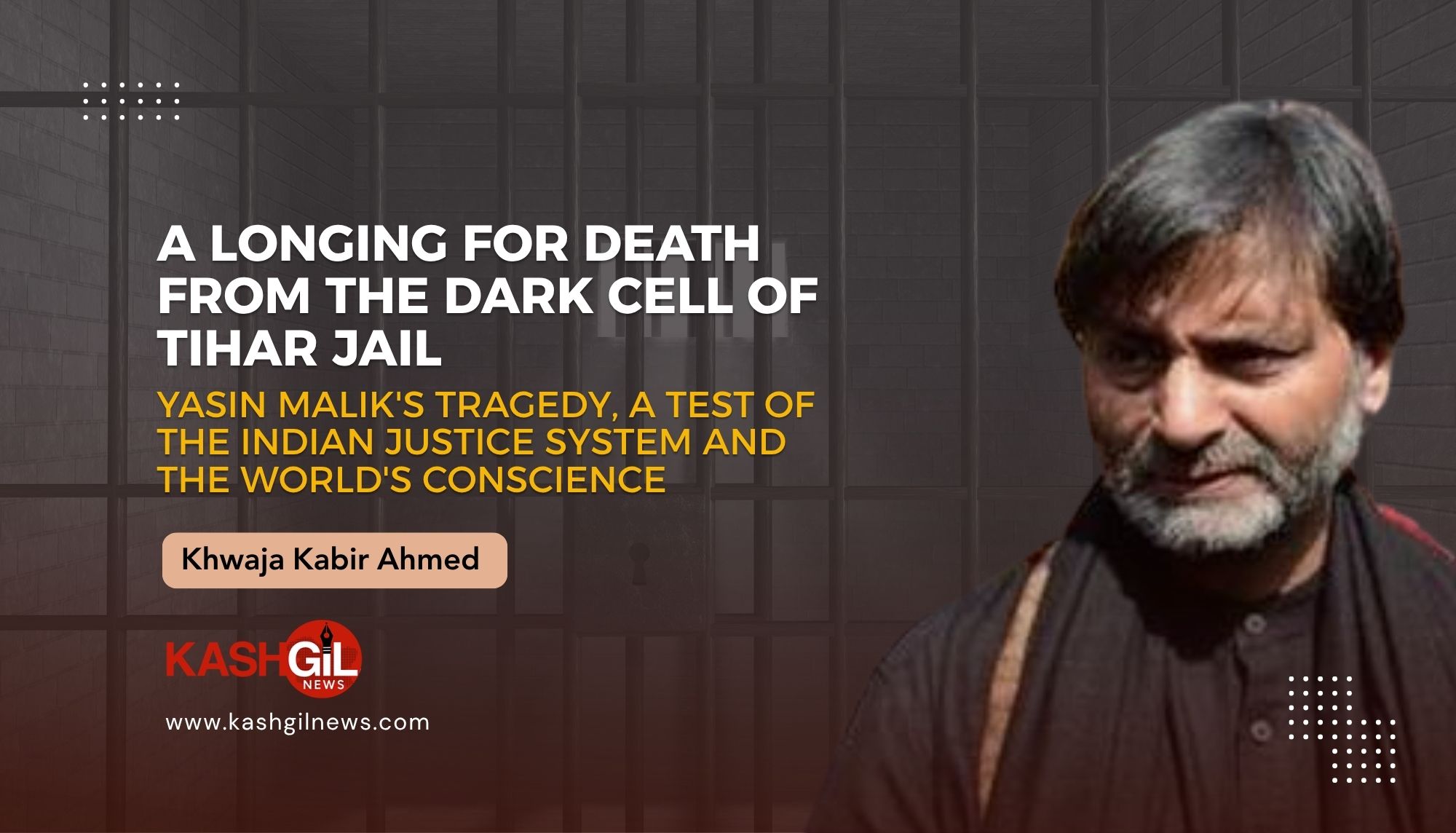
A voice has been raised from behind the high and solemn walls of Tihar Jail that not only India but the entire world must hear. This is not the voice of an ordinary prisoner but the voice of the great freedom fighter leader of the state of Jammu and Kashmir, Muhammad Yasin Malik, who has been in the custody of the Indian state for years and who recently submitted a death sentence application before the court, putting before the world a question that is not only related to his own life but also to justice, human rights, democracy, political freedom and the long-standing political problem of Jammu and Kashmir.
Yasin Malik has submitted a 25-page affidavit in the court in which he has denied his involvement in the murder of Kashmiri Pandit nurse Sarla Bhat in 1990, but has also said that he does not want to pursue the case further and if the court wants to punish him, he should be given the death penalty. More importantly, he has made it clear that his decision not to fight the case further should not be considered an admission of the prosecution’s allegations, any incident or his crime. Thus, a very unusual situation emerges where a person is denying the main charge against him, but at the same time is asking the court for the death penalty for himself. This is a point where a sensitive and responsible world will have to stop and think about what mental, human and legal state a person reaches and requests the end of his life.
One can disagree about Yasin Malik’s politics and his past. Everyone has the right to agree or disagree with his political stance. Some of his past decisions can be criticized, but the fundamental rights of a person should not depend on whether the state likes his political ideology or not. In any democratic and civilized society, the principle is clear that an accusation is not a crime, a case is not the same as a conviction, and state power cannot be a substitute for justice. If a person is accused of a serious crime, he should have a transparent, impartial and fair trial, he should be given the full right to defend himself, and if he is found guilty, he should be judged according to the law. But if he is not found guilty, then punishing him would not be justice, but the worst injustice.
Yasin Malik’s denial of his role in the murder of Sarla Bhat in his latest affidavit is important in this context. He denies involvement in the murder and raises questions about the case against him. Sarla Bhat was a human being and her murder should also be investigated impartially and the victim’s family should get justice. The crimes committed against Kashmiri Pandits cannot be ignored under any circumstances. But the universal principle of human rights is that the answer to one crime cannot be the violation of other fundamental rights. If there is an accusation against someone, the accusation must be proven in court through credible evidence. The sanctity of human life cannot be conditioned by any religion, nation, region or political affiliation.
This is where the real test of India’s claim to democracy begins. India calls itself the world’s largest democracy, but democracy is not just about elections, parliament, majority rule and constitutional institutions. The true spirit of democracy comes to the fore when a person stands before the state who disagrees with the state’s stance, who has a different opinion about the political future of its region or who challenges the state’s policies. The real strength of a great democracy lies in the fact that it treats its opponents in accordance with law, justice, human dignity and fundamental rights.
An important aspect of Yasin Malik’s political life is that he was associated with armed struggle in the past, but in the later period, he abandoned the armed path and spoke of solving the Kashmir issue through political and peaceful means. In such a situation, the question remains that if the intention was to resolve a political dispute, is the answer to every dispute jail, trial, life imprisonment and execution? If Kashmir is a political issue, its solution should also be political. A political question cannot be resolved by simply converting it into a criminal case.
Perhaps the most painful aspect of Yasin Malik’s case is one that is not fully reflected in the court files, and that is his family. Yasin Malik is the only son of his parents. He has three sisters. His father has already passed away and his elderly mother is now bearing the burden of separation from her only son and worrying about his future. What greater tragedy can there be for a mother than to have her only son behind prison walls for years and then the news comes out that he has asked the court for the death penalty for himself?
This is not just the story of a political prisoner. This is the story of an elderly mother waiting for the return of her only son. This is the story of three sisters who are worried about the future of their brother. It is also the story of Yasin Malik’s wife, Mashal Hussain Malik, who has lived with her husband’s imprisonment for years, her daughter’s deprivation of her father, and the threat that looms over her every moment. Mashal Malik has consistently raised her voice for her husband’s release, but as a wife and mother, she herself is enduring the unimaginable pain of this long separation and uncertainty. And it is also the story of Yasin Malik’s only daughter, thirteen-year-old Razia Sultana, for whom her father is not just a political leader but her father, her love, her support, and a fundamental relationship in her life. The years of a child’s childhood that should be spent in the closeness of parents, if they are spent within prison walls and visitation restrictions, this deprivation cannot be described in any legal provision.
On one side, an elderly mother is worried about her only son, on the other side, three sisters are afraid for the future of their only brother, a wife is enduring the pain of her husband’s long imprisonment, and on the other side, a thirteen-year-old girl is deprived of the closeness of her father. Thus, the imprisonment of one person has become the imprisonment of an entire family. And now, when this same person pleads for the death penalty for himself before the court, the world should not only see what he said; the world should also see what circumstances led a person to this point.
A prisoner’s plea for death for himself is itself an extraordinary human rights alarm. A civilized justice system should not only look at the words of the plea but also look at the context of this plea. Has a person lost hope? Has long imprisonment, separation from family, continuous trials, and political isolation brought him to this point? Does he feel that legal avenues have been closed to him? Is he no longer hopeful of getting justice? These are questions that would be dangerous for any justice system to ignore.
Yasin Malik is already serving a life sentence in another case in India. He was convicted in 2022 in a terror financing case, and there has been a legal attempt to convert his sentence to death. Now his name has come up again in the 1990 Sarla Bhatt murder case. When a man who has spent years in prison, who has been sentenced to life in one case and who faces more cases, when he says in front of the court, “Now give me death,” it is not just a judicial proceeding but a profound human and moral question. This question is not only for India but also for the international community.
Where is the United Nations? Where is the European Union? Where are the international human rights organizations? Where are the world’s major democracies? If human rights are truly universal, their application should not be based on political affiliation. If the right to life is a fundamental human right, it is also for an Indian citizen, a Kashmiri Pandit, and a Kashmiri Muslim. If a fair trial is a fundamental right, it is also for Yasin Malik.
Another harsh reality also emerges here, and that is the political powerlessness of Pakistan-administered Jammu and Kashmir. Just imagine if today in the Pakistan-administered state of Jammu and Kashmir there was an empowered legislative assembly that had real representation and full political authority of its people, if there was an empowered elected government that could effectively interpret the fundamental political and human rights of its people at the international level, would the situation not be different in Yasin Malik’s case?
An empowered government could have approached the UN human rights institutions. It could have reached out to the institutions of the European Union. She could have made her stand before international human rights organizations. She could have gone to major capitals of the world and raised the question of what was happening to a Kashmiri political leader. But when a political government of a region is itself facing the question of its basic political and external powers, with what force can it effectively articulate the rights of its people on the global stage?
How loudly can someone who is deprived of the power to speak for others on the global stage?
This is the gap that is being felt acutely today in the case of Yasin Malik. If the political leadership of Pakistan-administered Jammu and Kashmir had been fully empowered, if it had the power to truly represent its people and to articulate the rights of its people on the global stage, then in the case of Yasin Malik too, a strong, elected and popular voice would have been present before the world. But if governments operate with limited powers, if their foreign policy and decision-making in basic political matters are not in their own hands, with what force can they fight for the rights of their people on global forums?
This is not just Yasin Malik’s helplessness; it is also a question of the political helplessness of an entire nation. That is why the fundamental demand of the people of Pakistan-administered Jammu and Kashmir is also important that they get real and empowered political representation that can effectively raise the problems of their people not only at the local level but also at the international level. Real representation is not just about seats in the assembly; real representation also means real authority.
Now, in such circumstances, the responsibility before the international community increases even more. Yasin Malik’s case cannot be ignored by simply declaring it an internal judicial matter of India, because the state of Jammu and Kashmir is an internationally recognized disputed state, no part of which is a constitutional part of India or Pakistan, but is under the administration of both. Thus, the responsibilities on both countries are greater, and the international community also has a great responsibility to protect the rights of the people of this region, because human rights are related beyond borders. Therefore, the United Nations, the European Union, international human rights organizations and the world’s major democracies must see whether all the requirements of justice are being met in Yasin Malik’s cases, whether he has effective legal defense, what are the conditions of his detention and what human rights issues lie behind such a prisoner’s request for death.
The world must demand that India make Yasin Malik’s case transparent and fair, grant him the right to effective legal representation, independently review the conditions of his detention and in no case put his life in irreparable danger. If India has solid evidence against him, he should be presented in a transparent judicial process and tried according to law. But if the charges are not proven, he should be released. Putting a person to death simply as the price of a political dispute is not a solution to any problem.
It is also necessary to end the double standard in the matter of human rights. The crimes against Kashmiri Pandits are condemnable and their victims must get justice. Similarly, there should be impartial investigations into the alleged abuses, killings, arrests, enforced disappearances and restrictions on political freedoms against Kashmiri Muslims. The value of a human life cannot be determined by religion, nationality or political affiliation. Justice does not see religion, justice does not see nationality, justice does not see political affiliation. If the world is saddened by the killing of a Kashmiri Pandit, then it should be saddened by the killing of a Kashmiri Muslim. If the tears of one family are precious, the tears of another family are equally precious. This is the true spirit of human rights.
The question here is also important: if India is truly the world’s largest democracy, then it should adopt the same principles with its most difficult political opponent that it claims to uphold before the world. Does Yasin Malik have the right to a fair trial? Does he have access to effective legal defense? Is the evidence in the cases against him being examined in a completely transparent manner? And most importantly, when he himself is asking for death, is the responsibility of the state and the court only to decide on his request, or is it also important to know how a person reached this point?
States can imprison their opponents, can make them appear in courts, can keep them in jail for years, but the political question of a nation cannot be locked up in prison walls forever. Along with the world powers, India and Pakistan must also understand that the Kashmir issue will not end with Yasin Malik’s imprisonment, it will not end with his life imprisonment and if, God forbid, he is hanged, then even that will not end the political question of Kashmir.
On the contrary, a new question will stand before history: Was a political issue silenced by state power, prisons, trials and punishments instead of being resolved through political means? This question is bigger than all the others. It is a question of democracy, it is a question of human rights, it is a question of justice and it is a question of the conscience of the world.
The demand for Yasin Malik is not that he be declared above the law. The demand is only that the law should really be the law, not become a means of revenge. The demand is not that the charges be ignored; the demand is that the charges be tried in a transparent, impartial and fair judicial process. The demand is not that any individual be given immunity from the law; the demand is that the state should not be above human rights and the rule of law.
And above all, when a prisoner starts asking for death for himself, the world should not consider this request as a mere legal document. It should look at the person behind him. It should look at his elderly mother. It should look at his three sisters. One should look at his wife, Mashal Hussain Malik, who has been carrying the burden of her husband’s separation and her daughter’s future for years. One should look at his thirteen-year-old daughter. One should look at the years this family has spent in waiting, separation and fear.
Just think of the mother who prays for her only son. Think of the sisters who live in fear of losing their only brother. Think of the wife who waits for her husband’s release. Think of the thirteen-year-old girl whose father has been in prison for years and whose precious childhood years are being spent without the closeness of her father. Then ask yourself, can the justice system be so callous that these human tears have no value?
The world has recognized the rights to life, liberty, human dignity and a fair trial among the universal principles of human rights. These principles are not tested when everything is easy for the state. The real test is when a state faces someone who disagrees with its political stance. Today, the case of Yasin Malik is the hour of this test.
The United Nations must play its role. The European Union must play its role. International human rights organizations must play their role. The world’s major democracies must play their role. And India must also prove that its justice system does not only protect the powerful stance of the state but also protects the rights of a person who is a political opponent of the state.
The world should tell India that if there is a crime against Yasin Malik, then conduct a fair trial, if there is evidence, then present him before the court, if not proven guilty, then release him. But do not take a man to the gallows at the cost of a political dispute who has already been imprisoned for years and whose death petition itself is a testimony to a profound human tragedy.
And the political leadership of Pakistan-administered Jammu and Kashmir should also be asked this question: when will it stand up for the full and empowered political representation of its people? When will it demand real authority to effectively represent the political and human rights of its people at the global level? Because if a government itself is deprived of the authority to raise the voice of its people at the global level, who will raise the voice of Kashmiris like Yasin Malik before the world?
This is not a time for mere rhetoric but for practical human rights, diplomatic and political struggle. Yasin Malik should not be given death, but the right to live with justice. His elderly mother should have the right to meet her only son. His three sisters should have hope for the return of their brother. His wife, Mashal Hussain Malik, should have the right to live with her husband and thirteen-year-old Razia Sultana should have the right to return to her father’s shadow.
This is not just a question of Yasin Malik’s life. It is a question of a family’s life. It is a question of a nation’s political right. It is a question of the universality of human rights. And above all, it is a question of the conscience of the world.
States can imprison a person by force, but they cannot imprison the political consciousness of a nation. Prison walls can isolate a person from the world, but they cannot eliminate his political question. And the gallows cannot decide the future of a nation.
Now the world has to decide whether it will listen to this voice rising from the cell of Tihar Jail or remain a silent spectator.
Because the question of history will be very simple: when the only son of an elderly mother was begging for death from the cell of Tihar, when three sisters were afraid of their brother’s future, when a wife was waiting for her husband’s life and release, when a thirteen-year-old girl was deprived of her father, and when a Kashmiri political prisoner was demanding justice—where was the world?
٭٭٭
Share this content: