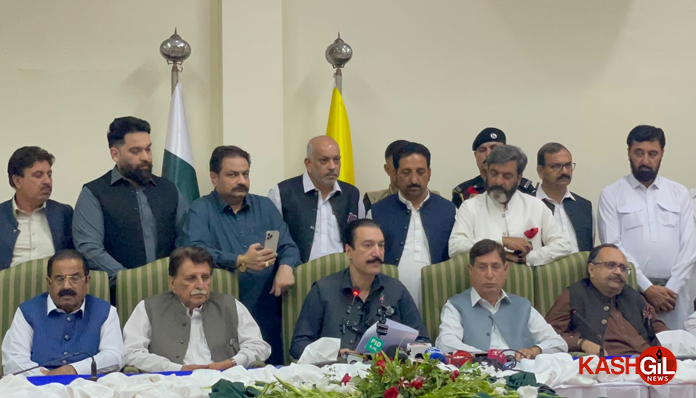
In the context of the ongoing dispute over refugee seats in Pakistan-administered Kashmir, a joint statement was issued at the end of the All Parties Conference hosted by Prime Minister Faisal Mumtaz Rathore and the Leader of the Opposition.
The statement of the All Parties Conference was read out in front of the media by Prime Minister Faisal Mumtaz Rathore.
The statement said:
“The leaders of the political and religious parties present in today’s all-party meeting unanimously adopted the following resolution.
The leaders of the Joint Public Action Committee were also invited to attend this meeting, but despite the wait, they did not become part of this consultative and democratic process.”
According to the statement:
☆ This meeting reiterates its full support for the ongoing legitimate struggle of the people of Jammu and Kashmir for the United Nations Security Council resolutions and the internationally recognized right to self-determination.
The meeting strongly condemns the ongoing human rights violations, repression and atrocities in Indian-administered Jammu and Kashmir. It also condemns the illegal detention and imprisonment of Hurriyat leadership and political activists and condemns Indian efforts to change the demographic balance in Jammu and Kashmir.
The meeting considers the ongoing democratic continuity and consolidation of the constitutional process in Azad Jammu and Kashmir as the basis of state stability and reiterates its commitment to making democratic institutions stronger and more functional.
The meeting emphasizes that political dissent is the beauty of democracy, but it cannot be allowed to be used to undermine state governance or institutional processes. Furthermore, the meeting urges all political, social and public sectors to promote tolerance, dialogue and peaceful political struggle so that sustainable peace prevails in the region.
The meeting values the role of national security institutions in Azad Jammu and Kashmir and considers them to be an important pillar of state stability. The meeting expresses concern that India is trying to create misunderstandings and undermine trust between state institutions and democratic structures through social media platforms and systematic propaganda, which is unacceptable.
The meeting declares that the general elections to the Legislative Assembly of Azad Jammu and Kashmir shall be held within the stipulated period in accordance with the Constitution and the law. All necessary administrative, legal and security measures shall be taken to ensure the conduct of free, fair, transparent, impartial and peaceful elections so that the people can exercise their right to vote without fear, intimidation, pressure or interference. Any attempt to sabotage, delay, influence or derail the electoral process shall be strictly countered in accordance with the law so that the democratic process continues.
The meeting pays tribute to the immortal sacrifices made by the refugees of Jammu and Kashmir for the Kashmir independence movement and the movement for the completion of Pakistan. The meeting recognizes that the representation of refugees residing in Pakistan is a historical and constitutional reality, however, the necessary reforms to remove some electoral complications and make them acceptable to political parties can be implemented through the Legislative Assembly in accordance with the Constitution.
The meeting declares that constitutional reforms are the exclusive authority and mandate of the elected representatives of the people, therefore, the matter of such reforms should be left to the Legislative Assembly. However, before this, a broad-based consultative process should be initiated in consultation with all relevant stakeholders, including political parties, bar associations, Bar Council, civil society and constitutional experts.
The All Parties Conference lasted for about five hours, in which representatives of 12 political parties and four former Prime Ministers participated. There was representation from various political and religious parties in the meeting.
The proposal for the All Parties Conference came to light when the talks between the Jammu and Kashmir Joint Public Action Committee, the Government of Pakistan and the Government of Azad Kashmir on May 30 stalled.
At the end of the negotiation process, the Pakistani Prime Minister’s Advisor on Political Affairs Rana Sanaullah told the media:
“The government of Azad Kashmir and the opposition party, the Muslim League (N), have decided to convene an all-party conference regarding this situation and the demands of the Awami Action Committee, in which all stakeholders should be taken into confidence.”
However, several nationalist parties, including the Pakistan Tehreek-e-Insaf, claim that they were not invited to this all-party conference.
Share this content: