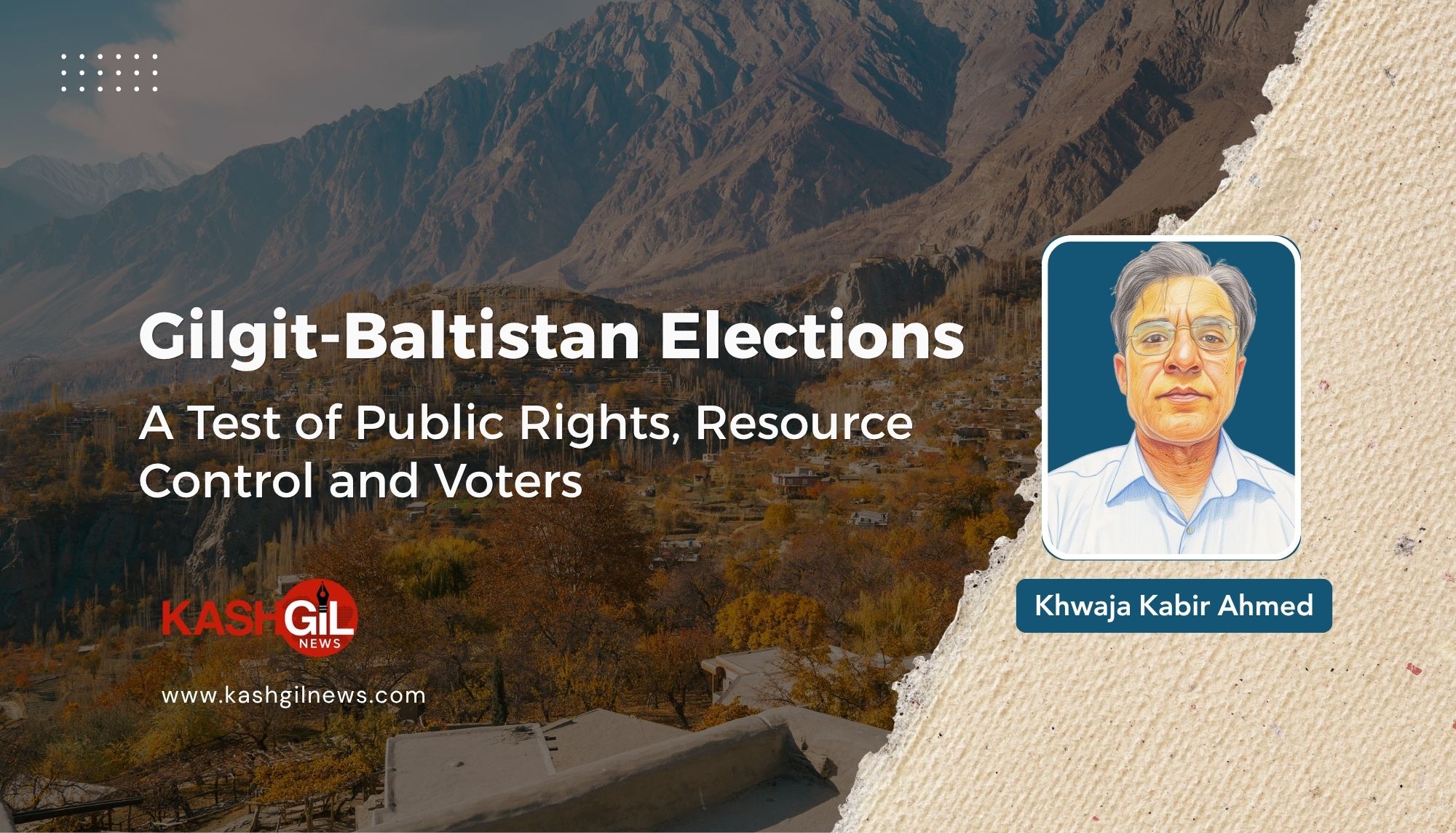
by: Khwaja Kabir Ahmed
The elections in Gilgit-Baltistan are not just a routine political activity but also an important opportunity to determine public rights, resource control, political awareness and the direction of the future. These elections are being held at a time when the people of Gilgit-Baltistan are raising serious questions regarding their rights, identity, resources and better governance. In this context, the responsibility of every voter increases to use his vote thoughtfully and elect representatives who can truly express the problems and aspirations of the people.
Gilgit-Baltistan is a region rich in natural resources, mineral reserves, water resources and tourist attractions. But it is a bitter reality that despite being rich in resources, the people here are still facing numerous basic problems. Issues such as lack of employment, lack of education and health facilities, inflation, weak infrastructure and local control over resources are a constant cause of concern for the people. These are the issues that have given rise to political consciousness among the people and provided an opportunity for the emergence of various public movements.
In the past years, the Public Action Committee Gilgit-Baltistan has emerged as an effective public platform. It has continuously struggled for public rights, tax enforcement, inflation, resource conservation and resolution of public issues. The movement of the Public Action Committee has proven that when the people unite for their rights, their voice is not easy to ignore. This struggle has played an important role in giving public issues a central position in the political landscape of Gilgit-Baltistan.
On the other hand, there is also a feeling in public circles that many representatives who reached the assemblies in the past could not meet the aspirations of the people. Critics are of the opinion that many politicians who came to power have been prioritizing personal, family or group interests rather than resolving public issues. According to them, if the representatives sitting in the assemblies were truly protectors of public rights, the people would not have had to resort to repeated protests and movements to achieve their fundamental rights. This is the reason why today a large section of the public is disappointed and distrustful of the traditional political parties and their representatives.
Pakistan’s major political parties only turn to Gilgit-Baltistan in every election and make big promises to the people, but the question of the public circles is what happens to these promises after the elections? Are the problems of the people really solved? Does the people’s authority over resources increase? Do the youth get jobs? Are the political and constitutional aspirations of the people given importance? These are the questions that the voters will have to find the answers to themselves.
In this situation, it is important for the people of Gilgit-Baltistan to give priority to their local representatives, local political forces and those individuals who have always been among the people, are aware of the public’s problems and whose political role has been associated with the struggle for public rights. Such representatives who have stood with the people not only during the election campaign but also in every difficult time and who have played a practical role in solving public problems.
The people of Gilgit-Baltistan have the first right to the resources of Gilgit-Baltistan. The benefits derived from these resources should also be directed towards the development, prosperity, education, health and employment of the local population. To achieve this goal, it is necessary that such people reach the assemblies who are true guardians of public interests and who can defend the rights of their people above all kinds of pressure.
The recent elections are an important opportunity for the people of Gilgit-Baltistan to decide through their votes whether they want to further strengthen the traditional political structures or bring forward a leadership that makes public rights, local authority over resources and public welfare the axis of their politics. This decision will not only affect the future of five years but will also affect the future of future generations.
It is the need of the hour that the people of Gilgit-Baltistan recognize the power of their vote, evaluate the performance and character of the candidates and elect such representatives who can become the voice of the people, stand up for public rights and play their role in building a bright and dignified future of Gilgit-Baltistan. This is the hallmark of a conscious nation and a strong democratic society.
٭٭٭
Share this content: